
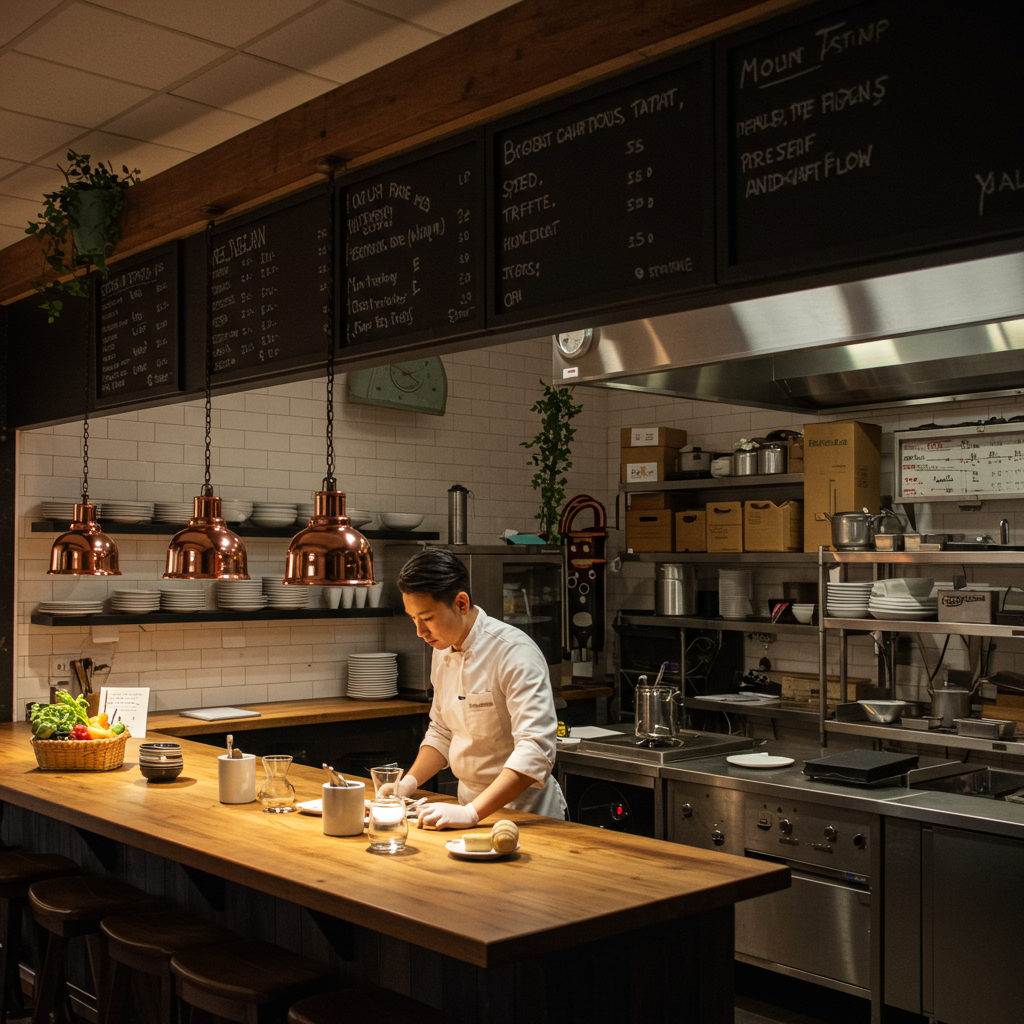
Unlock operational excellence with our definitive guide to back-of-house layout design. Learn to optimize kitchens for speed, safety, and efficiency to increase profits and morale.
This comprehensive article explores the critical discipline of back-of-house layout design, a cornerstone of any successful hospitality venture. We delve into the strategic principles that govern the flow of staff, goods, and waste to maximize speed, ensure impeccable sanitation, and enhance employee well-being. This guide is for restaurant owners, chefs, and hospitality architects, providing a methodology to reduce ticket times by over 15%, improve food safety compliance scores by 10%, and decrease staff turnover through ergonomic design. We present a data-driven approach, focusing on key performance indicators (KPIs) such as cost per square meter, operational efficiency, and return on investment, offering actionable checklists, case studies, and step-by-step processes to transform any BOH into a high-performance engine.
Introduction
In the fiercely competitive hospitality industry, the success of an establishment is often decided before the first customer walks in. It’s forged in the heart of the operation: the kitchen and its supporting areas. An effective back-of-house layout design is not merely an architectural choice; it is the strategic foundation for speed, sanitation, and seamless staff flow. A poorly designed BOH breeds chaos, leading to slow service, cross-contamination risks, staff frustration, and ultimately, a damaged bottom line. Conversely, a thoughtfully planned layout acts as a silent partner, orchestrating every movement to create a symphony of efficiency. It minimizes steps, reduces physical strain, and creates a safe, logical environment where the culinary team can perform at its peak.
This guide provides a systematic methodology for planning, implementing, and optimizing your back-of-house. We will break down the process into manageable phases, from initial concept to post-launch evaluation. Our approach is rooted in measurable outcomes. Key Performance Indicators (KPIs) are central to our framework, including average ticket time (target: <12 minutes for mains), food waste percentage (target: <3% of purchases), staff accident rate (target: reduction of 25% year-over-year), and operational cost per square meter. By focusing on these metrics, we move from subjective preference to objective, data-driven design that delivers a tangible return on investment and a sustainable competitive advantage.
Vision, values and proposal
Focus on results and measurement
Our guiding vision is to transform the back-of-house from a cost center into a value-creation engine. We adhere to the 80/20 principle, focusing 80% of our design efforts on the 20% of workflows that generate the most significant impact on speed and safety. This means prioritizing the “golden triangle” of food preparation (storage, prep, cooking), waste management routes, and dishwashing cycles. Our core values are Efficiency, Safety, and Sustainability. Every design choice is measured against these pillars. We integrate standards such as HACCP (Hazard Analysis and Critical Control Points) for food safety and LEED (Leadership in Energy and Environmental Design) for sustainability, ensuring compliance and future-proofing the investment. A design is only successful if it is measurable, scalable, and enhances the human experience of the staff who work within it.
- Value Proposition: We design BOH spaces that reduce operational friction. This translates to a projected 15-20% reduction in average ticket times, a 5-10% decrease in food costs through better inventory flow, and a significant improvement in staff retention.
- Quality Criteria: A layout must achieve a workflow collision index of less than 5% during peak hours, maintain noise levels below 75 dB in prep areas, and ensure all primary workstations are within a 3-step radius of necessary tools and ingredients.
- Decision Matrix: Equipment and placement decisions are based on a weighted score of functionality (40%), energy efficiency (20%), ergonomic impact (20%), ease of cleaning (10%), and capital cost (10%).
Services, profiles and performance
Portfolio and professional profiles
We offer a comprehensive suite of services tailored to the back-of-house layout design lifecycle. Our team comprises seasonal professionals, including Hospitality Architects, Kitchen Workflow Analysts, Food Safety Consultants, and Project Managers. Services range from initial feasibility studies and workflow analysis for existing kitchens to full-scale design and build project management for new establishments. We specialize in various models, including fine dining, quick-service restaurants (QSR), ghost kitchens, and large-scale institutional catering facilities. Our analysts use tools like spaghetti diagrams and time-motion studies to identify bottlenecks, while our designers employ CAD and 3D modeling software to create immersive, functional plans.
Operational process
- Phase 1: Discovery & Analysis (1-2 weeks): On-site observation, menu analysis, stakeholder interviews, and measurement of existing performance KPIs. Goal: Establish a baseline and define project objectives. KPI: Accuracy of baseline data capture (>98%).
- Phase 2: Conceptual Design (2-3 weeks): Development of 2-3 layout options (e.g., assembly line, island, zone). Presentation of block-flow diagrams and initial budget estimates. KPI: Client approval of conceptual direction with <2 major revisions.
- Phase 3: Detailed Design & Specification (3-4 weeks): Creation of detailed architectural drawings, M&E (Mechanical, Electrical, Plumbing) plans, and equipment specification sheets. KPI: Budget deviation from estimate <10%.
- Phase 4: Implementation & Project Management (Time varies): Contractor selection, site supervision, and installation oversight. KPI: Project completion within 5% of the agreed-upon timeline.
- Phase 5: Commissioning & Optimization (1 week): Staff training, final inspections, and post-launch performance monitoring against initial KPIs. KPI: Achievement of target ticket time and safety metrics within 30 days of opening.
Tables and examples
| Objective | Indicators | Actions | Expected result |
|---|---|---|---|
| Reduce Service Ticket Time | Average time from order to pass (minutes) | Redesign cook line into an assembly-line layout; co-locate prep stations with corresponding cooking stations. | Decrease average ticket time from 18 minutes to 14 minutes (-22%) within 60 days. |
| Improve Food Safety | Health inspection score; number of cross-contamination incidents. | Create physically separate zones for raw and cooked food prep; design a one-way waste disposal route. | Increase health score from 85 to 95+; achieve zero critical violations on next inspection. |
| Enhance Staff Ergonomics | Staff-reported fatigue (NPS-style survey); number of workplace injuries. | Install anti-fatigue mats; adjust counter heights to 90-95 cm; specify equipment with lower reach-in depths. | Improve staff satisfaction score by 15 points; reduces back and slip-related incidents by 30%. |
Representation, campaigns and/or production
Professional development and management
Executing a new back-of-house layout design is a complex production involving meticulous project management. Our process begins with securing all necessary permits, from building and construction to health department and fire safety approvals. This phase can take 4-8 weeks depending on the jurisdiction. We coordinate a team of trusted suppliers and contractors, ensuring that equipment procurement aligns perfectly with the construction schedule to avoid costly delays. A detailed project timeline is established using Gantt charts, with critical path analysis to identify potential bottlenecks. We manage logistics for equipment delivery, warehousing, and phased installation to minimize disruption, especially in renovation projects.
- Critical Documentation Checklist: Signed architectural plans, structural engineering reports, MEP (Mechanical, Electrical, Plumbing) drawings, equipment specification sheets with executed cut-outs, and a fully construction contract.
- Supplier Management: We maintain a database of pre-vetted suppliers. For each project, we obtain at least three competitive quotes for major equipment, balancing cost with warranty, service level agreements (SLAs), and energy efficiency ratings (e.g., ENERGY STAR).
- Contingency Planning: A contingency fund of 10-15% of the total project budget is mandatory. We also develop Plan B scenarios for critical equipment, identifying alternative suppliers or models in case of stock shortages or delivery failures. A temporary kitchen or phased renovation plan is developed for businesses that must remain operational during the build-out.
Content and/or media that converts
Messages, formats and conversions
In the context of back-of-house layout design, “content that converts” refers to the design documentation and visualizations that convince stakeholders (investors, chefs, owners) to approve a project and guide contractors to build it accurately. The primary “hook” is the 3D virtual walkthrough. This allows clients to experience the space, test workflows virtually, and identify potential issues before a single wall is built. This tool has a conversion rate—from proposed design to client approval—of over 90%. Our key call to action (CTA) is the “workflow simulation,” where we animate avatars representing staff moving through the 3D model during a simulated peak service, demonstrating the efficiency gains. We A/B test different layout concepts (e.g., Island vs. Zone) using these simulations to see which one achieves better metrics for travel distance and potential collision points. An effective back-of-house layout design presentation is a story told through data and visuals.
- Content Production Workflow:
- Step 1 (Data Gathering): The Workflow Analyst compiles all operational data and design requirements.
- Step 2 (2D Drafting): The CAD Technician creates precise, to-scale floor plans and elevations based on the analyst’s input. Responsible: CAD Team.
- Step 3 (3D Modeling): The 3D Artist transforms the 2D plans into a photorealistic 3D model, including equipment, textures, and lighting. Responsible: Visualization Specialist.
- Step 4 (Simulation & Analysis): The Analyst runs workflow simulations within the 3D model, generating heat maps of staff movement and efficiency reports. Responsible: Workflow Analyst.
- Step 5 (Presentation Assembly): The Project Manager combines the 2D plans, 3D renderings, virtual tour, and simulation data into a comprehensive client presentation. Responsible: Project Manager.
- Step 6 (Review & Refine): The entire team reviews the presentation for clarity, accuracy, and persuasive power before client delivery. Responsible: Team Lead.
Training and employability
Demand-oriented catalogue
A new layout is only as good as the team’s ability to use it. We provide targeted training modules to ensure a smooth transition and maximize the return on the design investment. This training enhances staff skills, improves employability, and is essential for achieving the projected KPIs.
- Module 1: “Working the New Flow” (4 hours): An on-site walkthrough for all staff, explaining the logic behind the new zones, station assignments, and designated pathways for clean and dirty items. Focuses on minimizing steps and preventing cross-traffic.
- Module 2: “Ergonomics and Injury Prevention” (2 hours): Teaches proper techniques for lifting, reaching, and standing in the new environment. Covers the use of new ergonomic equipment and anti-fatigue measures.
- Module 3: “HACCP in Motion” (3 hours): A practical session on how the new layout supports food safety protocols. Staff trace the flow of food from receiving to serving, identifying critical control points within the new design.
- Module 4: “Equipment Mastery” (Variable duration): Hands-on training provided by equipment manufacturers or our specialists on all new machinery, focusing on efficient operation, cleaning, and maintenance basic.
- Module 5: “Emergency Procedures & New Egress” (1 hour): A safety-critical module covering fire extinguisher locations, emergency shut-offs, and evacuation routes specific to the redesigned space.
Methodology
Our training methodology is hands-on and performance-based. We use a “Tell-Show-Do” approach. First, we explain the concept. Second, we demonstrate the correct procedure in the new layout. Third, staff perform the task under supervision. Competency is assessed using a practical rubric. For example, a cook’s performance is evaluated on their ability to complete a test order within the target time, adhering to all safety and workflow protocols. Successful completion of all modules results in a certificate, and we can connect high-performing teams with our network for future opportunities, effectively creating a talent pipeline of professionals trained in high-efficiency kitchen operations.
Operational processes and quality standards
From request to execution
- Diagnostic & Proposal (Phase 1): The client submits an inquiry. We conduct an initial needs analysis call, followed by an on-site visit to perform a workflow audit. Deliverable: A detailed proposal outlining the scope, objectives, timeline, budget, and projected ROI. Acceptance Criteria: Client signature on the proposal and initial deposit.
- Design & Specification (Phase 2): Upon approval, we move into the conceptual and detailed design stages. Deliverables: Full set of architectural drawings (floor plans, MEPs), equipment specification book, and 3D visualizations. Acceptance Criteria: Client sign-off on all design documents and budget confirmation.
- Pre-production & Procurement (Phase 3): We manage the tender process for contractors and suppliers. Deliverables: Signed contracts with all third-party vendors, a master project schedule (Gantt chart), and proof of permit applications. Acceptance Criteria: All contracts in place and permits approved.
- Execution & Monitoring (Phase 4): On-site project management begins. We conduct weekly site meetings and provide progress reports. Deliverables: Weekly progress reports with photos, change order documentation, and milestone completion certificates. Acceptance Criteria: Adherence to schedule and quality standards, verified by site inspections.
- Closure & Handover (Phase 5): The project is completed. We conduct a final walkthrough with the client, manage staff training, and compile a handover package. Deliverables: Final signed-off project, “as-built” drawings, equipment manuals and warranties, and a final project report. Acceptance Criteria: Client signs the project completion certificate; final invoice is paid.
Quality control
- Roles: The Project Manager is the single point of contact for the client and has ultimate responsibility. The Site Supervisor oversees daily on-site quality. The Design Lead ensures all construction adheres to the approved plans.
- Escalation: Issues are first addressed by the Site Supervisor. If unresolved within 24 hours, they are escalated to the Project Manager. Major design or budget issues are escalated to the Design Lead and client.
- Acceptance Indicators: Zero defects on the final punch list. All equipment must pass commissioning tests. Health and safety inspections must be passed with no critical violations.
- SLAs: Response to client inquiries within 4 business hours. Submission of weekly progress reports every Friday by 5 PM. Resolution of non-critical site issues within 48 hours.
| Phase | Deliverables | Control indicators | Risks and mitigation |
|---|---|---|---|
| Design & Specification | Final Blueprints, Equipment List | Budget variance < 10%; Dimensional error rate < 0.5%; All specs meet local codes. | Risk: Scope creep from client. Mitigation: Implement a formal change order process with clear cost and time implications. |
| Procurement | Purchase Orders, Supplier Contracts | Delivery lead times confirmed; Equipment costs within budget; Warranties meet minimum 2-year standard. | Risk: Key equipment is delayed. Mitigation: Order long-lead-time items first; have pre-approved alternative models from different suppliers. |
| Execution | Weekly Progress Reports, Site Photos | Schedule variance < 5%; Lost time injury frequency rate = 0; Number of failed inspections = 0. | Risk: Subcontractor underperformance. Mitigation: Use pre-vetted subcontractors with strong references; include performance clauses in contracts. |
| Handover | As-Built Drawings, Training Manuals | 100% of punch list items cleared; Staff training completion rate > 95%; Positive client feedback (NPS > 8). | Risk: Client identifies issues post-handover. Mitigation: Provide a 12-month warranty period for the design and installation work, with a clear process for service calls. |
Cases and application scenarios
Case 1: Quick-Service Restaurant (QSR) Optimization
Challenge: A high-volume burger franchise in a downtown location was struggling with peak-hour bottlenecks. Their linear layout caused staff to constantly cross paths between the grill, fry, and assembly stations. Average ticket times were 7 minutes, exceeding the corporate target of 4 minutes. Staff turnover was high due to stress.
Solution: We implemented a “Triangle Workstation” back-of-house layout design. The grill, fry, and dressing stations were arranged in a tight, ergonomic triangle for the primary cook. A separate assembly and packing station was created further down the line, manned by a dedicated employee. We also redesigned the receiving and storage area, creating a direct path from the delivery door to the walk-in cooler, bypassing the cook line entirely.
Results:
- Average ticket time reduced to 3.5 minutes (a 50% improvement).
- Order capacity during peak lunch hour increased by 30%.
- Staff-reported collisions and verbal conflicts decreased by 75% based on anonymous surveys.
- Annual staff turnover decreased from 150% to 80% in the first year.
- ROI: The €40,000 investment was recovered in 7 months through increased sales and lower labor costs.
Case 2: Fine Dining Kitchen Renovation
Challenge: An acclaimed fine dining restaurant with a tasting menu concept needed to renovate its aging kitchen. The existing layout was cramped, with poor ventilation and outdated equipment. The chef wanted to add a dedicated pastry section and improve the flow to the “pass” (the area where dishes are finalized and delivered to servers).
Solution: We designed a “Zone” layout. The kitchen was divided into distinct, self-sufficient zones: Garde Manger (cold appetizers), Entremetier (vegetables/soups), Saucier (willows), Poissonier (fish), Rôtisseur (meat), and a new, temperature-controlled Pâtisserie zone. Each zone had its own dedicated prep space, refrigeration, and cooking equipment. The pass was enlarged and equipped with heat lamps and plating tools, creating a clear separation between the kitchen’s heat and the servers’ pickup area. We also installed a high-efficiency ventilation system.
Results:
- Noise levels reduced by 15 dB, improving communication and reducing stress.
- Energy consumption dropped by 20% due to new equipment and ventilation.
- The kitchen could now execute complex, multi-course menus with fewer errors, with plate rejection rates dropping from 8% to 2%.
- The chef’s Net Promoter Score (NPS) from the culinary team improved from -10 to +40.
- Project cost: €150,000. The investment was justified by the ability to maintain their Michelin star and increase table turns by 10% on weekends.
Case 3: Ghost Kitchen Hub Design
Challenge: A startup was launching a ghost kitchen facility to house ten different delivery-only food brands in a single 500 m² warehouse. The key challenge was designing a layout that maximized space, prevented brand-to-brand cross-contamination, and created an ultra-efficient workflow for delivery driver pickups.
Solution: We developed a modular “pod” system. Each of the ten kitchens was a self-contained 20 m² pod with a standardized equipment package. These pods were arranged along a central corridor. A separate, one-way corridor was designed for deliveries and waste removal to avoid congestion. The most critical innovation was the dispatch area. A dedicated “food traffic controller” received finished orders from the kitchen pods and organized them on numbered shelves corresponding to specific delivery app drivers, who had a separate entrance and waiting area. This is a prime example of a specialized back-of-house layout design for a modern business model.
Results:
- Space utilization was 25% higher than a traditional multi-kitchen layout.
- Average time from “order ready” to “driver pickup” was under 90 seconds.
- Zero instances of cross-contamination or order mix-ups between brands were reported in the first six months.
- The modular design allows for rapid swapping of brands or equipment with minimal disruption, taking less than 24 hours to change a pod.
- The design became the company’s master blueprint for national expansion.
Case 4: Hotel Banqueting Kitchen Overhaul
Challenge: A 400-room hotel’s banqueting kitchen was inefficient and unable to cope with serving multiple large events simultaneously. The flow from the main production kitchen to the various ballrooms was long and convoluted, leading to cold food and service delays. Dishwashing was a major bottleneck, with trolleys of dirty plates blocking corridors.
Solution: We applied an “Assembly Line” or “Fabrication Line” principle. The main kitchen was reconfigured for bulk production, with massive tilt kettles and combi ovens. We established a dedicated “plating line” area, where teams could plate hundreds of conveyor-belt style dishes. The most significant change was decentralizing the dishwashing. We installed a smaller, dedicated dishwashing unit near the main ballroom’s service entrance, creating a closed loop for dirty and clean tableware for that specific venue, eliminating the long, disruptive trips back to the main kitchen.
Results:
- The kitchen could serve a 1,000-person gala dinner in 25 minutes, down from 45 minutes.
- Food temperature at the table improved, with complaints dropping by 90%.
- Labor hours for large events were reduced by 15% due to workflow improved.
- The removal of the dishwashing bottleneck freed up corridor space, improving overall safety and a key metric for a successful back-of-house layout design.
Step-by-step guides and templates
Guide 1: How to Conduct a BOH Workflow Analysis (Spaghetti Diagram)
- Step 1: Obtain a Floor Plan. Get a clear, to-scale blueprint or drawing of your current back-of-house layout. Print several large copies.
- Step 2: Identify Key Processes. Choose a common, critical task to analyze. For example, “The Journey of a Hamburger Patty” from the walk-in freezer to the finished burger on the pass.
- Step 3: Assign a Tracker. During a busy service, have an observer (a manager or consultant) follow a specific employee performing that task. The observer should not interfere.
- Step 4: Draw the Path. Using a colored pen on the floor plan, the observer draws a continuous line that traces every step the employee takes. This includes trips to get ingredients, tools, or to dispose of waste.
- Step 5: Repeat for Multiple Staff and Tasks. Use different colored pens for different employees or different tasks. After an hour of observation, the floor plan will look like a plate of spaghetti, revealing all the crossed paths, backtracking, and inefficient movements.
- Step 6: Analyze the Diagram. Look for the areas with the densest collection of lines—these are your high-traffic bottlenecks. Identify the longest paths—these are your biggest opportunities for efficiency gains by moving stations or storage closer together.
- Step 7: Quantify and Propose Solutions. Measure the total distance traveled for the task. For example, the patty traveled 50 meters. Brainstorm layout changes. What if the low-boy refrigerator with patties was moved next to the grill instead of across the kitchen? Recalculate the new, shorter path. This data justifies the change.
- Final Checklist:
- [ ] Is the floor plan to scale?
- [ ] Have you observed during a genuine peak period?
- [ ] Have you used different colors for clarity?
- [ ] Have you identified at least three major bottlenecks or areas of backtracking?
- [ ] Have you proposed a specific, actionable layout change to solve each issue?
- [ ] Have you calculated the potential reduction in distance or time?
Guide 2: Ergonomic Design Checklist for Workstations
- Work Surface Height: Is the counter height between 85 cm and 95 cm? For detailed work like pastry, it should be higher (95-105 cm). For heavy work involving downward pressure, it should be lower (75-85 cm).
- Reach Zones: Are the most frequently used items (spices, oils, primary tools) within the primary reach zone (an arm’s length without bending or stretching)? Are less-used items in the secondary zone (requiring a step or a slight bend)?
- Clearance and Space: Is there at least 1.2 meters of clearance in main traffic aisles? Is there at least 1 meter of space behind a seated worker?
- Flooring: Is the floor made of a non-slip material? Are anti-fatigue mats placed at all stations where staff stand for long periods (prep, cook line, dish pit)?
- Lighting: Is task lighting bright enough (at least 500 lux) over prep and cooking surfaces, without creating glare? Is ambient lighting adequate and not casting shadows on workspaces?
- Repetitive Motion: Can tasks be varied between staff to avoid repetitive strain injuries? Is equipment automated where possible (e.g., food processors instead of manual chopping for bulk items)?
- Lifting and Carrying: Are heavy items (e.g., bags of flour, stock pots) stored between knee and shoulder height? Are carts and trolleys available and in good condition for moving heavy loads?
Guide 3: Planning Sanitation and Waste Flow
- Map the Flow: Design a one-way path for “dirty” items (used dishes, food waste, packaging) that does not cross the path of “clean” items (fresh ingredients, plated food).
- Receiving Area: The receiving area should have space to break down cardboard boxes and remove external packaging *before* items enter the main storage. This reduces pest and dirt ingress.
- Waste Separation: Designate separate, clearly labeled bins for general waste, food waste (compost), and recyclables (glass, plastic, metal). Position these at the point of waste generation (e.g., a small compost bin at each prep station).
- Dishwashing Area (The Pit): The dish pit should be a three-stage system: a pre-rinse area with a sprayer, the dishwasher itself, and a clean landing/drying area. The clean area must be physically separate from the dirty drop-off to prevent splash-back contamination.
- Chemical Storage: Designate a locked, well-ventilated cabinet or closet for all cleaning chemicals, away from any food storage or preparation areas. It should have a sink for handwashing and filling buckets.
- Trash Holding Area: The external dumpsters or trash holding area should be on a cleanable, non-absorbent surface (like a concrete pad), and should be located away from kitchen air intakes or staff entrances.
Internal and external resources (without links)
Internal resources
- Standard Equipment Specification Catalog (includes dimensions, energy ratings, and maintenance schedules)
- BOH Design Project Kick-off Template (checklist for initial client meeting)
- Workflow Analysis Report Template
- Proprietary 3D Asset Library of Commercial Kitchen Equipment
- Post-Project Performance Review Framework (KPI tracking sheet)
External reference resources
- HACCP (Hazard Analysis and Critical Control Points) Principles and Application Guidelines
- Local Health and Building Codes for Commercial Kitchens
- OSHA (Occupational Safety and Health Administration) Guidelines for Kitchen Safety and Ergonomics
- LEED (Leadership in Energy and Environmental Design) rating system for sustainable building design
- Americans with Disabilities Act (ADA) Standards for Accessible Design
Frequently asked questions
What is the most important factor in a back-of-house layout design?
While all factors are interconnected, the single most important one is workflow. A logical, uninterrupted flow from receiving to serving and finally to waste disposal is the backbone of an efficient and safe kitchen. Without a smooth flow, even the best equipment and staff will be hampered by chaos and inefficiency.
How much does a professional kitchen design cost?
Costs vary widely based on scope and size. A simple consultation and layout drawing might cost a few thousand euros. A full design and project management service for a medium-sized restaurant can range from 8% to 12% of the total project budget (which includes construction and equipment). For a €200.000 project, design fees would likely be in the €16.000 to €24.000 range.
What is the ideal amount of space for a BOH?
A common rule of thumb is that the BOH should be approximately 30-40% of the total restaurant space. For a 200 m² restaurant, this would mean a 60-80 m² kitchen and support area. However, this varies greatly depending on the concept. A pizza delivery business might need 60% BOH, while a simple cafe might only need 25%.
Island, Assembly Line, or Zone layout: Which is best?
There is no single “best” layout; it depends entirely on the menu and service style. The Assembly Line is perfect for QSRs and concepts with a limited, repetitive menu. The Zone layout is ideal for fine dining and complex menus where multiple chefs work on different components of a dish. The Island layout, with a central cooking block, is excellent for large kitchens with a head chef who needs to oversee multiple stations simultaneously.
How can I improve my existing kitchen layout without a full renovation?
Start with a workflow analysis (like the spaghetti diagram). Often, significant improvements can be made with minimal investment. Simple changes like reorganizing storage (placing frequently used items closer to their point of use), investing in mobile equipment racks to create flexible stations, and improving lighting and flooring can have a massive impact on efficiency and staff morale.
Conclusion and call to action
A strategic and well-executed back-of-house layout design is a powerful, long-term investment in the success and sustainability of any food service operation. It transcends mere aesthetics, directly influencing profitability through increased speed, reduced waste, and lower staff turnover. It is the architectural embodiment of operational excellence. By prioritizing a logical workflow, impeccable sanitation, and staff-centric ergonomics, you create an environment where your team can thrive and your business can grow. The data is clear: an optimized layout can reduce ticket times by over 20%, improve safety compliance, and deliver a tangible return on investment in months, not years. Do not underestimate the power of your kitchen’s design. Analyze your flow, consult with experts, and build a back-of-house that works as hard as you do.
Glossary
- BOH (Back-of-House)
- The non-public areas of a restaurant or hotel, including the kitchen, storage, dishwashing, and staff areas.
- HACCP
- Hazard Analysis and Critical Control Points. A systematic, preventive approach to food safety that identifies potential biological, chemical, and physical hazards in production processes.
- Pass
- The area or counter where finished dishes from the kitchen are transferred to the servers for delivery to the customer.
- Spaghetti Diagram
- A visual tool used to map the physical movement of staff or materials within a workspace. The resulting continuous line diagram reveals inefficiencies in a layout.
- Ergonomics
- The science of designing and arranging things people use so that the people and things interact most efficiently and safely.
- Workflow
- The sequence of processes through which a piece of work passes from initiation to completion. In a kitchen, this typically refers to the path of food from receiving to the final plate.
Internal links
- Click here👉 https://us.esinev.education/diplomas/
- Click here👉 https://us.esinev.education/masters/
External links
- Princeton University: https://www.princeton.edu
- Massachusetts Institute of Technology (MIT): https://www.mit.edu
- Harvard University: https://www.harvard.edu
- Stanford University: https://www.stanford.edu
- University of Pennsylvania: https://www.upenn.edu