
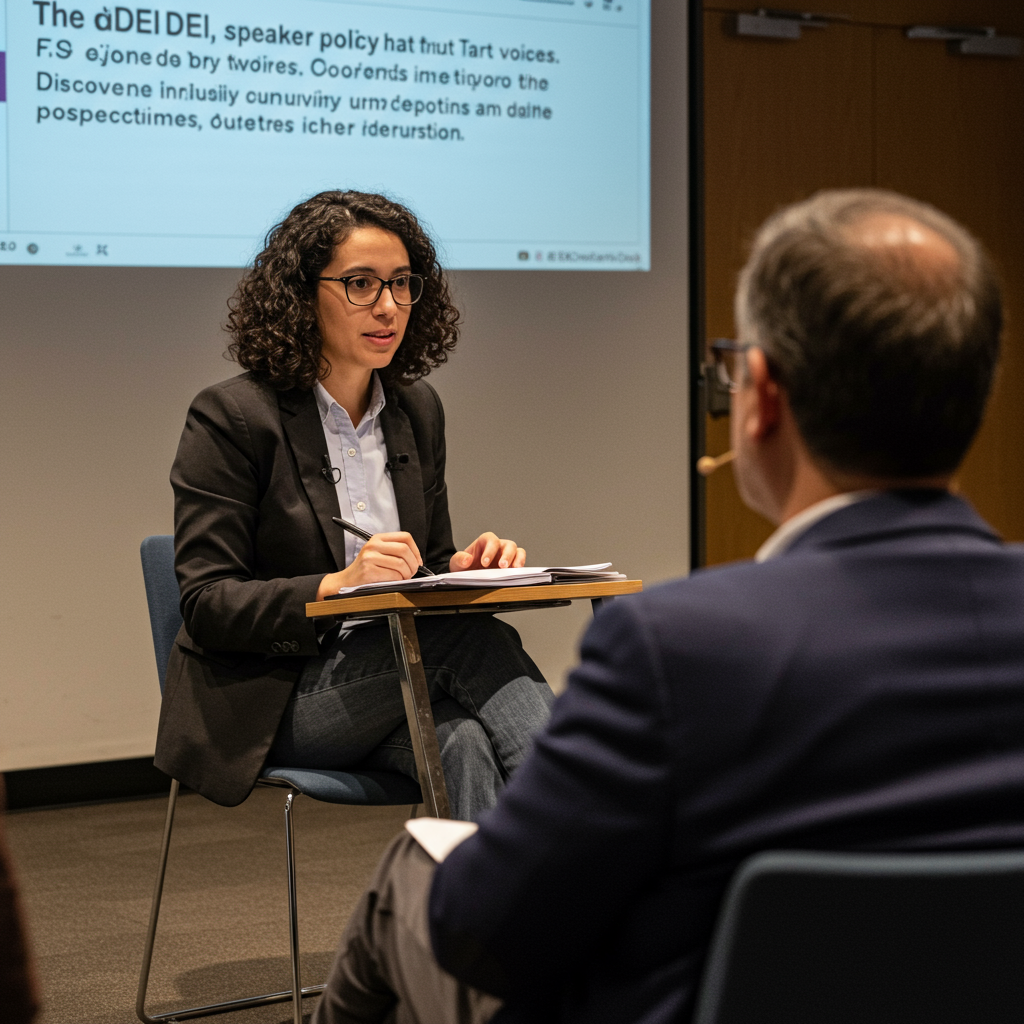
This article offers a comprehensive framework for developing and implementing a speakers policy focused on Diversity, Equity, and Inclusion (DEI). The goal is to move beyond symbolic representation and build an ecosystem where a plurality of voices enriches the dialogue and fosters innovation.
Through step-by-step guides, templates, and case studies, organizations will learn to establish auditable processes that increase the representation of underrepresented groups by 30% in the first year, improve audience satisfaction scores (NPS) by 15 points, and maintain budget variances below 5%. This guide is intended for HR leaders. HH., event organizers, and DEI committees seeking a measurable and sustainable impact.
Introduction
In today’s corporate and academic landscape, events, conferences, and panel discussions are crucial platforms for the exchange of ideas, innovation, and thought leadership. However, for too long, these settings have reflected a homogenous worldview, with an overrepresentation of the same voices and perspectives. Implementing a DEI Speakers Policy to Broaden Voices is not simply an exercise in political correctness; it is a fundamental business strategy for connecting with diverse audiences, fostering creativity, and reflecting the values of a global society. This strategic shift goes beyond meeting quotas; it is about actively enriching the conversation and, as a result, improving the quality and relevance of the content presented.
The methodology proposed in this guide is based on a systemic and data-driven approach.
This isn’t about creating a checklist, but about integrating the principles of Diversity, Equity, and Inclusion into the very DNA of event planning. We will measure success through a set of clear Key Performance Indicators (KPIs), such as the percentage of speakers from underrepresented groups, audience feedback scores on panel diversity, media reach of events, and impact on brand perception. The goal is to provide an auditable path from policy conception to evaluation and continuous improvement, ensuring sustainable and meaningful change.
Vision, Values, and Proposal
Focus on Results and Measurement
Our vision is to transform events from mere information transmissions into catalysts for change, where diversity of thought is the norm, not the exception. The values that underpin this proposal are equity, inclusion, excellence, and measurability. We apply the Pareto principle (80/20), focusing on actions that generate the greatest impact on the diversity of voices. This means prioritizing the creation of inclusive speaker databases, training selection committees to mitigate unconscious bias, and establishing partnerships with organizations that represent underrepresented communities. Our technical standard aligns with ISO 30415:2021 (Human Resources Management – Diversity and Inclusion), ensuring that processes are robust, consistent, and auditable.
Value Proposition: To increase the relevance and impact of events by including diverse perspectives, resulting in greater audience engagement, improved brand reputation, and the fostering of internal innovation.
Quality Criteria: A speaker or panel is considered successful not only for their technical expertise but also for their ability to bring a unique perspective and connect with a diverse audience. Quality is measured using a rubric that evaluates content, delivery, originality, and contribution to the program’s diversity.
- Selection Decision Matrix: Speaker selection will be based on a weighted matrix that balances subject matter expertise (40%), communication skills (30%), representation of an underrepresented perspective (20%), and alignment with the event’s values (10%).
- Commitment to Equity: Ensuring fair and transparent compensation for all speakers, regardless of their background, and providing the necessary resources (e.g., coaching, technical support) to ensure their success.
Services, Profiles, and Performance
Portfolio and Professional Profiles
To effectively implement a DEI Speaker Policy for To amplify voices, organizations can develop a portfolio of in-house services or hire specialized consultants. These services focus on the entire speaker management lifecycle, from strategy to execution. Key professional profiles include the Speaker and Talent Manager, the Inclusive Events Coordinator, and the Speaker and Talent Manager. Together, they ensure that the policy doesn’t remain merely on paper but translates into measurable and visible results.
Operational Process
-
- Phase 1: Policy Diagnosis and Design (2 weeks). Analysis of past events (KPI: identify representation gap, target >50% of speakers from the dominant demographic group). Drafting the policy with SMART objectives.
- Phase 2: Creation of the Diverse Talent Database (4 weeks). Proactive research and strategic alliances. (KPI: Add ≥100 new profiles from underrepresented groups per quarter).
Phase 3: Selection and Recruitment (3 weeks per event). Implementation of the decision matrix and equitable recruitment processes. (KPI: Selection rate of speakers from underrepresented groups >35%).
Phase 4: Speaker Support and Preparation (1-2 weeks before the event). Coaching sessions, material review, and technical testing. (KPI: Speaker confidence score >8/10).
Phase 5: Post-Event Execution and Measurement (1 week post-event). Gathering feedback from the audience and the speaker. (KPI: Audience NPS on panel diversity >+20).
ROI Analysis.
Tables and Examples
Achieve 40% female representation on all technical panels, with an audience satisfaction score ≥8.5/10.Ensure representation of people with disabilities.Number of speakers who identify with a disability; event accessibility (physical and digital).Consult with accessibility experts; offer flexible presentation formats; ensure live captioning and sign language interpretation.At least 5% of the speakers identify with a disability; 100% compliance with WCAG 2.1 AA guidelines for digital content.” “” …””””””</t Offer high-quality remote participation as a standard option.Achieve 20% of speakers from geographies underrepresented in the sector, enriching the event’s global perspective.
| Objective | Indicators | Actions | Expected Result |
|---|---|---|---|
| Increase the representation of women on technical panels by 25% in one year. | Percentage of female speakers at STEM events; audience feedback. | Partnerships with organizations such as “Women in Tech”; active networking; Review the “Calls for Papers” to use inclusive language. |
Representation, Campaigns, and Production
Professional Development and Management
A successful DEI Speakers Policy goes Beyond simply booking, it involves comprehensive management to ensure speakers feel valued, prepared, and safe. Logistics are fundamental: travel and accommodation arrangements must be inclusive and accessible. Coordination with suppliers, from catering (considering diverse dietary requirements) to audiovisual equipment (ensuring proper lighting for different skin tones), must be aligned with DEI principles. A detailed execution schedule is established, from contract signing to post-event follow-up, with clear checkpoints. This includes managing speaker agreements that are transparent and equitable regarding fees, intellectual property rights, and expectations.
Documentation Checklist: Clear contract, technical and accessibility requirements form, speaker guide with event code of conduct, emergency contact information.
Contingency Plan: Maintain a list of qualified and diverse backup speakers. Defined protocol for last-minute cancellations that does not compromise panel diversity.
- Supplier Coordination: Require key suppliers (venue, A/V, catering) to demonstrate their own policies and capabilities regarding accessibility. For example, A/V staff trained in microphone and lighting for people with different physical characteristics.
- Communication and Campaigns: Event promotional campaigns should highlight the diversity of its speakers. Use their stories and perspectives in marketing to attract a wider audience and establish the event’s inclusive tone from the outset.
Content and Media That Convert
Messages, Formats, and Conversions
Speaker diversity directly leads to greater content diversity. This, in turn, generates higher engagement and conversion rates, as wider audiences feel represented and understood. The hooks in the presentations should be authentic and relevant to the lived experiences of a global audience. Calls to action (CTAs) should be inclusive and consider different cultural and socioeconomic contexts. Conducting A/B testing on session titles and descriptions, comparing traditional approaches with those that explicitly highlight the speakers’ unique perspectives, can reveal which messages resonate most. Conversion metrics should include not only ticket sales but also social media engagement (shares, comments), post-event newsletter subscriptions, and the formation of communities around the topics covered. Implementing an effective DEI Speakers Policy is a powerful content marketing tool.
Inclusive Content Production Workflow
- Phase 1: Ideation and Call for Papers (Responsible: Content Committee). A call for papers is designed using inclusive language, specifying the interest in non-traditional perspectives on established topics. It is distributed through various channels.
- Phase 2: Curation and Selection (Responsible: Selection Committee with Bias Training). The weighted decision matrix is used. Proposals are evaluated anonymously in a first round to focus on the quality of the idea.Phase 3: Development and Coaching (Responsible: Speaker Manager). We work individually with each speaker to align their content with the event’s objectives, offering support in slide design, public speaking, and narrative. We ensure that the content is accessible (e.g., alternative text for images).
Phase 4: Production and Delivery (Responsible: Production Team). During the event, flawless technical support and a safe environment are guaranteed. The moderator is trained to manage time fairly and foster respectful dialogue.
Phase 5: Post-production and Distribution (Responsible: Marketing Team). The recorded content (videos, podcasts) is edited with high-quality subtitles and distributed across multiple platforms to maximize its reach. Viewing and engagement metrics are analyzed per session.
Training and employability
Demand-driven catalog
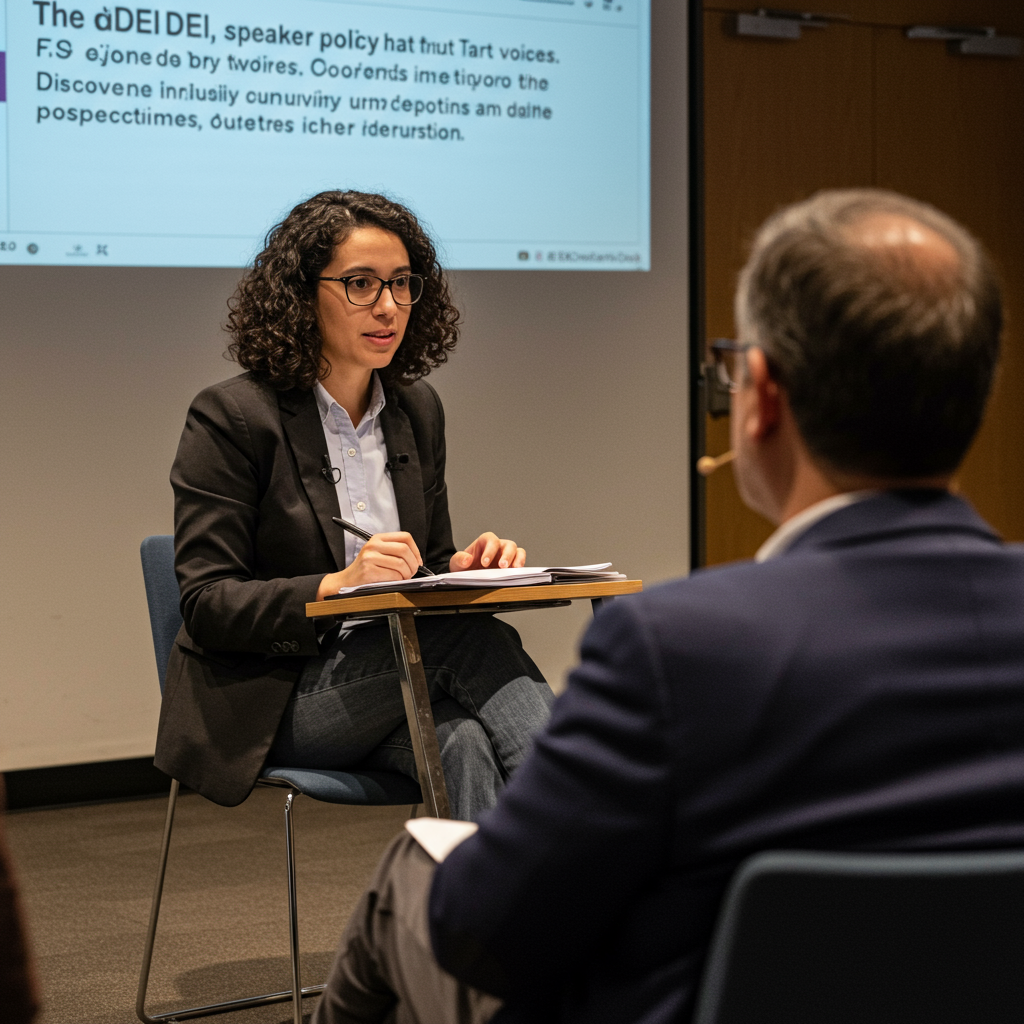
For a DEI policy to be sustainable, it is crucial to invest in talent development. This involves offering training to both organizers and speakers, especially those from emerging groups.
Module 1: Mitigating Unconscious Biases for Selection Committees. A 4-hour interactive workshop to learn how to identify and counteract common biases (affinity, confirmation bias, halo effect) in the speaker selection process.
Module 2: Designing Inclusive Events. A 2-day course for event organizers covering everything from writing Calls for Papers to physical and digital accessibility, inclusive moderation, and incident management.
Module 3: Speaker Academy for Emerging Talent. A 6-week mentorship program for new speakers from underrepresented groups. It covers public speaking, presentation design, personal branding, and contract negotiation.
Module 4: Inclusive Panel Moderation. Specific training for moderators on how to ensure equitable distribution of speaking time, manage difficult audience questions, and create a safe space for discussion.
Methodology
The training is based on a practical and experiential methodology. Assessment is conducted using clear rubrics that measure the acquisition of specific skills. For example, in the bias workshop, participants must analyze case studies, and their decisions are evaluated before and after the training. The Speaker Academy culminates in a final presentation before a panel of experts who provide constructive feedback. The program aims to create a job bank or network of certified speakers, connecting graduates with opportunities at other events and organizations, thereby enhancing their employability and visibility in the industry. The expected result is a 20% increase in the pool of qualified diverse talent within 18 months.
Operational Processes and Quality Standards
From Request to Execution
A standardized operational process is vital to ensure consistency and fairness in the application of the DEI policy. This pipeline defines each stage, its responsible parties, deliverables, and acceptance criteria.
- Diagnosis and Strategy: The requesting team (e.g., a marketing department) presents an event brief. The DEI team analyzes the objectives and defines diversity goals for the speakers. Deliverable: Event strategy document with DEI KPIs. Acceptance Criteria: Approval by the DEI committee and the event leader.Proposal and Sourcing: The Talent Manager actively searches the database and partner networks. They present a long list of potential candidates. Deliverable: A list of 10-15 candidates per slot, with detailed profiles. Acceptance Criteria: The list meets the representation objectives (e.g., ≥50% of candidates from underrepresented groups).
Selection and Contracting: The selection committee, using the decision matrix, evaluates and interviews the finalist candidates. Offers are extended. Deliverable: Signed contracts. Acceptance Criteria: The final panel meets or exceeds the established diversity KPIs.
Pre-Production and Support: The Speaker Manager coordinates logistics, preparation sessions, and content review. Deliverable: Confirmed travel plan, final presentation received, technical test completed. Acceptance criterion: Speaker confirms their preparation and satisfaction with the support (weekly check-in).
- Execution and Feedback: The event takes place. Real-time and post-event feedback is collected. Deliverable: Completed satisfaction surveys (audience and speakers), social media analytics report. Acceptance criterion: Survey response rate >25%.
- Closure and Analysis: A post-mortem report is prepared, analyzing KPI compliance, budget, and lessons learned. Deliverable: Final event report. Acceptance Criteria: The report includes actionable recommendations for future events and is presented to stakeholders within 15 days.Quality Control
Roles and Responsibilities: The DEI Committee has an oversight and auditing role. The Event Manager is ultimately responsible for execution. The Talent Manager is responsible for the diversity of the candidate pool.
Escalation: Any deviation from the policy or conflict of interest is immediately escalated to the DEI Committee for resolution.
Acceptance Indicators: A panel of speakers cannot be confirmed if it does not meet at least 75% of the diversity objectives defined in the strategy phase.
Service Level Agreements (SLAs): The response time to a speaker inquiry must be less than 24 hours. Fee payment must be processed within a maximum of 10 business days after the event.
- Search and ProposalLong list of diverse candidatesSize and diversity of the candidate pool (e.g., >60% from underrepresented groups).Risk: Difficulty finding experts in very specific topics. Mitigation: Expand the search through academic networks, NGOs, and niche communities; Make the format more flexible (e.g., co-presentation with a senior expert).Selection and HiringFinal panel of speakers hiredFinal panel composition vs. KPIs; average hiring time.Risk: The selection committee reverts to affinity bias. Mitigation: Mandatory bias training; presence of a “DEI observer” in deliberations; strict use of the decision matrix.
Phase Deliverables Control Indicators Risks and Mitigation Diagnosis and Strategy Event DEI Strategy Document Alignment with the company’s overall DEI objectives; SMART KPIs. Risk: Unrealistic or vague objectives. Mitigation: Use industry benchmark data and analysis of past events to set achievable but ambitious goals. Implementation and Feedback Satisfaction surveys, engagement analysis NPS scores; qualitative feedback on diversity and inclusion; Reported incident rate (code of conduct). Risk: Negative experience for a speaker or audience member. Mitigation: Clear and visible code of conduct; trained staff to handle incidents; anonymous and rapid-response reporting channel.
Application Cases and Scenarios
Case 1: “FutureCode” Annual Technology Conference
Challenge: The “FutureCode” conference, a leading event in the software industry with 5,000 attendees, received criticism for having 85% male and white speakers at its 2022 edition. Social media engagement was negative, and some key sponsors expressed concern. The event’s NPS dropped 10 points.
Solution: The organizing company implemented a rigorous DEI speaker policy. They created a diverse selection committee, drafted a Call for Papers using inclusive language that was distributed through new networks such as Techqueria and Women Who Code, and set a target of no more than 50% speakers of any one gender and no more than 60% of any one ethnicity. A mentorship program was offered to selected emerging speakers.
Results: In the 2023 edition, they achieved a panel with 48% women and non-binary people, and 45% speakers from underrepresented ethnic groups. The event’s NPS increased 22 points. Media coverage was overwhelmingly positive, highlighting the change. Ticket sales increased by 15%, and they secured two new top-tier sponsors attracted by their commitment to the DEI. The total cost of speakers remained within 3% of the original budget.
Case 2: Community Workshop Series of a Health NGO
Challenge: An NGO that offers mental health workshops in low-income neighborhoods noticed low attendance, especially among the immigrant population. Their workshop facilitators were mostly upper-middle-class psychologists with no lived experience in the communities they served.
Solution: They adopted a “community spokespeople” policy. Instead of seeking only experts with academic credentials, they prioritized hiring community leaders, social workers, and individuals with relevant lived experience who could connect culturally with the audience. These individuals were provided with training in facilitation and workshop structuring. Results: Workshop attendance tripled in six months. Satisfaction surveys showed that 95% of participants felt “understood and represented” by the facilitators. The NGO was able to gather much richer and more accurate information about community needs, allowing them to adjust their programs and secure an additional grant of €50,000 to expand the initiative.
Case 3: Global Quarterly Meetings of the Corporation “InnovaCorp”
Challenge: The quarterly (“all-hands”) meetings of InnovaCorp, a multinational with offices in 20 countries, were presented almost exclusively by executives from the US headquarters. Employees in other regions felt disconnected and perceived that their contributions were not valued. The internal engagement survey showed a 30% lower score in offices outside North America.
Solution: A “global voices” policy was implemented for all mass internal communications. Each quarterly meeting was required to have presenters from at least three different continents. Cross-cultural project teams were created to prepare the presentations, ensuring that the examples and data were globally relevant. Investment was made in technology to improve the quality of remote participation.
Results: Within a year, the gap in engagement scores between headquarters and global offices narrowed to less than 10%. Employees reported a greater sense of belonging and a better understanding of the company’s global strategy. Interregional collaboration on projects increased by 25%, an unexpected benefit attributed to the greater visibility of leaders and experts from different markets.
Case 4: Literary Festival in a Mid-Sized City
Challenge: An annual literary festival, while popular, was criticized for its lack of diversity in literary genres and authors. The program focused on established novelists, ignoring poetry, graphic novels, science fiction, and the voices of the local diaspora.
Solution: The new director implemented a curation policy based on “literary intersectionality.” Quotas were established for different genres, and authors from the LGBTQ+ community, authors with disabilities, and first- and second-generation immigrant writers were actively sought out. Thematic panels were created that blended different genres around a central idea, such as “Identity and Future.” Results: Full festival pass sales increased by 20%. Attendance among the under-30 age group grew by 40%. Local bookstores reported increased sales of previously underrepresented genres. The festival received a cultural grant from the regional government for its “innovative approach to social cohesion through literature.”
Step-by-Step Guides and Templates
Guide 1: How to Draft Your First DEI Speakers Policy
- Step 1: Form a Diverse Working Group. Include representatives from HR, marketing, different departments, and employee affinity groups.
- Step 2: Statement of Principles. Start with a paragraph explaining the “why.” Conecte la política con la misión y los valores de la organización.
- Paso 3: Definir el Alcance. Especifique a qué eventos se aplica la política (internos, externos, seminarios web, etc.).
- Paso 4: Establecer Objetivos Medibles (KPIs). Sea específico. Ejemplo: “Para 2025, todos los paneles con tres o más personas deben incluir al menos un 40 % de mujeres o personas no binarias y un 30 % de representación de grupos étnicos infrarrepresentados en nuestro sector”.
- Paso 5: Detallar el Proceso de Selección. Describa cómo se buscarán, evaluarán y seleccionarán los ponentes. Incluya el uso de una matriz de decisión y la formación obligatoria sobre sesgos.
- Paso 6: Definir Roles y Responsabilidades. ¿Quién es el responsable final? ¿Qué papel juega el comité DEI? ¿Quién gestiona la base de datos de ponentes?
- Paso 7: Establecer Pautas de Compensación Equitativa. Cree una política de honorarios transparente para evitar disparidades salariales. Incluya la cobertura de gastos de viaje y alojamiento.
- Paso 8: Incluir un Código de Conducta. Defina las expectativas de comportamiento para ponentes, organizadores y audiencia. Detalle un proceso para reportar y manejar violaciones.
- Paso 9: Plan de Comunicación. ¿Cómo se comunicará esta política interna y externamente? Publíquela en su sitio web para mostrar su compromiso.
- Paso 10: Proceso de Revisión. Establezca una revisión anual de la política para analizar los datos, evaluar el progreso hacia los KPIs y realizar los ajustes necesarios.
Guía 2: Checklist para un “Call for Speakers” (CFP) Inclusivo
- Lenguaje: ¿Usa un lenguaje neutro e inclusivo? (p. ej., “personas” en lugar de “hombres y mujeres”).
- Transparencia: ¿Se indica claramente el proceso de selección, los plazos y los criterios de evaluación?
- Compensación: ¿Se menciona explícitamente si hay honorarios, cobertura de viaje u otros beneficios? Esto respeta el tiempo de los solicitantes.
- Temas: ¿Los temas sugeridos son lo suficientemente amplios como para permitir perspectivas diversas? ¿Invita a interpretaciones no tradicionales?
- Ejemplos: ¿Los ejemplos de ponentes de años anteriores muestran diversidad? Si no, considere no ponerlos para no desanimar a nuevos perfiles.
- Preguntas Demográficas: Si se recopilan datos demográficos, ¿son opcionales? ¿Se explica claramente por qué se recopilan (para medir el progreso de DEI) y que no se usarán en la selección individual?
- Flexibilidad de Formato: ¿Se ofrece la opción de presentaciones remotas, en solitario, en panel o en formato taller?
- Soporte: ¿Se menciona que se ofrecerá apoyo o mentoría a los ponentes seleccionados, especialmente a los que tienen menos experiencia?
- Difusión: ¿Se ha planeado distribuir el CFP más allá de los canales habituales, contactando a grupos y comunidades específicas?
- Accesibilidad: ¿El formulario de solicitud es accesible para personas que usan lectores de pantalla?
Guía 3: Plantilla de Correo Electrónico de Rechazo Constructivo
Asunto: Actualización sobre su propuesta para [Nombre del Evento]
Estimado/a [Nombre del Ponente],
Muchas gracias por dedicar tiempo y esfuerzo a presentar su propuesta “[Título de la Propuesta]” para nuestro evento. Recibimos un número muy alto de propuestas de gran calidad, lo que hizo que el proceso de selección fuera increíblemente competitivo.
Aunque su propuesta no ha sido seleccionada para el programa de este año, el comité de revisión quedó impresionado por [mencionar algo específico y positivo, p. ej., “su enfoque innovador en el tema X” o “la profundidad de su investigación en Y”].
Para su referencia, este año nos hemos centrado en temas relacionados con [mencionar 1-2 temas clave] y hemos buscado equilibrar el programa con una mezcla de formatos [mencionar formatos]. A menudo, la decisión final se reduce a cómo encaja una charla específica en el rompecabezas global del programa.
Le animamos encarecidamente a que vuelva a presentar propuestas en el futuro. Mantenemos su información en nuestra base de datos de expertos y podríamos contactarle para otras oportunidades, como seminarios web o publicaciones en nuestro blog.
Gracias de nuevo por su interés en [Nombre del Evento].
Atentamente,
El Comité de Contenido de [Nombre del Evento]
Recursos internos y externos (sin enlaces)
Recursos internos
- Plantilla de Política de Ponentes DEI
- Matriz de Decisión para la Selección de Ponentes (Hoja de cálculo)
- Guía de Lenguaje Inclusivo para Comunicaciones de Eventos
- Checklist de Accesibilidad de Eventos (Físicos y Virtuales)
- Plantilla de Contrato Estándar para Ponentes
- Base de Datos de Ponentes y Talentos (Software CRM)
Recursos externos de referencia
- Norma ISO 30415:2021 – Gestión de Recursos Humanos: Diversidad e Inclusión
- Guías de Accesibilidad para el Contenido Web (WCAG) 2.1
- Informes sobre diversidad en eventos del sector (p. ej., de consultoras como McKinsey o Deloitte)
- Bases de datos públicas de ponentes de grupos infrarrepresentados (p. ej., Women Also Know Stuff, Black Speakers Collection)
- Guías de buenas prácticas de organizaciones como la Professional Convention Management Association (PCMA)
Preguntas frecuentes
¿Implementar una política DEI no compromete la “meritocracia” o la calidad de los ponentes?
Al contrario, la fortalece. Una verdadera meritocracia solo puede existir cuando hay igualdad de oportunidades. Una política DEI no busca rebajar los estándares, sino ampliar el campo de búsqueda para encontrar el mejor talento que antes era pasado por alto debido a sesgos y redes limitadas. Al considerar una gama más amplia de candidatos, aumenta la probabilidad de encontrar ponentes excelentes que además aportan perspectivas frescas y valiosas.
Nuestra industria es muy homogénea. ¿Cómo podemos encontrar ponentes diversos cualificados?
Esto requiere un esfuerzo proactivo. En lugar de esperar a que las propuestas lleguen, hay que buscarlas. Esto implica asociarse con organizaciones profesionales de grupos infrarrepresentados, buscar en plataformas académicas, LinkedIn, y pedir recomendaciones a su red extendida. A menudo, el talento está ahí, pero no en los círculos tradicionales. Considere también crear un programa de desarrollo para talentos emergentes en su propio sector.
¿Cómo manejamos las críticas o el rechazo de personas que se oponen a estas iniciativas?
La clave es la comunicación transparente y basada en datos. En lugar de enmarcarlo como un tema “político”, enfóquelo como una estrategia de negocio para mejorar la innovación, el alcance de mercado y la calidad del evento. Utilice los datos de sus propios eventos para demostrar el impacto positivo en la satisfacción de la audiencia y otros KPIs. Prepare a sus líderes y portavoces con argumentos claros y constructivos. No se disculpe por su compromiso con la equidad.
Tenemos un presupuesto limitado. ¿No son más caros los ponentes de alto perfil de grupos diversos?
La compensación debe ser equitativa y basarse en la experiencia, no en la demografía. Una política de honorarios transparente ayuda a estandarizar los costes. Además, una buena política DEI no se trata solo de contratar a “celebridades”, sino de descubrir nuevas voces. Muchos ponentes excelentes y emergentes de todos los orígenes tienen tarifas razonables. El ROI de atraer a una audiencia más amplia y comprometida a menudo supera con creces cualquier coste marginal.
¿Cómo medimos el éxito de nuestra política más allá de los números?
Los datos cuantitativos (KPIs) son cruciales, pero deben complementarse con datos cualitativos. Realice entrevistas en profundidad con ponentes para evaluar su experiencia. Analice los comentarios de la audiencia en las encuestas y en las redes sociales para captar el sentimiento. Observe si las conversaciones y las preguntas durante el evento se vuelven más ricas y variadas. El éxito también se ve en el impacto a largo plazo: si su evento se convierte en una plataforma de lanzamiento para nuevas voces en la industria.
Conclusión y llamada a la acción
La transición hacia eventos verdaderamente inclusivos es una maratón, no un sprint. Sin embargo, cada paso cuenta y el impacto es acumulativo y profundo. Implementar una política de ponentes DEI para ampliar voces no es solo una obligación ética, sino una poderosa palanca para la excelencia, la innovación y la relevancia en un mundo cada vez más diverso. Al adoptar un enfoque sistemático, basado en datos y centrado en el ser humano, las organizaciones pueden transformar sus plataformas de meros escenarios a ecosistemas vibrantes de ideas. Los resultados son claros: audiencias más comprometidas, conversaciones más ricas, una marca más fuerte y, en última instancia, un mayor impacto en el negocio y en la sociedad. El momento de actuar es ahora. Comience por evaluar sus últimos cinco eventos, identifique las brechas y reúna a un equipo para redactar el primer borrador de su política. El viaje hacia la ampliación de voces comienza con un solo paso deliberado.
Glosario
- DEI (Diversidad, Equidad e Inclusión)
- Un marco organizacional que busca promover la representación y participación justa de diferentes grupos de individuos, incluyendo personas de diferentes razas, etnias, géneros, orientaciones sexuales, discapacidades, edades y religiones.
- Interseccionalidad
- El concepto de que las identidades sociales y políticas (como raza, género, clase) se combinan para crear experiencias únicas de discriminación y privilegio.
- Sesgo Inconsciente
- Actitudes o estereotipos sociales que afectan nuestra comprensión, acciones y decisiones de manera inconsciente. En la selección de ponentes, el sesgo de afinidad (preferir a personas similares a nosotros) es común.
- NPS (Net Promoter Score)
- Una métrica de lealtad del cliente (o en este caso, de la audiencia) que se mide con una sola pregunta: “¿Qué tan probable es que recomiende este evento a un amigo o colega?”.
- Grupos Infrarrepresentados
- Sectores de la población que tienen una presencia menor en un campo o industria en particular en comparación con su proporción en la población general.
- Call for Papers/Speakers (CFP)
- Una invitación abierta que una organización de eventos emite para que los expertos presenten sus propuestas de ponencias para ser consideradas en el programa.
Internal links
- Click here👉 https://us.esinev.education/diplomas/
- Click here👉 https://us.esinev.education/masters/
External links
- Princeton University: https://www.princeton.edu
- Massachusetts Institute of Technology (MIT): https://www.mit.edu
- Harvard University: https://www.harvard.edu
- Stanford University: https://www.stanford.edu
- University of Pennsylvania: https://www.upenn.edu