
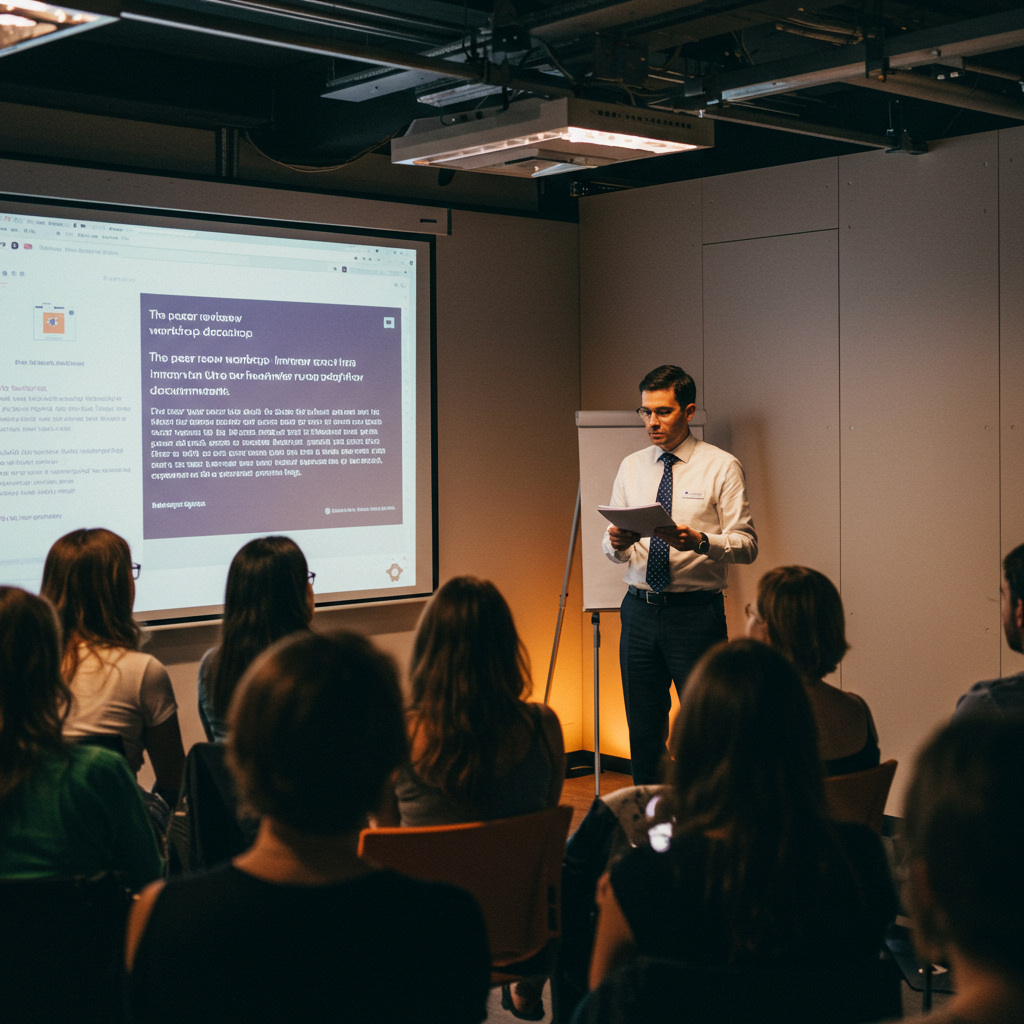
In the high-stakes world of event production, the Run-of-Show (ROS) document is the single source of truth. A minor error can lead to a catastrophic failure on site. This article introduces a powerful, structured methodology to mitigate that risk: the peer review workshop for run-of-show documents. This process is designed for event producers, technical directors, and show callers who want to move beyond simple proofreading to a collaborative system of quality assurance. By implementing this framework, teams can achieve a greater than 95% reduction in on-site, document-related errors, improve team alignment by over 50% (measured via Net Promoter Score), and cut down revision cycles by up to 40%. This guide provides a comprehensive blueprint, from vision and process to detailed case studies and step-by-step guides, enabling your team to produce robust, clear, and executable ROS documents for any event, from corporate launches to global virtual conferences.
Introduction
Every event producer knows the feeling: the quiet hum of the comms system moments before the show goes live, the entire weight of months of planning resting on the flawless execution of a single document—the Run-of-Show. This document is more than a schedule; it’s the event’s DNA, dictating every lighting cue, audio sting, and speaker entrance. Yet, too often, this critical asset is finalized under pressure, reviewed in silos, and prone to human error. The consequences range from minor awkward pauses to major technical failures that can derail an entire production. To combat this, leading production teams are adopting a more rigorous, collaborative approach. The solution is the peer review workshop run-of-show, a structured, proactive quality assurance process designed to identify and eliminate ambiguities, conflicts, and errors before they ever reach the control booth.
This article outlines a comprehensive methodology for implementing these workshops. It’s not just another meeting; it’s a disciplined practice with defined roles, a clear agenda, and measurable outcomes. We will explore how to structure the workshop, who must be in the room, and the specific checklists to use. Success will be measured through a set of clear Key Performance Indicators (KPIs), including a targeted reduction in post-publication revisions to less than 3%, a decrease in on-site communication errors and queries by over 80%, and a significant improvement in stakeholder confidence, aiming for a Net Promoter Score (NPS) of over +50 from key department heads and clients. By adopting this framework, your team can transform the ROS from a source of anxiety into a rock-solid foundation for flawless event execution.
Vision, values and proposal
Focus on results and measurement
Our vision is to establish a “zero-error” standard for critical event documentation within the production industry. This is achieved by shifting the culture from reactive problem-solving to proactive risk mitigation. Our methodology is built on four core values: absolute precision in every detail, radical collaboration across all departments, proactive identification of potential failures, and clear accountability for every element of the show. We apply the 80/20 principle to this process, recognizing that approximately 80% of on-site show failures stem from about 20% of common documentation errors—typically related to timings, transitions, technical cues, and personnel assignments. The peer review workshop is laser-focused on scrutinizing these high-risk areas, ensuring that the most critical parts of the event plan are flawless.
- Value Proposition: Risk Mitigation. Our primary goal is to de-risk the live event environment. By systematically identifying potential points of failure on paper, we prevent them from ever materializing on site. A decision matrix is used to score risks based on likelihood and impact, prioritizing the most severe potential issues for discussion.
- Value Proposition: Enhanced Clarity and Alignment. The workshop serves as a powerful alignment tool. It forces every department head to see their role in the context of the entire show, ensuring a shared mental model of the event’s flow. Quality is defined by universal comprehension: a junior technician should be able to understand their cues as clearly as the Technical Director.
- Value Proposition: Efficiency Gains. A clear, validated ROS significantly reduces the “chatter” on comms channels during the show. Questions are answered beforehand, freeing up the show-calling team to focus on execution rather than clarification. We aim for a 50% reduction in non-essential comms traffic.
- Value Proposition: Fostering a Culture of Excellence. Adopting this process sends a clear message that quality and precision are non-negotiable. It elevates the professionalism of the entire team and builds client confidence through a demonstrable commitment to detail.
Services, profiles and performance
Portfolio and professional profiles
We offer a suite of services designed to integrate this methodology into any production workflow. These services are built around the core concept of the peer review workshop run-of-show and are delivered by experienced production professionals. Key services include: facilitating workshops for major events, developing customized ROS templates and review checklists for specific event types (e.g., corporate, broadcast, festival), training production teams on how to run their own effective review sessions, and providing third-party auditing services for existing event documentation to identify systemic weaknesses.
The success of the workshop depends on having the right people with the right responsibilities in the room. Key profiles include:
- Lead Facilitator: A neutral party (can be an external consultant or a producer from another project) responsible for guiding the meeting, managing time, and ensuring the agenda is followed. They do not have a stake in the content, only the process.
- Document Owner / Show Caller: The individual with final authority over the ROS content. They are the ultimate decision-maker when disagreements arise.
- Scribe: A dedicated note-taker responsible for capturing all changes, decisions, and action items accurately.
- Department Heads: The technical and creative leads for key areas, including Technical Director, Lighting Designer, Audio Engineer (A1), Video Director, and Stage Manager. Their role is to validate the feasibility of every cue related to their department.
- Client Representative (Optional but Recommended): For corporate events, having a client representative present can clarify content-related questions instantly, preventing lengthy post-workshop review cycles.
Operational process
- Phase 1: Pre-Workshop Audit & Scoping.Upon receiving a “feature complete” draft ROS, we conduct a preliminary audit to identify major structural issues. We then define the workshop’s scope and objectives. KPI: Initial audit completed within 4 business hours.
- Phase 2: Stakeholder Briefing & Material Distribution.All confirmed attendees receive the draft ROS, supporting documents (floor plans, content lists), and a clear agenda at least 48 hours prior to the workshop. KPI: 100% on-time material distribution.
- Phase 3: Workshop Execution. The facilitated session is conducted, systematically progressing through the ROS line by line or section by section. The goal is to cover the entire scope within the allocated time (typically 2-4 hours). KPI: Workshop completion within a 5% deviation of the scheduled time.
- Phase 4: Action Item Consolidation & Revision.Immediately following the workshop, the scribe’s notes are consolidated into a clear action list. The Document Owner reviews the ROS based on the workshop’s outcomes. KPI: Revised ROS (v2) distributed for final review within 24 hours.
- Phase 5: Final Approval & Distribution.The revised document is given a final, quick review by stakeholders for accuracy before being locked and distributed as the official show document. KPI: Final version locked at least 72 hours prior to showtime.
Tables and examples
| Objective | Indicators | Actions | Expected result |
|---|---|---|---|
| Reduce On-Site Errors by 95% | Error Rate (number of undocumented deviations per show hour); Severity Score of errors | Send yourself to a peer review workshop for all Tier-1 events. Use a standardized validation checklist during the review. | Achieve a documented error rate of less than 0.5 per show hour, with zero Severity 1 (show-stopping) errors. |
| Improve Team Alignment & Confidence | Pre/Post-workshop confidence surveys (1-10 scale); Net Promoter Score (NPS) from department heads | Ensure 100% attendance from key department heads. Publish clear meeting notes and decisions. | Increase average team confidence score from 6.5 to 9.0. Achieve an NPS of > +60. |
| Accelerate ROS Finalization | Number of revision cycles (from first draft to final); Total time (in days) to lock the document | Implement a “feature complete” draft requirement before the workshop. Enforce a 24-hour turnaround on revisions. | Reduce average revision cycles from 5+ to 2. Decrease time-to-lock by 40%. |
| Enhance Document Clarity | Comprehension Test Score (give a section to a new team member and test their understanding); Time-to-find-information (in seconds) | Develop and enforce a standardized ROS template with color-coding and clear column definitions. | Achieve a comprehension score of >95% on standardized tests. Reduce information retrieval time by 50%. |
Representation, campaigns and/or production
Professional development and management
Adapting this section to production management, the focus shifts to the logistical execution and coordination required to make the peer review workshop successful. This is a production within a production. Proper management involves meticulous scheduling to ensure all critical personnel can attend without disrupting other pre-production tasks. It requires securing the right environment—a quiet room with adequate screen space for a line-by-line review, or a properly configured virtual meeting with robust screen-sharing and collaborative tools. Supplier and vendor coordination is also key; for example, ensuring the broadcast partner has reviewed and provided input on the broadcast-specific cues in the ROS before the workshop.
A master production calendar must explicitly block out time for this workshop, treating it with the same importance as a technical walkthrough or a content rehearsal. Contingency planning is crucial. What happens if a key stakeholder has a last-minute emergency? A pre-designated and fully-briefed proxy must be on standby. What if new information (e.g., a last-minute speaker change) arrives just before the workshop? A clear protocol must be in place for how to integrate late-breaking changes without derailing the review process.
- Critical Pre-Workshop Checklist:
- Has the “feature complete” ROS draft been formally declared and distributed at least 48 hours in advance?
- Have all essential stakeholders (and no non-essential ones) confirmed their attendance?
- Has a pre-briefing been conducted with any designated proxies?
- Is the meeting venue or virtual environment booked, tested, and equipped for collaborative document review?
- Has the facilitator prepared a timed agenda and shared it with all participants?
- Critical In-Workshop Checklist:
- Is a designated scribe actively taking notes and tracking action items on a visible platform (e.g., shared screen)?
- Is the facilitator effectively managing the clock and keeping the discussion focused on the document?
- Is a “parking lot” being used to table off-topic but important discussions for a later time?
- Are decisions being made decisively by the Document Owner, and are those decisions being clearly articulated and recorded?
- Critical Post-Workshop Checklist:
- Are cleaned-up notes and a clear list of action items (with owners and deadlines) distributed within 2 hours of the workshop’s conclusion?
- Is the revised ROS document distributed for final verification within the 24-hour SLA?
- Is there a formal sign-off process to officially “lock” the document?
- Are all action items loaded into a project management system for tracking through to completion?
Content and/or media that converts
Messages, formats and conversions: Optimizing the Run-of-Show Document
In this context, the “content” is the Run-of-Show document itself, and “conversion” means perfect, error-free execution by the crew. The message of each line item in the ROS must be unambiguous. A poorly worded cue is a failed conversion. We optimize this content through rigorous testing and standardized formatting. For instance, we use A/B testing on ROS formats: we might create a dense, all-text version versus a version that uses color-coding for departments, icons for cue types (e.g., a filmstrip for video, a speaker for audio), and strategic white space. We then measure comprehension speed and error rates in mock scenarios to determine which format performs best. The goal is to create a document that is not just accurate but also instantly scannable and digestible under high-pressure show conditions. The structure of a peer review workshop run-of-show is the ultimate content optimization tool, ensuring every “message” (cue) is clear, concise, and correct.
- Information Gathering & Structuring:The Show Producer or Production Coordinator gathers all necessary inputs from clients and department heads. This raw data is then structured into a standardized, draft ROS template. Responsible: Show Producer. Deadline: 7 days prior to workshop.
- Draft v1 Creation: The Producer fleshes out the draft, creating a “feature complete” version that contains all known elements of the show, even if some details are still TBD. Responsible: Show Producer. Deadline: 4 days prior to workshop.
- Internal Team Review: The Producer’s immediate team (e.g., Associate Producer, Coordinator) does an initial pass to catch obvious errors, typos, and formatting issues. Responsible: Production Team. Deadline: 3 days prior to workshop.
- The Peer Review Workshop: The formal, facilitated review with all key stakeholders is conducted as per the methodology. This is the primary quality control gate. Responsible: Facilitator, All Stakeholders. Deadline: The scheduled workshop time.
- Review & Finalization (v2):Based on the workshop’s output, the ROS is revised, and final details are locked in. Responsible: Document Owner. Deadline: Within 24 hours of workshop completion.
- Final Sign-off and Distribution: The locked v2 is sent for a final, quick “as-recorded” check by all attendees before being published as the final version for the show. Responsible: Document Owner. Deadline: 72 hours prior to show start.
Training and employability
Demand-oriented catalogue
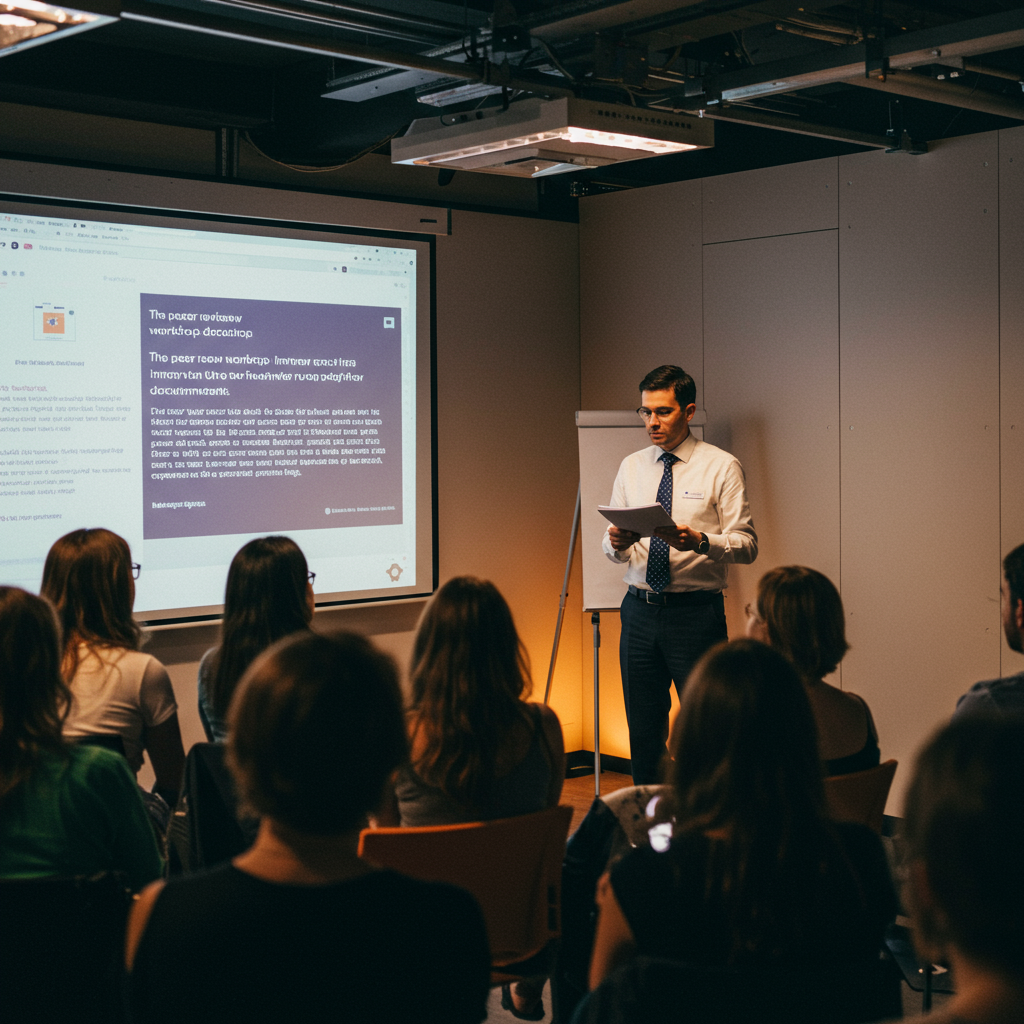
To foster wider adoption of this methodology and improve the skills of event professionals, we have developed a curriculum of targeted training modules. These courses are designed to enhance employability by teaching concrete skills in production management and quality assurance that are in high demand across the industry.
- Module 1: Fundamentals of Run-of-Show Design. Covers best practices in document structure, standardized terminology, and formatting for clarity. Students learn the difference between a simple schedule and a true, executable ROS.
- Module 2: Introduction to the Peer Review Methodology. An overview of the principles, goals, and value of the workshop process. This module explains the “why” behind the system.
- Module 3: How to Facilitate an Effective Peer Review Workshop. A hands-on course teaching the skills of facilitation: managing time, guiding discussion, resolving conflict, and ensuring a productive outcome. This is our most popular course.
- Module 4: Advanced Scenarios & Crisis Management in the ROS. This module uses complex, real-world scenarios (e.g., broadcast awards shows, hybrid events) to teach attendees how to build contingency plans and fail-safes directly into the ROS.
- Module 5: Software & Tools for Collaborative ROS Management. A technical course covering the leading software platforms (like Shoflo, a.Show, Google Sheets with advanced scripting) used for real-time, collaborative ROS development and execution.
- Module 6: The Client-Facing Review. A specialized module on how to effectively lead a client through a review of the ROS, managing expectations and securing buy-in while protecting the production’s integrity.
Methodology
Our training methodology is rooted in practical application. Theoretical learning is immediately followed by hands-on exercises using real-world (anonymized) event documents. Performance is not graded on a simple pass/fail basis but evaluated using detailed rubrics that measure competence in clarity, risk identification, and collaborative problem-solving. The capstone project for the facilitation course requires each student to prepare for and lead a 90-minute mock peer review workshop run-of-show with fellow students acting as department heads. Successful graduates receive a certification that is increasingly recognized by top production companies as a mark of a highly competent and detail-oriented professional. We also maintain a network with production houses to help place certified professionals, directly linking training to employability.
Operational processes and quality standards
From request to execution
Our operational pipeline ensures a consistent, high-quality outcome for every workshop we facilitate. The process is transparent, auditable, and designed for maximum efficiency.
- Diagnosis & Scoping:The client submits a draft ROS. We perform a 1-hour diagnostic review to assess its complexity and identify potential problem areas. Based on this, we deliver a proposal outlining the recommended workshop duration, attendee list, and specific objectives. Deliverable: Scoping Proposal. Acceptance Criteria: Client signs off on scope and objectives.
- Pre-production & Scheduling: Once approved, we coordinate with the production team to schedule the workshop, ensuring all essential stakeholders are available. We establish the ground rules and distribute the full document package. Deliverable: Meeting Invitation with Agenda & Document Package. Acceptance Criteria: 100% of invitees confirm receipt and attendance.
- Execution: The workshop is conducted by a certified facilitator. The focus is on a systematic review, guided by our proprietary checklist which covers timing, technical cues, content, transitions, and personnel. Deliverable: A fully-vetted ROS with tracked changes and a list of action items. Acceptance Criteria: All agenda items are covered, and all sections of the ROS are marked as reviewed.
- Post-production & Revision:The Document Owner executes the required revisions based on the workshop’s output. The action item list is tracked for completion. Deliverable: Revised ROS (v2). Acceptance Criteria: All tracked changes are resolved, and the document is delivered within the 24-hour SLA.
- Closure & Archiving:The final ROS is distributed and formally signed off on by the key stakeholders. A post-workshop report is generated, summarizing the key risks identified and mitigated. The entire package is archived for future reference. Deliverable: Final Signed-off ROS and Post-Workshop Report. Acceptance Criteria: All stakeholders have confirmed receipt of the final document.
Quality control
Quality control is embedded in every stage of the process, governed by strict Service Level Agreements (SLAs) and clear roles.
- Roles & Escalation:The Facilitator owns the process quality, the Document Owner owns the content quality. Any disagreements on content that cannot be resolved in 5 minutes are “parked” by the facilitator and become the sole responsibility of the Document Owner to resolve post-workshop, preventing stalemates.
- Indicators of Acceptance: A workshop is not considered complete until every line item has been verbally acknowledged as “clear” or “cleared with changes” by the relevant department head. The final document is not accepted until the Document Owner has formally signed it off.
- SLAs: We guarantee a 48-hour lead time for document distribution, a 24-hour turnaround for post-workshop revisions, and a 2-hour turnaround for the distribution of notes and action items.
| Phase | Deliverables | Control indicators | Risks and mitigation |
|---|---|---|---|
| Pre-Workshop | Agenda, “Feature Complete” Draft ROS, Supporting Docs | Materials distributed ≥ 48h in advance (100% compliance). All essential stakeholders have confirmed (100%). | Risk: A key stakeholder is a last-minute no-show. Mitigation: A pre-designated and fully briefed proxy is required for every essential role. |
| Execution | Live-edited ROS, Scribe Notes, Action Item List, Parking Lot List | Adherence to agenda timing (±10%). All agenda items covered (100%). Write notes are clear and accurate. | Risk: Discussion becomes circular or derails. Mitigation: The facilitator is trained to strictly enforce the agenda and use the “parking lot” to table off-topic issues. |
| Post-Workshop | Revised ROS (v2), Completed Action Items, Final Sign-off Sheet | Revised ROS delivered in < 24h. Action items tracked to 100% completion before show day. | Risk: The Document Owner becomes a bottleneck for revisions. Mitigation: The 24-hour SLA is part of the initial agreement, and automated reminders are sent. |
Cases and application scenarios
Case 1: Global Corporate Product Launch
Scenario: A Fortune 500 tech company was launching a flagship product via a hybrid event with a live audience of 500 and a broadcast audience of 50,000. The production involved complex stage automation, holographic elements, live product demos, and 12 high-profile executive speakers over a 90-minute keynote.
Challenge: The initial 60-page Run-of-Show was a patchwork of contributions from marketing, PR, and the production team. It was dense, contained conflicting terminology, and had several timing sequences that were mathematically impossible. The risk of a major on-air failure was estimated to be over 40% by the Technical Director.
Action: We were engaged to facilitate a 4-hour peer review workshop run-of-show. Attendees included the Executive Producer (Document Owner), Show Caller, Technical Director, and leads for Lighting, Audio, Video, Stage Automation, and Broadcast. We projected the ROS on a large screen and went through it, page by page. The facilitator enforced a strict protocol: the Show Caller read the cue, and each department head had to verbally confirm “Clear” or flag an issue.
Results: The workshop identified 12 critical timing conflicts, including an instance where a speaker was cued to enter a stage location that would still be occupied by a moving set piece. We also found 3 incorrect video playback file names and 5 missing audio cues for speaker transitions. The team collaboratively re-timed large sections of the show in real-time. The final, revised ROS was 15% shorter but infinitely clearer. The keynote was executed flawlessly with zero on-site errors related to the ROS. The client’s post-event NPS was +85. The ROI was immense, primarily through the avoidance of potential brand damage from a public failure, estimated by the client’s marketing team to be worth over $250,000.
Case 2: Multi-Stage Music Festival
Scenario: A three-day music festival with five stages and over 150 artists. The core challenge was managing the rapid and safe changeovers between acts on the main stage, which involved rolling risers, complex backline, and video wall content swaps.
Challenge: The festival’s master schedule was accurate, but the detailed changeover ROS for the main stage was a source of constant friction between the festival’s stage management and the artists’ tour managers. Ambiguous instructions led to delays, which had a cascading effect on the entire day’s schedule.
Action: We implemented a two-tiered review process. First, a core team workshop was held with the Festival Producer, Stage Manager, and technical leads to lock down the master changeover template. This ROS was designed with clear sections for each department’s tasks during the 25-minute changeover window. Second, a new mandatory process was introduced: a 20-minute mini-review session was held with the tour manager of each main stage artist 90 minutes before their set. In this session, the Stage Manager and the tour manager would review their specific changeover plan together, line by line, confirming every detail from audio patching to where the artist’s water bottles should be placed.
Results: Average changeover times on the main stage were reduced by 12%, from 25 minutes to 22 minutes. Over the course of a 10-hour day, this saved 30 minutes of potential dead time, allowing the festival to run consistently on schedule. The number of disputes or confusions during changeover dropped by over 90%, according to the Stage Manager’s log. The feedback from tour managers was overwhelmingly positive, with many citing it as the “most organized changeover” they had experienced. This improved artist relations and festival reputation.
Case 3: High-Stakes Financial Investor Day (Virtual)
Scenario: A publicly-traded financial services firm was holding its annual Investor Day as a fully virtual, 4-hour live broadcast. The event involved the CEO, CFO, and five divisional presidents presenting from different global locations, integrated with pre-recorded videos and live, moderated Q&A sessions.
Challenge: The complexity of managing multiple incoming remote feeds, switching between live and pre-recorded content, and displaying complex financial data graphics on cue, all while maintaining a seamless broadcast, was immense. The ROS was the critical tool for the broadcast director, but the draft version lacked the necessary detail for the graphics operator and the remote feed switcher.
Action: A 3-hour virtual peer review workshop was conducted using a collaborative online platform where all participants could view and comment on the ROS simultaneously. The attendees included the Producer, Broadcast Director, Technical Director, Graphics Operator, and the leads for each remote location. A key part of the workshop was a “communications drill,” where the team would simulate the 15 seconds around a complex transition, with the Broadcast Director calling the cues and each operator verbally confirming their action as if it were live. This process revealed that the naming convention for graphics was confusing and that there were no contingency cues for a dropped remote feed.
Results: The team standardized the graphics naming convention and built a “contingency” column into the ROS. For every live remote feed, there was a corresponding pre-approved holding slide and pre-recorded “we are experiencing technical difficulties” audio cue. During the live event, one of the remote speakers did drop their connection for 45 seconds. Because of the reviewed ROS, the TD was able to call the contingency cue instantly, the graphics operator displayed the correct holding slide, and the broadcast continued smoothly until the feed was restored. The client was ecstatic that the potential crisis was handled so professionally, reinforcing the value of the meticulous planning process.
Step-by-step guides and templates
Guide 1: How to Prepare for a Run-of-Show Peer Review Workshop
Effective preparation is 90% of the success. Follow these steps to ensure your workshop is productive from the very first minute.
- Declare “Feature Complete” on the Draft: Do not schedule the workshop until you have a draft ROS that contains every known segment, speaker, and element of the show. It’s acceptable to have “TBD” for minor details (like a final video filename), but the structure and flow must be complete. Bringing an incomplete document wastes everyone’s time.
- Define the Scope and Objectives: Be explicit about what the workshop will and will not cover. Is the focus purely on technical execution, or will you also be reviewing creative content and speaker notes? A clear objective, e.g., “To validate all technical cues and confirm all timings for the General Session,” prevents scope creep.
- Identify the “Minimum Viable Attendees”: The guest list is critical. Invite only those who are essential for validating the document. Too many people leads to side conversations; too few leads to unanswered questions. Every attendee should have a specific role (e.g., validating audio cues, confirming lighting states).
- Create and Distribute a Timed Agenda: An agenda manages expectations. Allocate specific time blocks to each section of the ROS (e.g., 09:00-09:45: Walk-in to Opening Video; 09:45-10:30: CEO Keynote). This helps the facilitator keep the meeting on track.
- Distribute All Materials 48 Hours in Advance: Send a single, consolidated package including the draft ROS, the agenda, and all relevant supporting documents (floor plans, content lists, speaker bios). The email should explicitly state that attendees are expected to have reviewed the materials before the workshop.
- Final Checklist for the Organizer:
- Is the meeting room/virtual space confirmed and tested?
- Has every single attendee confirmed they have received the materials and will be present?
- Have you pre-briefed any proxies?
- Is the designated scribe prepared with a note-taking template?
- Is the facilitator fully briefed on the event’s objectives and potential friction points?
Guide 2: Roles and Responsibilities During the Workshop
A clear division of labor is essential for an efficient workshop. Each person must understand their role and responsibilities.
- The Facilitator: The Conductor.
- Starts the meeting on time and states the objectives.
- Guides the team through the ROS, line by line, according to the agenda.
- Manages the clock and keeps the conversation focused. Uses phrases like, “That’s an important point, let’s add it to the parking lot and discuss after the workshop.”
- Ensures all voices are heard, especially from quieter team members.
- Remains completely neutral on content decisions. Their job is to manage the process, not the outcome.
- The Document Owner (Producer/Show Caller): The Decider.
- Holds the ultimate authority on the ROS content.
- Clarifies the creative or strategic intent behind any given sequence.
- Makes the final call when disagreements or options are presented (e.g., “We’ll go with the 5-second transition, not the 3-second one.”).
- Is the primary person responsible for implementing the revisions after the workshop.
- The Scribe: The Recorder.
- Maintains the master copy of the ROS during the meeting, tracking all changes live if possible.
- Keeps a separate, detailed log of all decisions, action items (with assigned owners and deadlines), and “parking lot” items.
- Reads back decisions or changes to ensure they have been captured accurately.
- Is responsible for cleaning up and distributing the notes and action list post-workshop.
- The Experts (Department Heads): The Validators.
- Are responsible for every cue that falls under their purview.
- Must verbally confirm the feasibility of each cue. For example, when the Show Caller reads “LX Cue 24 GO,” the Lighting Director must confirm, “Clear. That’s a 3-second fade.”
- Must flag any cue that is impossible, unsafe, or requires more resources (time, gear, personnel) than allocated.
- Must listen to the cues for other departments to understand how they will be impacted.
Guide 3: The Post-Workshop Action Plan for a Flawless ROS
The work isn’t over when the meeting ends. A disciplined follow-up process is what turns discussion into a final, executable document.
- Immediate Note Distribution (Time: T+2 Hours): Within two hours of the workshop’s conclusion, the Scribe must clean up their notes and distribute two key documents to all attendees: 1) The summary of key decisions made, and 2) The master action item list, clearly formatted with columns for “Action Item,” “Owner,” and “Due Date.”
- Owner Resolves Parked Items (Time: T+4 Hours): The Document Owner reviews the “parking lot” list and makes a final decision on each item, communicating the outcome to the relevant stakeholders.
- Document Revision (Time: T+24 Hours): The Document Owner (or their designee) incorporates all the agreed-upon changes into a new version of the Run-of-Show, clearly labeled (e.g., “ROS_v2.0_Post-Workshop”). All changes from the previous version should be highlighted or tracked for easy review.
- Final Verification (Time: T+36 Hours): The revised ROS (v2) is distributed to all workshop attendees with a request for a final, quick verification. This is not a time for new ideas; it is solely to confirm that the changes were implemented correctly. Attendees are given a firm deadline (e.g., 12 hours) to flag any discrepancies.
- Lock and Publish (Time: T+48-72 Hours): Once the verification period is over and any minor corrections are made, the document is officially “locked.” The version number is finalized (e.g., “ROS_vFINAL_YYYY-MM-DD”), and it is distributed to the entire production crew as the single source of truth for the event. All previous versions should be moved to an “Archive” folder to prevent confusion.
Internal and external resources (without links)
Internal resources
- Run-of-Show Template Library (Standard templates for Corporate Keynotes, Awards Shows, Virtual Conferences, and Music Festivals)
- Peer Review Workshop Checklist Template (A standardized list of items to verify, covering timing, technical, safety, and content)
- Standardized Glossary of Production Terms (Ensures all team members use consistent terminology in the ROS)
- Post-Workshop Report Template
- Action Item Tracking Dashboard Template
External reference resources
- Event Safety Alliance (ESA) – Reopening Guide and other safety publications
- The Purple Guide to Health, Safety and Welfare at Music and Other Events
- International Organization for Standardization (ISO) 20121: Event sustainability management systems
- Production and Safety Alliance (PSA) guidance documents
- Various publications from trade organizations like a.Show on production management best practices
Frequently asked questions
Who absolutely must attend the peer review workshop?
The essential attendees are the Document Owner (usually the Show Producer or Show Caller), and the primary operational leads from each key technical and production department: Technical Director, Lighting, Audio, Video, and Stage Management. Anyone whose team is responsible for executing cues in the document must be represented. All other roles, including client-side, are optional but can be beneficial.
How long should a typical workshop be?
The ideal length is between 2 and 4 hours. Less than 2 hours is often not enough time for a thorough review of a complex show. More than 4 hours leads to fatigue and diminished attention to detail. If a show is extremely long or complex (e.g., a multi-day conference), it’s better to schedule multiple, shorter workshops, each focused on a specific section of the event.
What happens if we can’t agree on something during the workshop?
This is where the roles of Facilitator and Document Owner are critical. The Facilitator’s job is to identify a stalemate. Once a topic has been debated for a set amount of time (e.g., 5 minutes) without resolution, the Facilitator will move it to the “parking lot” and state that the Document Owner will make the final decision after the workshop. This prevents the entire group’s time from being wasted on a single issue.
Is this process really necessary for small events?
Yes, the process is scalable. For a small event, like a single-room meeting with one projector, the “workshop” might be a 30-minute meeting with just the Producer, the client, and the on-site A/V technician. The principles remain the same: a collaborative, line-by-line review to ensure everyone is aligned. The formality and duration scale with the event’s complexity, but the discipline of review should always be present.
What’s the difference between a peer review workshop and a regular production meeting?
A regular production meeting is typically a status update, where various departments report on their progress. It’s broad in scope. A peer review workshop for the run-of-show is a highly focused, task-oriented session with a single purpose: to scrutinize and validate one specific document, line by line. It is a quality assurance process, not a general project status meeting.
Conclusion and call to action
The Run-of-Show is the backbone of any live event. Treating its creation and validation as a casual, last-minute task is a recipe for failure. By implementing a formal, structured peer review workshop run-of-show, production teams can systematically eliminate errors, resolve ambiguities, and ensure every member of the crew is operating from a single, flawless source of truth. The benefits are tangible and measurable: dramatic reductions in on-site errors, shorter revision cycles, enhanced team alignment, and ultimately, smoother and more professional event executions. This methodology transforms the ROS from a simple schedule into a robust, strategic asset that actively mitigates risk.
The path to flawless event production begins with discipline in planning. We urge you to adopt this framework for your next production. Start small if you must, but start. Use the guides and checklists provided in this article to structure your first workshop. Measure the results. You will find that the investment of a few focused hours in a collaborative review will pay immense dividends in the high-pressure environment of a live show. Elevate your process, empower your team, and deliver excellence, every time.
Glossary
- Run-of-Show (ROS)
- A detailed, line-by-line, and time-coded document that outlines the sequence of events, technical cues, and personnel actions for a production from start to finish.
- Show Caller
- The person responsible for calling verbal cues to the technical crew during a show to prompt their actions, ensuring the production follows the ROS exactly.
- Cue
- A signal (either verbal or visual) that initiates a specific action, such as a change in lighting, the start of a video playback, or an audio effect.
- Parking Lot
- A technique used by facilitators to manage off-topic but important issues that arise during a meeting. The topic is “parked” on a list to be addressed at a later time, allowing the meeting to stay on its agenda.
- Technical Director (TD)
- The senior technical person responsible for overseeing all technical departments (audio, video, lighting, etc.) and ensuring the successful technical execution of the event.
- Stakeholder
- Any individual, group, or department with a vested interest in the outcome of the event and whose actions can affect or be affected by the Run-of-Show.
Internal links
- Click here👉 https://us.esinev.education/diplomas/
- Click here👉 https://us.esinev.education/masters/
External links
- Princeton University: https://www.princeton.edu
- Massachusetts Institute of Technology (MIT): https://www.mit.edu
- Harvard University: https://www.harvard.edu
- Stanford University: https://www.stanford.edu
- University of Pennsylvania: https://www.upenn.edu