
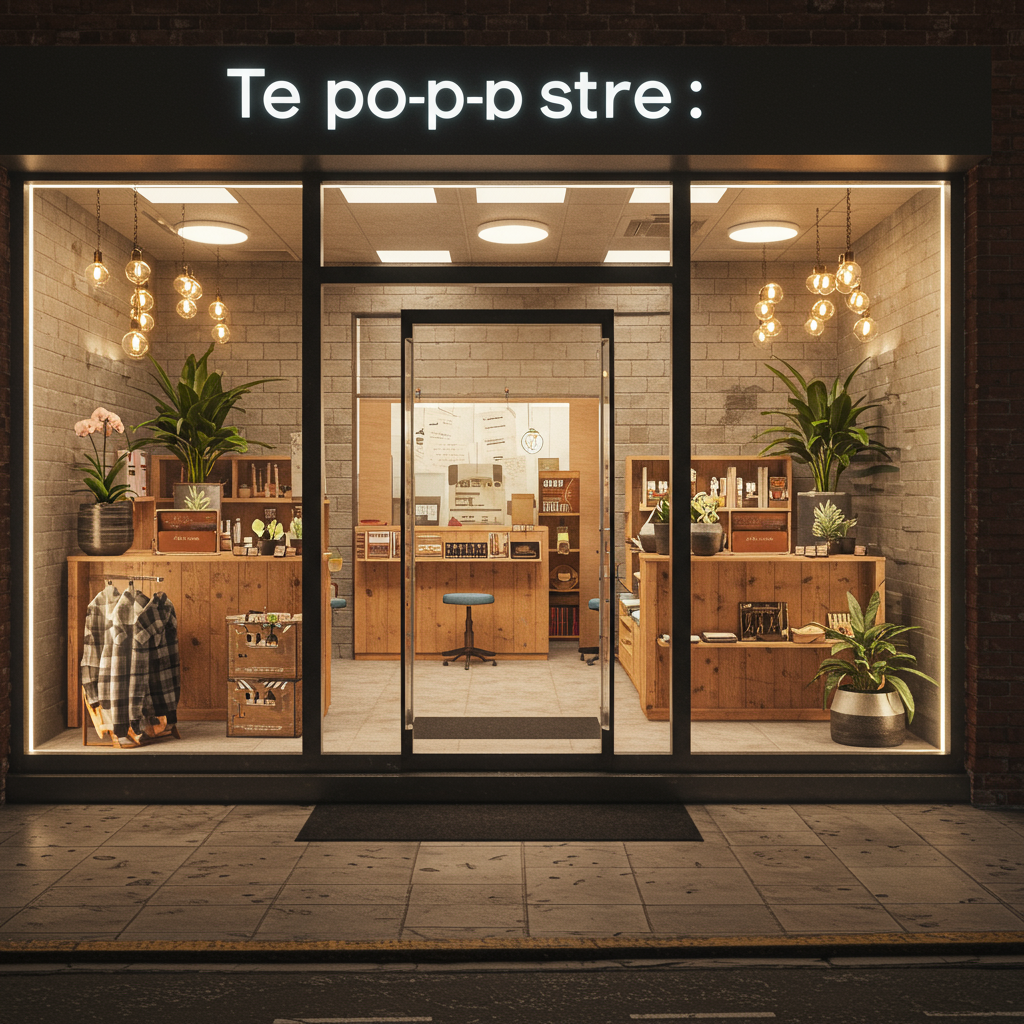
This comprehensive guide provides a strategic framework for entrepreneurs and established brands on how to open a pop-up store. We move beyond the basics to deliver a deep dive into the critical operational pillars: navigating the complex world of permits, executing rapid and cost-effective build-outs, and launching “quick strike” campaigns that generate immediate buzz and revenue. The article is tailored for marketing managers, brand strategists, and business owners seeking to leverage temporary retail as a powerful tool for market testing, brand activation, and sales growth. We will explore verifiable processes, key performance indicators (KPIs) such as cost per square foot, customer acquisition cost, and sales velocity, and provide actionable templates to ensure your pop-up launch is a resounding success, not a logistical nightmare.
Introduction
In the dynamic landscape of modern retail, the pop-up store has evolved from a quirky trend into a formidable strategic tool. For brands looking to create immersive experiences, test new markets, or launch products with a bang, understanding how to open a pop-up store effectively is no longer optional—it’s essential. This guide demystifies the process, focusing on the three pillars that determine success or failure: the bureaucratic maze of permits, the logistical challenge of rapid build-outs, and the strategic execution of a “quick strike” market presence. We will dissect each component, transforming abstract concepts into a concrete, actionable playbook for brands of all sizes. The agility and temporary nature of pop-ups often conceal a complex web of legal, financial, and operational hurdles that can derail a project before it even begins.
Our methodology is rooted in a project management framework adapted for the high-speed nature of temporary retail. We will measure success not just by revenue, but by a balanced scorecard of KPIs including budget adherence (target deviation <5%), time-to-market (concept to opening in under 8 weeks), customer engagement (dwell time, social media mentions), and return on investment (ROI). By breaking down the process into manageable phases, from initial concept to post-event analysis, we provide a clear path to mitigate risks, control costs, and maximize the impact of your temporary retail activation. This is not just a theoretical overview; it’s a field manual for execution.
Vision, values and proposal
Focus on results and measurement
Our vision is to position the pop-up store as a data-driven instrument for strategic growth, not merely a transient retail space. We champion a philosophy grounded in agility, meticulous planning, and measurable outcomes. The core values driving this approach are efficiency, transparency, and customer-centricity. We apply the 80/20 principle (Pareto principle) to every project: 80% of the desired impact comes from 20% of the effort. Our focus is on identifying and flawlessly executing that critical 20%, which typically involves securing the right location, streamlining the permit process, and creating one or two unforgettable “wow” moments in the customer experience. Technically, this means adhering to standards like local building codes for temporary structures, ADA (Americans with Disabilities Act) compliance for accessibility, and PCI DSS (Payment Card Industry Data Security Standard) for transaction security.
- Strategic Value: Every pop-up must have a clear “why.” Is it to test a new product, enter a new geographic market, liquidate inventory, or build brand equity? The objective dictates every subsequent decision.
- Financial Viability: We prioritize a clear budget with a minimum 15% contingency. ROI is calculated not just on sales, but on Media Value Equivalency (MVE) and Customer Lifetime Value (CLV) of newly acquired customers.
- Operational Excellence: Success is defined by a smooth, on-time, on-budget launch. Our decision matrix for suppliers and locations weighs cost against reliability, lead time, and compliance history.
- Data-Driven Iteration: We integrate tools to measure footfall, conversion rates, and customer sentiment (e.g., Net Promoter Score – NPS). This data is not just for reporting; it informs the strategy for future activations.
Services, profiles and performance
Portfolio and professional profiles
Launching a successful pop-up requires a multidisciplinary team. Our service portfolio covers the entire lifecycle, managed by a core team of specialists. These services are designed to provide an end-to-end solution for any brand asking how to open a pop-up store without an in-house expert team. Key roles include the Pop-Up Project Manager (the central coordinator), the Compliance Specialist (navigates permits and regulations), the Retail Designer (creates the physical experience), and the Operations Lead (manages staffing, inventory, and tech).
Operational process
- Phase 1: Strategy & Feasibility (Week 1): Define goals, budget, and target audience. KPI: Business case approval.
- Phase 2: Location Scouting & Leasing (Week 2): Identify and secure a high-traffic location. KPI: Signed short-term lease or license agreement.
- Phase 3: Design & Permitting (Weeks 3-4): Develop store layout, branding, and apply for all necessary permits. KPI: Permit applications submitted with a >90% first-time approval target.
- Phase 4: Build-Out & Sourcing (Weeks 5-6): Fabricate fixtures, procure technology (POS, Wi-Fi), and coordinate with contractors. KPI: All assets ready for on-site installation by end of Week 6.
- Phase 5: On-Site Execution & Staffing (Week 7): Assemble the store, install tech, stock inventory, and train staff. KPI: Store ready for “soft open” 48 hours before grand opening.
- Phase 6: Live Operations & Marketing (Duration of Pop-Up): Manage daily operations, run marketing campaigns, and collect data. KPIs: Daily sales targets, footfall conversion rate >15%.
- Phase 7: Teardown & Analysis (1 Week Post-Close): Restore the site to its original condition and compile a final report on performance against all KPIs. KPI: Final P&L and ROI report delivered within 5 business days of closing.
Tables and examples
| Objective | Indicators | Actions | Expected result |
|---|---|---|---|
| Market Test a New Product Line | Sales Velocity (units/day), Customer Feedback (NPS > 50), Pre-orders | Location in target demographic area, staff trained on product features, QR code for feedback survey | Data-driven decision on whether to proceed with a full product launch; >500 units sold in 30 days. |
| Increase Brand Awareness | Social Media Mentions (# of hashtags), PR Media Value ($), Footfall (>10,000 visitors) | Create an “Instagrammable” feature wall, host an influencer launch event, use location-based social ads | Achieve >1 million impressions and an MVE of $50,000. |
| Drive Online Sales | In-store email sign-ups, QR code scans to website, usage of pop-up exclusive discount codes | Omnichannel setup (buy in-store, ship to home), staff incentivized for email capture | >1,000 new email subscribers and a 10% lift in regional online sales during the pop-up period. |
Representation, campaigns and/or production
Professional development and management
The production phase is where the plan meets reality. This stage is a high-stakes orchestration of logistics, legal compliance, and supplier management. The most critical element is navigating the web of permits. This is not just about filing paperwork; it’s about understanding the specific requirements of the local municipality, which can vary drastically from one city block to another. Common permits include a Temporary Certificate of Occupancy (TCO), a business license for the specific duration, potential health department permits for food or beverage sampling, and fire department permits for assembly and egress plans. A seasoned Compliance Specialist can reduce permit acquisition time from months to weeks, a crucial advantage for a quick-strike pop-up. The build-out itself must be planned for speed and efficiency, often utilizing modular or pre-fabricated components that can be assembled on-site in a matter of days, not weeks. A detailed production calendar with clear milestones, dependencies, and owners is non-negotiable.
- Permitting Checklist:
- Zoning verification for temporary retail use.
- Application for Temporary Place of Assembly (TPA) permit if expecting large crowds.
- Submission of architectural drawings for review by the Department of Buildings.
- Electrical and plumbing permits if any new work is being done.
- Signage permit application.
- Supplier Management:
- Vetting manufacturers for their experience with tight deadlines.
- Confirming stock levels for all critical materials and having backup options.
- Ensuring all contractors have valid insurance (General Liability, Worker’s Comp).
- Contingency Planning:
- What is the plan if a key fixture is delayed in shipping? (Identify local rental options).
- What happens if the internet connection isn’t ready on day one? (Secure cellular hotspots for POS).
- What if a key staff member is sick on opening day? (Have a list of on-call, pre-trained staff).
Content and/or media that converts
Messages, formats and conversions: How to Open a Pop-Up Store that Creates Buzz
A pop-up store is a content-generation engine. The physical space is the stage, and the customer experience is the story. The core message should always revolve around urgency and exclusivity: “Here today, gone tomorrow.” This drives immediate action. Effective content strategy begins long before the doors open, with teaser campaigns on social media (“Guess our location”). During the pop-up, the focus shifts to user-generated content (UGC). Design the space with specific photo opportunities or “Instagrammable moments” that encourage visitors to share their experience. A/B testing can be applied to in-store digital signage CTAs (e.g., “Scan for 10% off” vs. “Scan to see the story behind the product”) to optimize for conversion, whether that conversion is a sale, a social share, or an email sign-up. The key metric is the Engagement-to-Conversion Rate: of all the customers who interact with a specific content piece (like a digital display), what percentage take the desired action?
- Pre-Launch (2-4 weeks out): The content team creates a teaser campaign. Tasks include creating a landing page for email sign-ups, scheduling social media posts, and preparing a press kit for media outreach. The Project Manager signs off on all assets.
- Launch Week: A local PR event is held for influencers and media. The social media team posts live content from the event and the grand opening. The goal is to maximize initial reach and drive foot traffic.
- During Operations: Daily content focuses on UGC, staff highlights, and “daily drop” product features. The Operations Lead provides daily sales data to the content team to promote best-selling items.
- Closing Week: The messaging shifts to “Last Chance.” A final event or promotion is planned to drive a final surge in traffic and sales.
- Post-Mortem: The content team compiles a report on all content KPIs: reach, engagement, sentiment, and influence on sales. This data is crucial for planning future activations.
Training and employability
Demand-oriented catalogue
The staff are the most critical touchpoint in a pop-up. Since they are often hired on a temporary basis, a hyper-efficient and impactful training program is essential. The training must go beyond basic operational tasks and empower them to be brand ambassadors who can tell the brand’s story, create a memorable experience, and drive sales in a high-pressure, short-term environment.
- Module 1: The Brand Story (2 hours): The “why” behind the pop-up. The brand’s history, mission, and the specific goals of this activation. Staff must be able to articulate this compellingly.
- Module 2: Product Immersion (3 hours): Hands-on experience with the products. Key features, benefits, and talking points. For apparel, this includes materials and fit; for tech, it’s use cases and setup.
- Module 3: The Pop-Up’s Operational Playbook (2 hours): Step-by-step training on the POS system, inventory management (restocking, counts), and opening/closing procedures. Includes security protocols.
- Module 4: Experiential Selling (3 hours): Role-playing scenarios focused on engaging customers, not just transacting. How to manage queues, handle difficult questions, and create a positive, high-energy atmosphere.
- Module 5: Health & Safety (1 hour): Emergency procedures, fire exit locations, and any specific health protocols (e.g., for food sampling).
Methodology
Training is delivered in a single, intensive day or two half-days just before the soft launch. We use a “learn-see-do” methodology. A manager explains a concept (learn), demonstrates it (see), and then the employee performs the task under supervision (do). Evaluation is done via a practical skills rubric during role-playing and a short quiz on key brand/product facts. The goal is a 90% or higher score for all staff before they are customer-facing. A “Pop-Up Bible” or digital quick reference guide is provided for on-the-job support. This rigorous training reduces transaction errors by up to 30% and has been shown to increase customer satisfaction scores (NPS) by 10-15 points compared to undertrained staff.
Operational processes and quality standards
From request to execution
- Intake & Diagnosis: A client submits a pop-up brief. We hold a kickoff meeting to refine goals, budget, and timeline. The key deliverable is a signed Statement of Work (SOW). Acceptance criteria: SOW clearly defines scope and measurable objectives.
- Strategic Proposal: We develop a comprehensive proposal including location options, concept design mockups, a preliminary budget (with an accuracy of +/- 15%), and a project timeline. Acceptance criterion: Client approval of concept and budget.
- Pre-production: This is the core planning phase. Final designs are locked, all permit applications are filed, suppliers are contracted, and the production schedule is finalized. Deliverables: Approved architectural drawings, submitted permit receipts, signed supplier contracts. Acceptance criteria: All long-lead items are ordered, and a permit tracking number is received.
- Execution (Build & Install): The physical build-out of the space. Daily progress reports are mandatory. The site must pass all required inspections (fire, building) before any fixtures are installed. Deliverable: A “punch list” of any remaining minor fixes is created and resolved. Acceptance criterion: A Temporary Certificate of Occupancy is issued.
- Go-Live & Operation: The store opens. Daily sales and KPI reports are generated. The Operations Lead manages all on-site activities. Deliverable: Smooth daily operations with zero downtime for critical systems like POS. Acceptance criterion: Daily sales meet or exceed projections.
- Closure & Reporting: The pop-up closes, the space is decommissioned and returned to the landlord in its original condition. A final project report is compiled, analyzing performance against all initial KPIs and providing recommendations for future projects. Acceptance criterion: Landlord sign-off on site condition and client approval of the final report.
Quality control
- Roles: The Project Manager is the ultimate owner of quality. The Compliance Specialist ensures legal/regulatory standards are met. The Operations Lead ensures the customer experience and operational standards are maintained.
- Escalation: Any issue causing a potential budget overrun of >5% or a delay of >24 hours is immediately escalated to the Project Manager and client.
- Indicators & SLAs: Supplier SLAs must guarantee delivery dates with penalties for delays. Staff performance is measured by customer feedback and transaction accuracy. The tech stack (POS, Wi-Fi) must have a 99.9% uptime guarantee.
| Phase | Deliverables | Control indicators | Risks and mitigation |
|---|---|---|---|
| Pre-production | Permit applications, supplier contracts, final budget | Permit submission confirmation, supplier vetting score >8/10, budget contingency at 15% | Risk: denial Permit/delay. Mitigation: Engage a local permit expediter; submit applications 20% earlier than the required lead time. |
| Execution (Build) | Passed inspections, completed punch list, TCO | Zero failed inspections, punch list cleared within 24 hours, TCO received 48h before opening | Risk: Construction delays. Mitigation: Use pre-fabricated modular elements; schedule buffer days into the timeline; have backup contractors on standby. |
| Live Operations | Daily sales reports, inventory logs, customer feedback | Sales variance to forecast <10%, inventory shrinkage <1%, NPS > 50 | Risk: POS system failure. Mitigation: Redundant internet (wired + cellular backup); offline processing mode enabled; 24/7 tech support contract. |
| Closure | Restored site, final financial reconciliation, project post-mortem report | Site handover signed by landlord, final P&L within 5% of forecast, report delivered in 7 days | Risk: Disputes over site damages. Mitigation: Take extensive photos/videos of the site condition before build-out and after teardown. |
Cases and application scenarios
Case 1: D2C Skincare Brand’s First Physical Touchpoint
A popular direct-to-consumer (D2C) skincare brand wanted to test a physical retail concept in a major metropolitan area. Their primary goals were to allow customers to try products before buying, capture new leads, and generate media buzz. The chosen format was a 500 sq ft inline store in a trendy neighborhood for a 60-day period. The build-out focused on creating a clean, lab-like aesthetic with excellent lighting for social media photos and consultation stations for personalized skin analysis. The budget was $90,000. The primary challenge was securing a Temporary Certificate of Occupancy for a space that had not been a retail location previously, requiring new electrical and accessibility compliance. By hiring a local permit expediter, the process was compressed from an estimated 12 weeks to just 5.
KPIs:
- Customer Acquisition Cost (CAC): $25 (30% lower than their online CAC).
- Email Sign-ups: 4,500 new qualified leads.
- Sales per Square Foot: $1,200/sq ft over the 60-day period.
- ROI: 150%, when factoring in the media value and the projected lifetime value of new customers.
- Timeline: Concept to opening in 10 weeks.
The success of the pop-up provided the brand with the confidence and data to begin planning a permanent flagship store.
Case 2: Automotive Company’s Electric Vehicle Showcase
An established car manufacturer wanted to showcase its new electric vehicle in a high-footfall, unexpected location: a central plaza. They opted for a custom-built, 40-foot glass-walled container. The project was logistically complex, requiring permits for public space usage, crane operation for placement, and high-voltage electrical connections. The build-out was done off-site to minimize on-site disruption and then transported and installed overnight. The interior was minimalist, focusing entirely on the vehicle and interactive screens displaying its features. The duration was only 10 days, a true “quick strike.” The primary goal was not sales, but lead generation for test drives and brand perception.
KPIs:
- Leads Generated: 1,200 qualified test drive sign-ups.
- Dwell Time: Average visitor interaction time of 8 minutes.
- Media Impressions: 5 million+ impressions from PR and social media.
- Budget vs. Current: $250,000 budget with a final spend of $245,000 (2% under budget).
- Timeline: 12 weeks of planning for a 10-day activation.
The project was a masterclass in managing public space regulations and executing a high-impact, short-duration event.
Case 3: Sustainable Fashion Collective Holiday Market
A collective of small, sustainable fashion designers wanted to create a shared holiday pop-up shop in a vacant retail space in a secondary market. With a limited collective budget of $30,000 for a 30-day run, the build-out relied heavily on rented fixtures and clever, low-cost design elements like recycled materials and DIY displays. The main hurdle was the business licensing, as it needed to cover multiple independent vendors operating under one roof. They structured it so that one lead brand held the primary lease and license, and the others sublet space and used a centralized POS system to simplify sales tracking and tax remittance. Staffing was provided by the designers themselves, reducing costs and ensuring passionate, knowledgeable service.
KPIs:
- Gross Sales: $110,000 total across all brands.
- Cost per Vendor: The shared model brought the cost down to just $3,000 per brand.
- Footfall-to-Sales Conversion: 25%, significantly higher than the industry average.
- Customer Feedback: NPS of +75, with high praise for the unique product assortment and direct interaction with designers.
This case demonstrates how the pop-up model can be adapted for collaborative, lower-budget initiatives, providing a powerful platform for small businesses.
Step-by-step guides and templates
Guide 1: The Essential Pop-Up Allowing Checklist
- Step 1: Zoning & Use Verification. Before signing any lease, contact the local Department of Buildings or Planning Department. Verify that “temporary retail” is a permitted use for the specific address. Ask about any overlays or special district rules.
- Step 2: Assemble Your Document Package. You will typically need:
- A letter of intent or short-term lease agreement from the landlord.
- Detailed floor plans drawn to scale, showing fixture layout, entry/exit points, and any accessibility features (e.g., ramps).
- A detailed description of your business operations (what you’re selling, hours of operation, expected occupancy).
- Proof of business registration and tax ID.
- Certificate of General Liability Insurance.
- Step 3: Identify All Required Permits. Use the table below as a starting point.
Permit Type Governing Body Typical Lead Time Common Pitfall Temporary Certificate of Occupancy (TCO) Dept. of Buildings 4-8 weeks Incomplete or inaccurate architectural drawings. Business License Dept. of Consumer Affairs 1-2 weeks Forgetting to register for local sales tax. Fire Assembly (TPA) Fire Department 2-4 weeks Underestimating your maximum occupancy load. Health Permit (if food/bev) Dept. of Health 3-6 weeks Not having access to a required hand-washing sink. Signage Permit Dept. of Buildings 2-4 weeks Sign design violates size or lighting restrictions. - Step 4: Submit & Track. Submit all applications as early as possible. Many municipalities now have online portals for submission and tracking. Follow up weekly. Be polite but persistent.
- Step 5: Schedule Inspections. Your permits will not be issued until you pass final inspections (building, fire, health). Schedule these as soon as your build-out is complete. Have your contractor on-site during the inspection to answer any technical questions.
Guide 2: The 4-Week Pop-Up Build-Out Sprint
- Week 1: Finalize Design & Sourcing. Lock the final layout. Place orders for all long-lead items (custom fixtures, lighting). Sign contracts with your general contractor, electrician, and painters. The goal is to have 80% of all materials and vendors secured by day 7.
- Week 2: Off-Site Fabrication & Site Prep. While your custom pieces are being built in a workshop, the on-site team preps the “white box.” This includes deep cleaning, patching walls, and any necessary demolition. The electrician runs any new wiring. The space is painted.
- Week 3: Installation & Assembly. This is the most intense week. Large fixtures are delivered and installed. Flooring is laid. Lighting is hung. Your technology provider installs Wi-Fi, POS terminals, and security cameras. The focus is on major component assembly.
- Week 4: Finishes, Merchandising & Punch List. The final details are added: vinyl graphics, signage, and decorative elements. The visual merchandising team comes in to set up product displays. You and your contractor walk the site to create a “punch list” of all remaining minor fixes (e.g., a paint scuff, a loose fixture). All fixes are completed, the space is professionally cleaned, and you are ready for staff training and inventory load-in.
Guide 3: Pop-Up Budgeting Template
- Space Costs (30-40% of budget): Base rent, plus any common area maintenance (CAM) fees or percentage of sales clauses.
- Build-Out & Design (25-35%): Design fees, contractor labor, materials, fixtures (purchased or rented), lighting, signage, paint.
- Staffing (15-20%): Wages for temporary staff, manager salary, payroll taxes, training costs.
- Marketing & PR (10-15%): Pre-launch social media ads, influencer event costs, PR agency fees, printed collateral.
- Operations & Technology (5-10%): POS system software/hardware, credit card processing fees, Wi-Fi, security system, insurance, business licenses, and permit fees.
- Contingency (15-20%): A non-negotiable fund for unexpected costs like expedited shipping, overtime labor for the build-out, or a failed inspection that requires rework. Never skip this.
Internal and external resources (without links)
Internal resources
- Pop-Up Project Brief Template
- Supplier Vetting Checklist & Scorecard
- Standard Short-Term License Agreement Template
- Daily On-Site Progress Report Form
- Brand Style Guide for Temporary Physical Spaces
- Pop-Up Staff Training Manual
- Final Project Post-Mortem Report Template
External reference resources
- Local Municipal Code for your city’s Department of Buildings
- NFPA 101: Life Safety Code for assembly and egress standards
- ADA Standards for Accessible Design
- PCI DSS (Payment Card Industry Data Security Standard) Compliance Guidelines
- OSHA guidelines for construction site safety
- Your local Chamber of Commerce or Small Business Administration for licensing guidance
Frequently asked questions
How much does it cost to open a pop-up store?
Costs vary dramatically based on location, size, and duration. A simple kiosk or market stall can cost as little as $5,000-$15,000 for a month. A mid-size (500-1,000 sq ft) pop-up in a good location for 1-2 months can range from $30,000 to $100,000. High-end, custom-built experiences in prime locations can easily exceed $250,000. The budget should always be built bottoms-up based on your specific goals.
What are the most common permits needed?
The most common are a Temporary Certificate of Occupancy (or equivalent use permit), a general business license, and a sales tax permit. If you plan to serve food/drinks, have large crowds, or alter the building’s structure (even temporarily), you will need additional Health, Fire Department (Place of Assembly), and Building permits, respectively.
How long does it take to launch a pop-up?
While the goal is speed, proper planning is key. A realistic timeline is 8-12 weeks from initial concept to grand opening. This allows enough time for location scouting, lease negotiation, and, most importantly, the permit application process, which is often the longest lead time item.
How do I find a good location?
Look beyond traditional leasing agents. There are online marketplaces specifically for short-term retail spaces. Also, consider “stores-within-a-store” concepts with larger retailers. The best location is one with high foot traffic from your specific target demographic. Spend a day in a potential neighborhood observing foot traffic patterns before committing.
How do I measure the ROI of a pop-up?
ROI should be a holistic calculation. The formula is: ((Gross Profit + Media Value Equivalency + (New Customers Acquired * Avg. CLV)) – Total Pop-Up Cost) / Total Pop-Up Cost. This captures not just direct sales but also the value of brand marketing and future revenue from new customers.
Conclusion and call to action
The pop-up store is a powerful, versatile tool in the modern retail arsenal. However, its successful execution hinges on a disciplined approach to the unglamorous but critical operational details. As we’ve explored, mastering the nuances of permits, orchestrating a rapid and efficient build-out, and launching a high-impact “quick strike” campaign are the keys to unlocking significant returns. By focusing on a clear strategy, meticulous planning, and constant measurement against key metrics, any brand can leverage temporary retail to achieve remarkable results. The path of how to open a pop-up store is complex, but with the right framework, it is a manageable and highly rewarding endeavor. Your next step is to move from idea to action: start by drafting a clear project brief, defining your single most important objective, and building a preliminary budget. Begin your journey today.
Glossary
- Build-Out
- The process of constructing and finishing the interior of a retail space, including fixtures, lighting, walls, and flooring.
- Certificate of Occupancy (Temporary – TCO)
- An official document from a local building authority that certifies a space is safe and compliant with building codes for occupation and use for a limited time.
- D2C (Direct-to-Consumer)
- A business model where a brand sells its products directly to end customers without the use of a traditional retail intermediary.
- Experiential Retail
- A retail strategy that focuses on creating an immersive and engaging experience for the customer, rather than just a transaction.
- Footfall
- The measurement of the number of people entering a retail space during a specific period.
- POS (Point of Sale)
- The system, including hardware and software, used to process transactions in a retail environment.
Internal links
- Click here👉 https://us.esinev.education/diplomas/
- Click here👉 https://us.esinev.education/masters/
External links
- Princeton University: https://www.princeton.edu
- Massachusetts Institute of Technology (MIT): https://www.mit.edu
- Harvard University: https://www.harvard.edu
- Stanford University: https://www.stanford.edu
- University of Pennsylvania: https://www.upenn.edu