
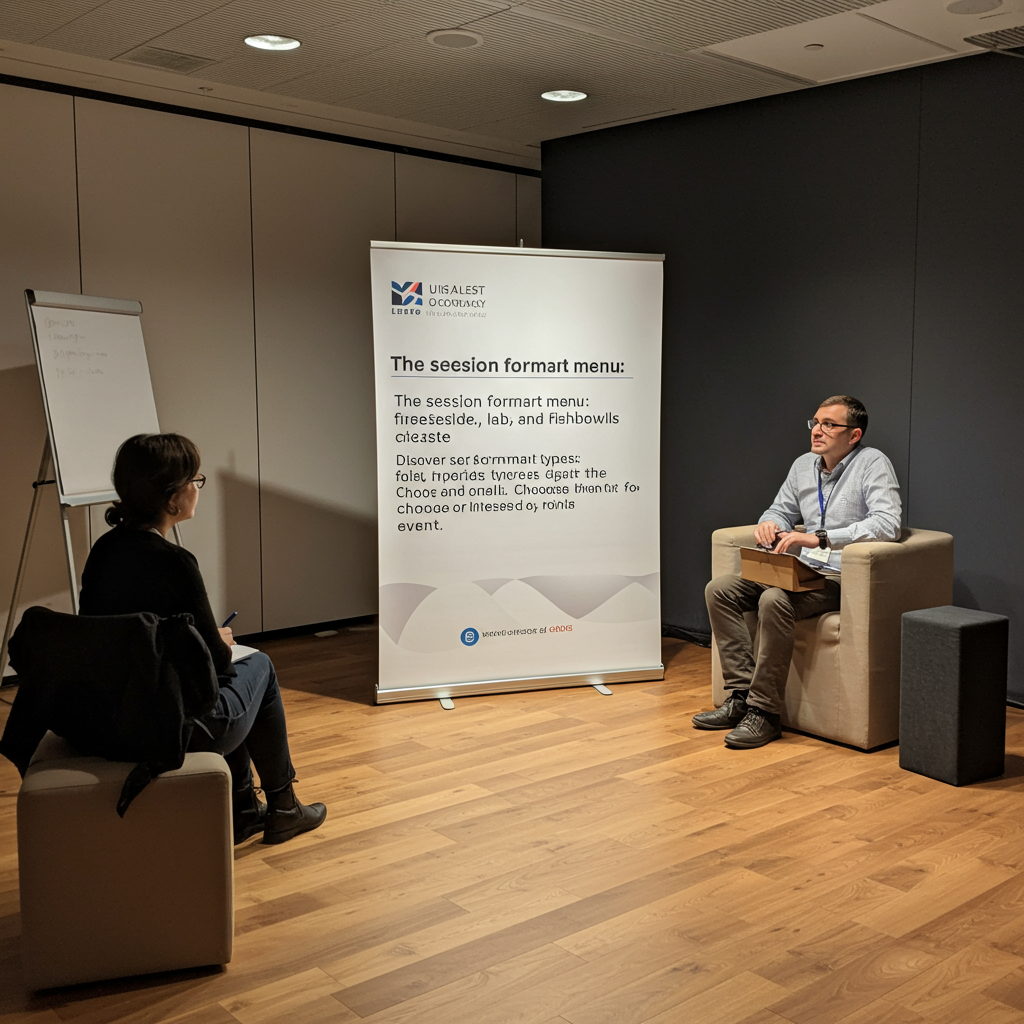
This definitive guide explores the strategic selection and implementation of modern, interactive session format types. Moving beyond the traditional lecture, we delve into the mechanics, benefits, and key performance indicators (KPIs) of Fireside Chats, Labs, and Fishbowls. This article is designed for event planners, corporate trainers, community managers, and facilitators seeking to increase engagement, foster genuine dialogue, and generate measurable outcomes. Readers will gain access to detailed operational processes, real-world case studies, and step-by-step guides to effectively design and execute sessions that resonate with participants. Key metrics covered include Net Promoter Score (NPS), engagement rates, idea generation velocity, and post-session knowledge retention, ensuring a tangible return on investment for any event or workshop.
Introduction
In the modern landscape of conferences, workshops, and corporate meetings, the era of passive listening is over. Audiences demand interaction, genuine connection, and tangible takeaways. The key to unlocking this value lies not just in the content delivered, but in the structure that holds it. Choosing the right tool for the job is paramount, and this is where a deep understanding of different session format types becomes a strategic advantage. This article serves as a comprehensive menu, moving beyond the monolithic keynote to explore dynamic formats like the intimate Fireside Chat, the hands-on Lab, and the participatory Fishbowl. By mastering these structures, organizers can transform passive attendees into active contributors, fostering an environment of co-creation and shared discovery.
Our methodology focuses on a results-oriented approach to session design. We will dissect each format through the lens of its core objective, ideal audience size, logistical requirements, and, most importantly, its potential for measurable impact. Success will be quantified through a blend of qualitative and quantitative KPIs, including audience engagement metrics (e.g., questions asked per minute, participant contribution ratio), post-session feedback via Net Promoter Score (NPS), and objective-based outcomes like the number of viable ideas generated in a lab or the percentage of participants reporting increased understanding of a complex topic after a fishbowl discussion. This framework ensures that the choice of a session format is not an afterthought but a deliberate, data-informed decision designed to achieve specific business or community goals.
Vision, values and proposal
Focus on results and measurement
Our vision is to elevate every gathering from a simple information transfer to a transformative experience. We believe that the right session structure can break down hierarchies, amplify quiet voices, and accelerate problem-solving. Our core value is purpose-driven design: we begin with the end in mind. Applying the 80/20 principle, we focus 80% of our design effort on the 20% of interactions that will generate the most significant impact. This means prioritizing psychological safety, clear instructions, and well-defined outcomes over superficial flair. Our technical standards are rooted in principles of adult learning theory and group dynamics, ensuring that every format choice is grounded in evidence of what truly works to engage the human mind.
- Fundamental Value: The purpose dictates the format. We never choose a format because it’s trendy; we select it because it is the most effective vehicle for the desired outcome (e.g., a Fireside Chat for authenticity, a Lab for innovation, a Fishbowl for democratizing dialogue).
- Quality Criterion: Participation is the metric. A successful session is not measured by the eloquence of the speaker, but by the quality and quantity of audience participation. We aim for a participation rate of at least 60% in interactive formats.Decision Matrix: Our proposal process involves a simple matrix:
What is the main objective? (Inform, debate, create, decide)
What is the size and composition of the audience? (Experts, novices, mixed)
What are the time and space constraints? (60 minutes, 3 hours, virtual, in-person)
What is the desired level of interaction? (Low, moderate, high)
Commitment to Inclusion: We actively design formats that mitigate common biases, such as the tendency for the same few people to dominate a conversation. Formats like the Fishbowl are explicitly chosen to create space for diverse perspectives.
Services, profiles and performance
Portfolio and professional profiles
We offer a full suite of session design and facilitation services, tailored to corporate, non-profit, and academic clients. Our core offerings are built around the strategic implementation of various session format types. Our team consists of experienced facilitators, instructional designers, and event producers who work collaboratively to ensure seamless execution. Profiles range from Senior Facilitators with over 10 years of experience managing large-group dynamics to Production Coordinators who handle all logistical aspects, ensuring the environment is perfectly set for interaction.
Operational process
- Phase 1: Discovery and Diagnosis (1 week). We conduct stakeholder interviews to define clear, measurable objectives for the session. KPI: Mutual understanding of success metrics, signed off by the client.
- Phase 2: Format Design (1-2 weeks). Our team proposes a primary session format and potential variations, complete with a detailed agenda, run-of-show, and resource plan. KPI: Client approval of the proposed design with a confidence score of >90%.
- Phase 3: Pre-Production and Preparation (2-4 weeks). This includes speaker/moderator coaching, creation of materials (worksheets, slides), and technical setup. KPI: All assets delivered and tested 72 hours before the event; speakers report a preparedness level of 5/5.
- Phase 4: Execution and Facilitation (Day of the event). On-site or virtual delivery of the session, managed by our lead facilitator and support team. KPI: Adherence to the run-of-show with a time deviation of <5%.
- Phase 5: Measurement and Closure (1 week post-event). We collect and analyze feedback, measure against initial KPIs, and deliver a comprehensive post-event report with actionable insights. KPI: Delivery of final report within 5 business days, achieving a client NPS of >50.
Charts and Examples
Prepare questions tailored to the audience.The audience perceives leadership as more accessible and human, increasing internal trust.Generate innovative solutions to a business problem.Number of viable ideas generated > 10; Active participation rate > 85%.Implement a 3-hour “Innovation Lab” with multidisciplinary teams and a Design Thinking framework.A portfolio of 3-5 solution prototypes with a clear action plan for further development.Facilitate a complex and polarized debate constructively.Reduction of negative sentiment in post-session surveys by 20%. 70% of participants report having understood an opposing perspective.Use the “Fishbowl” format to structure the conversation, with a moderator trained in mediation.De-escalate the conflict and create a basis for future dialogue, with points of agreement identified.
| Objective | Key Performance Indicators (KPIs) | Session Design Actions | Expected Outcome |
|---|---|---|---|
| Increase authenticity and connection with leadership. | Event NPS > 60; Speaker Authenticity Rating > 4.5/5. | Design a “Fireside Chat” session instead of a lecture. |
Representation, campaigns and/or production
Professional development and management
The production of a high-impact session goes far beyond choosing a format; it requires meticulous logistical planning and execution. Our production management services cover every detail, from venue selection and room layout to technology sourcing and supplier coordination. For a Fireside Chat, this might mean sourcing comfortable chairs and appropriate lighting to create intimacy. For a Lab, it involves procuring all necessary materials like whiteboards, sticky notes, and prototyping tools. We manage the entire lifecycle, ensuring that the physical or digital environment perfectly supports the session’s objectives. Our process includes robust contingency planning to mitigate risks such as technology failure or speaker unavailability.
- Critical Logistics Checklist:
- Space: Does the seating arrangement align with the format (circles for Fishbowl, groups for Labs)? Is there enough room for movement? Is the acoustics adequate (noise level < 55 dB)?
- Technology: Microphones (handheld, lapel), projectors/screens, stable internet connection (>100 Mbps), virtual platforms with breakout rooms, real-time voting tools. Plan B for each critical technology component.
- Materials: Complete inventory of all necessary supplies (markers, sticky notes, flip charts, manuals) verified 24 hours prior. Stock alternatives for key consumables.
- Staff: Clearly defined roles and responsibilities for the facilitator, moderator, technical support, and registration staff. Established communication channels (e.g., walkie-talkies, Slack channel).
- Contingency Plans:
- Main Speaker Failure: A trained moderator to turn the session into an interactive workshop or debate with the audience.
- Wi-Fi Network Failure: Printed backup materials; A plan for manually collecting data/feedback.
- Low participation: Facilitator strategies for merging groups or adapting exercises for a smaller number of people without losing energy.
Content and/or media that convert
Messages, formats, and conversions: adapting content to session format types
Content is not format-agnostic; They must be designed in symbiosis. A message that works like a lecture will fail in a Lab if it isn’t reframed as a challenge or a problem to solve. Our content strategy focuses on conversion, where “conversion” can mean transforming doubt into belief, passivity into action, or a prospect into a customer. For each format, we design specific hooks and calls to action (CTAs). For example, the CTA for a Fireside Chat might be “Share your own story,” while the one for a Lab is “Build your first prototype.” We conduct A/B tests on pre-event materials, such as invitation emails, to see which format description generates the highest sign-up rate. The key conversion metric is the “Post-Session Activation Rate”: the percentage of attendees who complete a specific action (e.g., joining a community, downloading a resource, signing up for a follow-up) within 48 hours of the event.
Content Briefing (Responsible: Instructional Designer): Define the 3-5 key learning or action points that participants should take away.
Content to Format Mapping (Responsible: Lead Facilitator): Break down each key point into an activity, discussion question, or story that aligns with the chosen session format. For example, a statistic becomes a poll question in a Fireside Chat or the starting point for an ideation challenge in a Lab.
- Asset Creation (Responsible: Content Creator): Develop all supporting materials: work guides, canvas templates, minimalist slides, moderator scripts. All assets are designed for interaction, not passive reading.
- Quality Review and Rehearsal (Responsible: Entire Team): Conduct a full simulation of the session to identify points of friction in the content flow and interaction. The time for each segment is measured to ensure the agenda is adjusted.
- Final Iteration (Responsible: Instructional Designer): Refine the assets and script based on feedback from the rehearsal. The goal is to reduce the cognitive load for participants by making instructions unambiguous and content easy to understand.
Training and employability
Demand-driven catalog
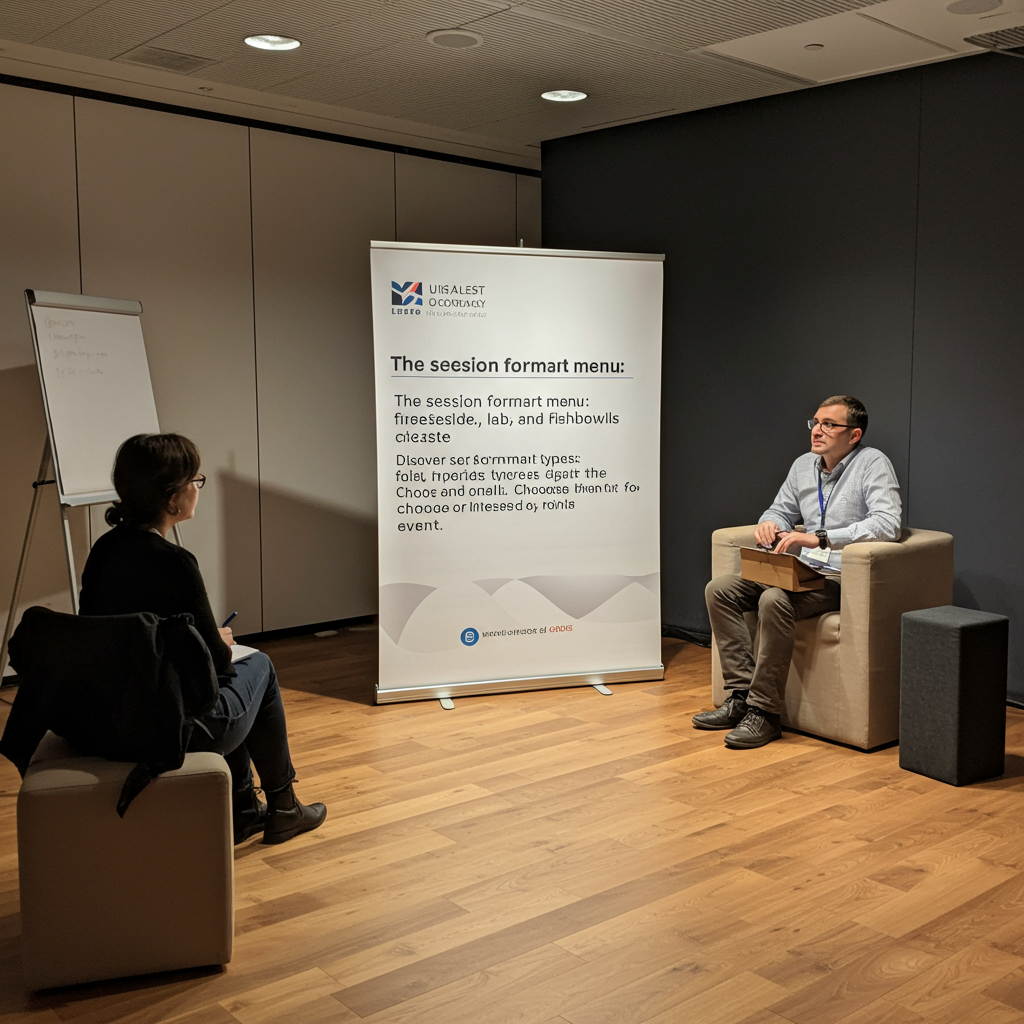
We offer training programs for internal teams to develop their own capabilities in Facilitation and session design. Our courses are designed to be practical, immersive, and directly applicable to real-world challenges. The goal is to improve participants’ employability by equipping them with highly sought-after communication and leadership skills.
-
- Module 1: Fundamentals of Interactive Session Design. Covers the psychology of participation, how to set clear objectives, and how to select the appropriate session format types from a decision matrix.
- Module 2: The Art of Moderating Fireside Chat. Techniques for building rapport, asking incisive yet respectful questions, managing time, and weaving audience questions naturally into the conversation.
- Module 3: Facilitating Innovation Labs. A practical guide to Design Thinking and Agile frameworks, managing small group dynamics, ideation and prototyping techniques, and how to converge toward actionable solutions.
- Module 4: Orchestrating a Fishbowl Debate. Advanced skills in managing difficult conversations, ensuring equal voice, active listening, and synthesizing divergent viewpoints. Includes practice in handling disruptive participants.Module 5: Virtual Facilitation and Digital Tools. Adapting interactive formats to the online environment using tools such as Mural, Miro, Mentimeter, and the advanced features of videoconferencing platforms.
Methodology
Our training methodology is “learning by doing.” Each module consists of 20% theory and 80% simulated practice. Participants take turns facilitating mini-sessions and receive structured feedback from their peers and the lead instructor. Assessment is conducted using a detailed rubric that evaluates competencies such as clarity of instructions, time management, inclusivity, and adaptability. At the end of the program, graduates have the option to join our job bank for junior facilitators or receive support to implement these techniques in their own organizations. We expect participants to increase their facilitation confidence score by an average of 70% from the beginning to the end of the course.
Operational Processes and Quality Standards
From Request to Execution
Our operational pipeline is designed to be transparent, efficient, and customer-centric. Each phase has clear deliverables and acceptance criteria to ensure alignment and avoid surprises.
Diagnosis (Phase 1):
Activity: Initial meeting (60 min) to understand the “why” of the event.
Deliverable: “Objectives Brief” document that defines the audience, SMART objectives, and success metrics.
Acceptance Criteria: Written approval of the brief by the client.
Proposal (Phase 2):
Activity: Internal brainstorming and development of a session concept.
Deliverable: Detailed proposal that includes 1-2 session format options types, a draft agenda, a preliminary budget, and biographies of the facilitation team.
Acceptance Criteria: Client selects an option and signs the service agreement.
Pre-production (Phase 3):
Activity: Weekly follow-up meetings, logistics coordination, speaker coaching, and materials development.
Deliverable: Completed “Event Roadbook” containing the detailed minute-by-minute run-of-show, scripts, floor plans, and contingency plans.
Acceptance Criteria: Successfully completed dress rehearsal with all speakers and key staff.
Execution (Phase 4):
- Activity: Conducting the event/session.
- Deliverable: A smooth and engaging session experience.
- Acceptance Criteria: Real-time data collection (polls, questions) and positive informal feedback.
- Post-event and Closure (Phase 5):
- Activity: Data analysis, feedback survey, internal recap meeting and meeting with the client.
- Deliverable: Impact report summarizing the results against the initial KPIs, feedback analysis, and recommendations for future events.
- Acceptance Criteria: Final acceptance of the report by the client and processing of the final invoice.
Quality Control
-
- Roles: A “Lead Producer” is assigned to each project as the single point of contact and ultimately responsible for quality. A “Lead Facilitator” is responsible for the quality of the room experience.
- Escalation: Any deviation from the plan with a potential impact of >10% on the budget or schedule is escalated to the Lead Producer within 2 hours.
- Service Level Agreements (SLAs):
- Response to client inquiries within <8 business hours.
- Delivery of draft documents at least 48 hours in advance of review meetings.
- Average session score on feedback surveys >4.2/5.0.
DiagnosisObjectives BriefClarity of defined KPIs; Stakeholder alignment.Risk: Vague objectives.Mitigation: Use the SMART framework to define each objective; do not proceed until the objectives are signed off.ProposalSession concept and budgetThe proposal directly addresses each objective in the brief; the budget has a clear breakdown.Risk: Mismatch between expectations and budget. Mitigation: Offer tiered options (Good, Better, Best) to provide flexibility.ClosureImpact ReportThe report clearly connects the results to the initial KPIs; the recommendations are specific and actionable.Risk: Difficulty in demonstrating ROI. Mitigation: Define ROI metrics in the diagnostic phase and collect relevant data throughout the process.
| Phase | Key Deliverables | Quality Control Indicators | Risks and Mitigation | ||||
|---|---|---|---|---|---|---|---|
| Pre-production | Event Roadmap | All roles have defined tasks; timings are calculated with a 15% buffer. | Risk: Unprepared speaker. Mitigation: Mandatory coaching sessions; provide clear talking points instead of a rigid script. | Execution | Live Experience | Active participation rate; Real-time feedback scores; Adherence to the schedule. | Risk: Technical failure. Mitigation: Dedicated on-site technical support; proven contingency plans for each critical system. |
Application Cases and Scenarios
Case 1: SaaS Product Launch with a Fireside Chat
Client: A mid-sized B2B software company. Scope: A virtual launch event for 500 potential and existing clients. Objective: Humanize the brand, showcase the vision behind the new product, and build trust, rather than delivering a technical demo. KPIs: Attendance rate > 40%, generate > 100 audience questions, achieve a “brand trust” score > 4.5/5 in the post-event survey, and obtain > 50 qualified demo requests. Timeframe: 6 weeks. ROI: The goal was to generate a €250,000 sales pipeline.
Development: A traditional slide presentation was discarded. Instead, we designed a 60-minute Fireside Chat with the company’s CEO and Head of Product, moderated by a freelance tech journalist. The script was structured around the product’s “why” story, the challenges encountered, and early customer stories. We used an event platform that allowed the audience to vote on each other’s questions, ensuring that the most popular ones were answered. The final 15 minutes were dedicated exclusively to questions from the live audience. The call to action was an exclusive offer for attendees. Results: An attendance rate of 48% was achieved. 215 questions were received during the session. The brand trust score was 4.7/5. 82 qualified demo requests were generated, resulting in an estimated pipeline of €410,000, exceeding the target by 64%.
Case 2: Interdepartmental Strategy Workshop with an Innovation Lab
Client: A regional hospital. Scope: A full-day, in-person workshop for 60 department heads (clinical and administrative). Objective: To break down departmental silos and co-create solutions to improve patient flow and reduce wait times. KPIs: Generate at least 5 pilot project plans with departmental sponsors, achieve an interdepartmental collaboration rate (measured by observed interactions) 50% higher than previous workshops, and obtain a “workshop usefulness” score > 4.6/5. Timeline: 8 weeks of planning.
Development: We designed a “Patient Journey Innovation Lab.” Participants were divided into 10 mixed teams, ensuring that each team had clinical and administrative representation. The day was structured following the Design Thinking framework: Empathize (reviewing patient testimonials), Define (identifying key pain points), Ideate (using the “Crazy Eights” technique), Prototype (creating flowcharts and communication plans), and Test (presenting the prototypes to a panel of managers). Each phase was timed and facilitated to maintain energy and focus. Results: Eight pilot project plans were developed, six of which received immediate sponsorship for implementation. The usefulness score was 4.8/5, and qualitative feedback overwhelmingly highlighted the value of structured collaboration. Three of the implemented pilots led to an average 15% reduction in wait times over the following six months.
Case 3: Community Conference on Urban Development in a Fishbowl Format
Client: A city council. Scope: A two-hour public meeting on a controversial redevelopment plan, with an expected attendance of 200 residents. Objective: To facilitate constructive dialogue, ensure residents’ concerns were heard by policymakers, and reduce the hostility that had characterized previous meetings. KPIs: At least 50% of the speeches were from members of the general public (not just well-known activists), interruptions were reduced by 80% compared to the previous meeting, and >60% of attendees reported feeling “heard” in the exit survey. Timeframe: 4 weeks.
Development: The room was set up in concentric circles. The inner circle (“fishbowl”) had 5 chairs: 2 for city council representatives, and 3 empty. Only people in the fishbowl could speak. Any resident from the outer circle could enter and take an empty chair to join the conversation. If all the chairs were taken, a newcomer had to wait for someone to leave voluntarily. A professional moderator established and maintained the rules of the conversation (e.g., no personal attacks, speaking from personal experience). Results: The format slowed down the conversation and raised the quality of the speeches. Más de 40 residentes diferentes hablaron, muchos por primera vez. Las interrupciones fueron casi nulas. El 72% de los asistentes reportaron sentirse escuchados. Aunque el desacuerdo sobre el plan persistió, la reunión concluyó con un acuerdo para formar un comité ciudadano-ayuntamiento, un resultado que parecía imposible anteriormente.
Guías paso a paso y plantillas
Guía 1: Cómo planificar y ejecutar un Fireside Chat perfecto
- Definir el Objetivo Estratégico: ¿Es para inspirar, informar, construir confianza o celebrar? El objetivo determinará el tono y el contenido.
- Seleccionar a los Participantes:
- Ponente(s): Elige a alguien con una historia que contar, no solo con un título. Debe ser alguien capaz de ser vulnerable y auténtico.
- Moderador: Crucial. No debe ser un subordinado. Lo ideal es un periodista, un analista de la industria o un facilitador profesional. Debe ser curioso, un buen oyente y capaz de mantener la conversación en curso.
- Investigación y Preparación (La fase más importante):
- El moderador debe investigar a fondo al ponente, más allá de su biografía oficial. Escuchar podcasts, leer entrevistas.
- Realizar una llamada de preparación de 30-45 minutos entre el moderador y el ponente. No para ensayar las respuestas, sino para establecer una buena relación, discutir los temas generales y establecer los límites.
- El moderador debe preparar un arco narrativo para la conversación: un comienzo atractivo, un nudo con algo de tensión o profundidad, y un final inspirador o con una llamada a la acción. Preparar 15-20 preguntas, sabiendo que solo se usarán 8-10.
- Diseñar el Entorno:
- Presencial: Dos sillas cómodas, una pequeña mesa auxiliar, buena iluminación, alfombra para mejorar la acústica. El fondo debe ser profesional pero no aburrido.
- Virtual: Ambos participantes deben tener una buena cámara, micrófono e iluminación. Utilizar fondos idénticos o complementarios si es posible para crear una sensación de espacio compartido.
- Estructurar la Sesión (Ejemplo de 60 minutos):
- 0-3 min: Bienvenida e introducción del moderador. Establecer el tono y presentar al ponente de forma personal.
- 3-20 min: Explorar los orígenes y el viaje del ponente. Preguntas sobre los primeros días, los desafíos y los aprendizajes.
- 20-40 min: Profundizar en el tema central de la charla. El “nudo” de la historia.
- 40-55 min: Integrar las preguntas de la audiencia. El moderador debe agrupar preguntas similares y tejerlas en la conversación.
- 55-60 min: Preguntas de cierre. Pedir una reflexión final, un consejo o una mirada al futuro. El moderador agradece y cierra.
- Checklist Final:
- [ ] ¿Se ha probado todo el equipo de audio y vídeo?
- [ ] ¿Tienen los ponentes un vaso de agua?
- [ ] ¿Está claro el proceso de recogida de preguntas de la audiencia?
- [ ] ¿Hay un cronómetro visible para el moderador?
- [ ] ¿Se ha desactivado el sonido de todos los teléfonos?
Guía 2: Plantilla de Agenda para un Innovation Lab de medio día (4 horas)
- (00:00 – 00:20) Bienvenida y Calentamiento:
- Introducción del facilitador.
- Explicación del desafío y las reglas del juego.
- Actividad rompehielos para fomentar la conexión en los equipos.
- (00:20 – 01:00) Fase de Empatía y Definición:
- Presentación de los datos/testimonios del problema.
- Los equipos discuten y definen el problema central desde la perspectiva del usuario usando la plantilla “How Might We…”.
- Cada equipo comparte su declaración del problema.
- (01:00 – 01:45) Fase de Ideación Divergente:
- Explicación de las reglas del brainstorming (ej. aplazar el juicio, fomentar las ideas locas).
- Ronda de ideación individual en silencio usando notas adhesivas.
- Puesta en común y agrupación de ideas por temas en el equipo.
- (01:45 – 02:00) Descanso.
- (02:00 – 02:30) Fase de Convergencia y Selección de Ideas:
- Los equipos utilizan la votación por puntos (dot voting) para seleccionar las 1-2 ideas más prometedoras.
- Discusión para refinar la idea seleccionada.
- (02:30 – 03:30) Fase de Prototipado:
- Los equipos utilizan materiales (papel, cartón, herramientas de wireframing digital) para crear una representación de baja fidelidad de su solución.
- Se centran en hacer la idea tangible y en cómo un usuario interactuaría con ella.
- Preparan una presentación de 3 minutos.
- (03:30 – 04:00) Presentaciones y Próximos Pasos:
- Cada equipo presenta su prototipo.
- Sesión de feedback rápido del resto de los grupos.
- Cierre del facilitador, resumiendo los logros y delineando los próximos pasos claros para llevar las ideas adelante.
Guía 3: Checklist de Moderación para una Sesión de Fishbowl
- Pre-Sesión:
- [ ] Confirmar que la disposición de la sala es correcta (círculos concéntricos).
- [ ] Preparar una diapositiva o rotafolio con las reglas de la conversación claramente visibles.
- [ ] Tener una pregunta inicial potente y abierta para empezar la conversación.
- [ ] Identificar a los “sembradores” iniciales para la pecera, si es necesario, para empezar con buen pie.
- Inicio de la Sesión:
- [ ] Dar la bienvenida y explicar el propósito de la sesión.
- [ ] Explicar el formato y las reglas del Fishbowl de forma muy clara y concisa. Enfatizar que el círculo exterior es para escuchar activamente.
- [ ] Invitar a los primeros participantes a la pecera y plantear la pregunta inicial.
- Durante la Sesión:
- [ ] Mantenerse neutral. Tu rol es hacer cumplir el proceso, no participar en el contenido.
- [ ] Proteger la pecera. Intervenir amablemente si alguien del círculo exterior intenta hablar.
- [ ] Fomentar la rotación. Si una persona ha estado en la pecera mucho tiempo, puedes decir: “Gracias por tus contribuciones, ¿te importaría dejar tu asiento libre para que alguien más pueda entrar?”.
- [ ] Gestionar el silencio. A veces el silencio es productivo. No te apresures a llenarlo.
- [ ] Sintetizar periódicamente. Cada 15-20 minutos, puedes pausar y decir: “Hagamos un resumen, hasta ahora he oído estos temas clave…”.
- [ ] Si la conversación se estanca, inyectar una nueva pregunta para reorientarla.
- Cierre de la Sesión:
- [ ] Avisar con 10 minutos de antelación que la sesión va a terminar.
- [ ] Pedir a los últimos participantes en la pecera una reflexión final o una conclusión clave.
- [ ] Abrir brevemente al círculo exterior para impresiones sobre el proceso (no sobre el contenido).
- [ ] Agradecer a todos por su participación valiente y respetuosa.
- [ ] Resumir los principales resultados y comunicar los próximos pasos.
Recursos internos y externos (sin enlaces)
Recursos internos
- Catálogo de más de 25 plantillas de session format types.
- Manual del Facilitador: Buenas prácticas para la gestión de grupos.
- Plantilla de “Libro de ruta del evento” estandarizada.
- Base de datos de actividades rompehielos y de dinamización clasificadas por objetivo.
- Guía de estilo para la creación de materiales de apoyo visualmente coherentes.
Recursos externos de referencia
- “The Art of Gathering: How We Meet and Why It Matters” de Priya Parker.
- “Gamestorming: A Playbook for Innovators, Rulebreakers, and Changemakers” de Dave Gray, Sunni Brown y James Macanufo.
- Estándares de competencia de la International Association of Facilitators (IAF).
- El kit de herramientas de metodologías de IDEO.
- “Robert’s Rules of Order” para la gestión de procedimientos parlamentarios formales (como contrapunto a los formatos de diálogo).
Preguntas frecuentes
¿Cuál es el número ideal de participantes para cada formato?
Fireside Chat: Puede escalar desde 20 a más de 1.000 personas, ya que es un formato de uno a muchos. La clave es la tecnología para la recogida de preguntas en grupos grandes. Lab: Funciona mejor con grupos de 12 a 80 personas. El tamaño ideal de los equipos de trabajo es de 4 a 6 personas. Más de 80 personas requiere un equipo de facilitación más grande. Fishbowl: Ideal para grupos de 20 a 100 personas. Con menos de 20, la rotación puede ser lenta. Con más de 100, el círculo exterior se vuelve demasiado grande y los participantes pueden sentirse desconectados.
¿Se pueden adaptar estos formatos a un entorno virtual?
Absolutamente. Un Fireside Chat es nativo del entorno virtual. Un Lab virtual funciona excelentemente usando salas de subgrupos y pizarras colaborativas online (como Miro o Mural). Un Fishbowl virtual se puede replicar dando privilegios de “panelista” (con vídeo/audio) a quienes están en la “pecera”, mientras que el resto de los asistentes permanecen en modo de solo escucha/chat.
¿Cuánto tiempo se necesita para un formato de sesión eficaz?
Fireside Chat: Típicamente de 45 a 60 minutos. Menos de 30 minutos se siente apresurado, y más de 75 puede agotar la atención. Lab: Requiere una inversión de tiempo significativa. Un mínimo de 90 minutos para una sola fase (ej. solo ideación), pero un lab completo (de la empatía al prototipado) necesita al menos 3-4 horas. Fishbowl: Generalmente de 60 a 90 minutos. Esto da tiempo suficiente para que varias rotaciones ocurran y se desarrollen diferentes hilos de conversación.
¿Qué pasa si los participantes no quieren participar?
Esto suele ser un síntoma de un diseño deficiente. Para mitigar esto, es crucial: 1) Establecer la seguridad psicológica desde el principio. 2) Hacer que las instrucciones sean increíblemente claras y el primer paso de participación sea de muy bajo riesgo (ej. una votación anónima). 3) Asegurarse de que el tema es relevante para ellos. En los Labs, la dinámica de grupo pequeño ayuda a que los introvertidos participen. En los Fishbowls, el acto de simplemente entrar en la pecera sin tener que hablar de inmediato reduce la barrera.
¿Cómo se mide el ROI de elegir un mejor formato de sesión?
El ROI se mide vinculando los resultados de la sesión a los objetivos de negocio. Por ejemplo: si el objetivo era la innovación, el ROI se mide por el valor potencial de los proyectos piloto generados en un Lab. Si el objetivo era la retención de empleados, se puede medir la mejora en las puntuaciones de compromiso en las encuestas posteriores a una serie de Fireside Chats con el liderazgo. Para eventos externos, el ROI puede ser la tasa de conversión de asistentes a clientes potenciales cualificados. La clave es definir estas métricas de negocio *antes* de la sesión.
Conclusión y llamada a la acción
La elección de un formato de sesión ya no es un detalle logístico, sino una decisión estratégica fundamental que puede determinar el éxito o el fracaso de un evento. Al pasar de un enfoque de “talla única” a un menú curado de session format types, las organizaciones pueden desbloquear niveles sin precedentes de compromiso, colaboración e impacto. Hemos explorado cómo un Fireside Chat puede construir puentes de autenticidad, cómo un Lab puede catalizar la innovación tangible, y cómo un Fishbowl puede transformar un debate conflictivo en un diálogo constructivo. El hilo conductor es la intencionalidad: alinear el formato con el propósito. Los KPIs, desde el NPS hasta la generación de ideas y la resolución de conflictos, demuestran que un buen diseño de sesión no es un coste, sino una inversión con un retorno medible y significativo. El futuro de las reuniones efectivas reside en nuestra capacidad para diseñar experiencias que valoren la voz de cada participante.
¿Está listo para transformar su próximo evento de una presentación pasiva a una experiencia participativa inolvidable? Contáctenos para una consulta de diagnóstico gratuita. Analizaremos sus objetivos y le ayudaremos a seleccionar y diseñar los session format types que generarán los resultados que busca.
Glosario
- Fireside Chat
- Un formato de entrevista conversacional que involucra a un ponente y un moderador en un entorno informal, diseñado para fomentar la autenticidad y la narración de historias.
- Innovation Lab
- Un formato de taller práctico y altamente interactivo donde los participantes trabajan en equipos pequeños para resolver un problema específico, a menudo utilizando marcos como el Design Thinking.
- Fishbowl
- Un formato de debate participativo en el que un pequeño grupo de personas en el centro (la pecera) discute un tema, mientras que el resto del público observa y puede entrar en la pecera para unirse a la conversación.
- Facilitador
- Una persona neutral que ayuda a un grupo a trabajar en conjunto de manera más eficaz, gestionando el proceso de la reunión sin influir en el contenido de la discusión.
- Run-of-Show
- Un documento detallado, cronometrado minuto a minuto, que describe todas las acciones, señales y transiciones de un evento o sesión.
- Net Promoter Score (NPS)
- Una métrica de lealtad del cliente que se mide con una sola pregunta: “¿Qué tan probable es que recomiende [este evento/producto/servicio] a un amigo o colega?”.
Internal links
- Click here👉 https://us.esinev.education/diplomas/
- Click here👉 https://us.esinev.education/masters/
External links
- Princeton University: https://www.princeton.edu
- Massachusetts Institute of Technology (MIT): https://www.mit.edu
- Harvard University: https://www.harvard.edu
- Stanford University: https://www.stanford.edu
- University of Pennsylvania: https://www.upenn.edu