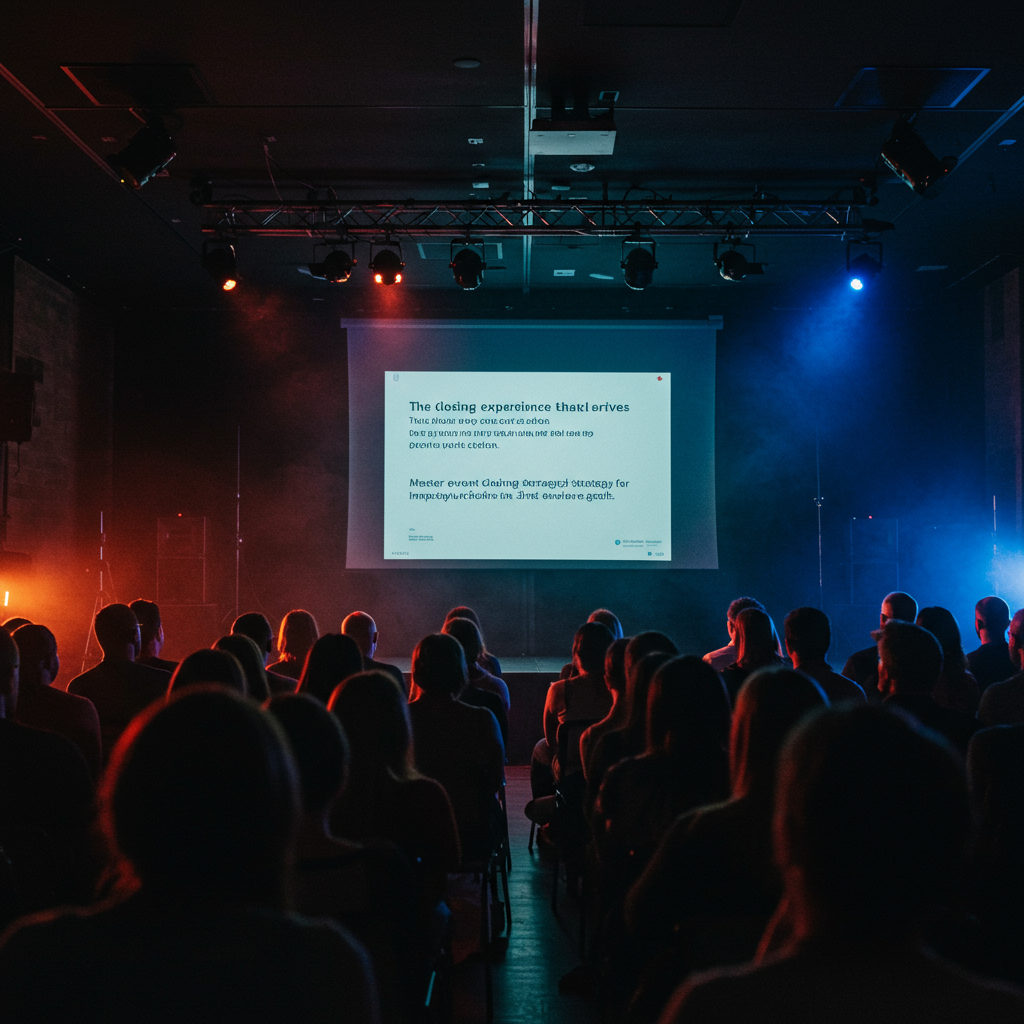
The final moments of an event are often the most memorable, yet they are frequently an afterthought in the planning process. This guide provides a comprehensive framework for designing and executing a powerful event closing strategy that serves as a bridge between the event’s climax and tangible business outcomes. We delve into the psychology, logistics, and content required to convert attendee enthusiasm into action. By focusing on a data-driven approach, this article details how to measure success through key performance indicators (KPIs) such as post-event engagement rates, lead conversion metrics, and Net Promoter Score (NPS). This content is essential for event managers, marketing directors, and corporate leaders who want to maximize the return on their event investment and build lasting relationships with their audience.
Introduction
For too long, the end of an event has been treated as a simple conclusion—a perfunctory “thank you and goodbye.” This approach squanders the most valuable asset an event creates: a captive, engaged, and motivated audience. The moment the lights come up is precisely when the most critical phase of the attendee journey should begin. A robust event closing strategy is not merely about ending on a high note; it is the critical pivot point that transforms passive listeners into active participants in your brand’s ecosystem. It is the mechanism that ensures the energy, insights, and connections forged during the event translate into measurable, long-term value. Without a deliberate strategy, the millions invested in creating an experience can evaporate within hours.
This article outlines a methodological framework for building a closing experience that drives post-event action. We will explore how to architect every element, from the final keynote’s narrative to the first post-event email, with a singular focus on conversion and continued engagement. The success of this strategy will be measured through a portfolio of KPIs, including a target 30% increase in post-event engagement (e.g., content downloads, community sign-ups), a 15% improvement in lead-to-opportunity conversion rates within 60 days, and a Net Promoter Score (NPS) consistently above 40. This is about shifting the paradigm from event management to experience architecture, where the close is the true beginning.
Vision, values and proposal
Focus on results and measurement
Our vision is to redefines the event lifecycle, positioning the closing experience as the primary catalyst for business growth. We operate on the core belief that an event’s return on investment is realized not during the event itself, but in the weeks and months that follow. Our values are rooted in attendee-centricity, data-driven decision-making, and the creation of sustainable value. We apply the Pareto principle (80/20 rule) to our event closing strategy, focusing on the 20% of closing activities that generate 80% of the post-event results. This means prioritizing a single, clear call-to-action over a dozen weak suggestions, and personalizing follow-up communications based on behavioral data rather than generic blasts. Our technical standards are uncompromising, ensuring that every digital touchpoint, from QR codes to landing pages, is seamless, fast, and mobile-first.
- Attendee-Centric Design: Every element of the closing is designed from the attendee’s perspective. What do they need to hear? What is the single most valuable next step for them?
- Data-Driven Personalization: We leverage data on session attendance, poll responses, and app engagement to segment audiences and deliver highly relevant post-event content and offers.
- Seamless Transition: The journey from the physical or virtual event space to the next digital touchpoint must be frictionless. This is a non-negotiable quality standard.
- Value-First Principle: The primary call-to-action must offer genuine, immediate value to the attendee, such as exclusive content, a free tool, or priority access, rather than being a purely self-serving sales pitch.
- Long-Term Nurturing: The closing is not a one-off action but the start of a planned nurturing sequence that maintains momentum and builds a relationship over time.
Services, profiles and performance
Portfolio and professional profiles
We offer a suite of services designed to architect and execute a high-impact event closing strategy. These services can be engaged individually or as a complete package for end-to-end management. Our team consists of seasoned professionals who understand the unique intersection of live events, marketing automation, and content strategy.
- Closing Experience Design: Crafting the narrative, content, and flow of the final event sessions to inspire and direct action. Involves keynote speakers, scriptwriters, and experience designers.
- Post-Event Communication Strategy: Developing a multi-channel follow-up plan (email, SMS, social, retargeting) that is segmented, personalized, and automated. Managed by Marketing Automation Specialists and Digital Marketers.
- Content Repurposing & Distribution: Transforming event content (recordings, slides, quotes) into a library of assets for sustained lead nurturing and community engagement. Executed by Content Strategists and Video Producers.
- Lead Management & ROI Analysis: Integrating event data with CRM systems, tracking the journey from attendee to customer, and delivering a comprehensive ROI report. Handled by Data Analysts and MarTech Integrationists.
Operational process
- Phase 1: Discovery & Goal Setting (Weeks 1-2): We work with stakeholders to define the primary post-event objective (e.g., generate MQLs, drive software adoption). KPI: Clearly defined and agreed-upon success metrics with a target deviation of less than 5%.
- Phase 2: Strategy & Journey Mapping (Weeks 3-4): We map the ideal attendee journey from the closing session to the final conversion point. Deliverable: A detailed journey map and communication flowchart.
- Phase 3: Content & Asset Production (Weeks 5-8): Creation of all necessary assets: closing keynote slides, videos, email templates, landing pages, and downloadable content. KPI: All assets approved and tested one week prior to the event.
- Phase 4: Technical Integration & Testing (Weeks 9-10): We ensure all systems (event platform, CRM, marketing automation) are seamlessly connected and data flows correctly. KPI: Successful end-to-end data sync test with 100% accuracy.
- Phase 5: On-Site/Virtual Execution (Event Day): We manage the execution of the closing session and trigger the initial post-event communications. KPI: First communication deployed within 1 hour of event conclusion.
- Phase 6: Nurturing & Optimization (Days 1-60 Post-Event): We monitor the automated nurturing sequences, analyze performance data, and make real-time adjustments. KPI: A/B testing reveals a winning email subject line with a >5% open rate improvement.
- Phase 7: Reporting & ROI Analysis (Day 90 Post-Event): Delivery of a final report detailing performance against initial goals, insights learned, and strategic recommendations. KPI: Report delivered on time, showing clear ROI or ROO (Return on Objectives).
Tables and examples
| Objective | Indicators (KPIs) | Key Actions | Expected result |
|---|---|---|---|
| Increase Qualified Leads by 25% | Marketing Qualified Leads (MQLs) generated; Cost Per MQL; MQL-to-SQL Conversion Rate | Closing session CTA for an exclusive industry report; Segmented follow-up based on sessions attended. | Generation of over 500 new MQLs at a Cost Per MQL below $150, with a conversion rate of over 15%. |
| Boost Community Engagement | New members in online community; Post-event content engagement rate (likes, shares, comments) | Exclusive invitation to a private attendee-only online group (e.g., Slack, Discord) during the closing. | Achieve a 40% attendee sign-up rate for the community within 72 hours of the event. |
| Drive Early-Bird Sales for Next Event | Ticket sales revenue in the first 48 hours; Conversion rate of the early-bird offer. | Announce a “secret” headliner for the next year and offer a 24-hour flash sale via a QR code. | Sell 20% of next year’s tickets within 48 hours, providing immediate cash flow and validating interest. |
| Improve Attendee Satisfaction | Net Promoter Score (NPS); Survey completion rate; Qualitative feedback analysis. | Deploy a short, mobile-friendly survey link immediately after the event, incentivized with a prize draw. | Achieve an NPS of 45+ with a survey completion rate of over 35%. |
Representation, campaigns and/or production
Professional development and management
The execution of the closing experience is a production in itself, requiring meticulous coordination of talent, technology, and timing. Our production management ensures every element is flawlessly delivered, whether in a physical ballroom or a virtual studio. This involves detailed run-of-show documents, technical rehearsals, and contingency plans for every conceivable issue. We manage all speaker preparations, ensuring their closing remarks are not only inspiring but also perfectly aligned with the strategic call-to-action. Supplier coordination is key, from the A/V team responsible for crystal-clear sound and visuals to the platform provider ensuring interactive elements like polls and Q&As function without a hitch.
- Speaker Briefing Checklist: Final script reviewed and approved; CTA slide integrated and tested; timing cues rehearsed; backup plan for teleprompter failure confirmed.
- Technical Production Checklist: All video, audio, and lighting cues documented in the run-of-show; network bandwidth tested for streaming quality; QR codes and links tested on multiple devices; backup power and internet sources secured.
- Audience Engagement Checklist: Moderation team briefed for final Q&A; social media team ready with final posts and hashtags; support team on standby for any attendee technical issues.
- Contingency Planning: Pre-recorded version of the keynote available; alternative engagement activity ready in case of a speaker delay; static information slide prepared if a live poll fails.
- Post-Event Trigger Checklist: Marketing automation workflow activated and tested; primary contact list segmented and loaded; “send” button is authorized by the project lead immediately upon event conclusion.
Content and/or media that converts
Messages, formats and conversions
The content of your closing and immediate follow-up is the fuel for post-event action. It must be compelling, valuable, and strategically designed to guide the attendee toward the desired outcome. The closing keynote should be less of a summary and more of a “springboard,” synthesizing the event’s key themes into a powerful narrative that culminates in a clear, singular Call-to-Action (CTA). This CTA is the centerpiece of your entire event closing strategy. We leverage A/B testing extensively, experimenting with different email subject lines (e.g., “Your exclusive resources from [Event Name]” vs. “Don’t lose your [Event Name] momentum”), CTA button copy, and landing page layouts to continuously optimize conversion rates. The goal is to create a content ecosystem that makes the next step feel like the natural, logical, and most valuable choice for the attendee.
- Content Ideation: Based on event themes and the primary CTA, brainstorm content formats that add value. This includes summary “playbooks,” exclusive video interviews, or access to a resource library.
- Keynote Scripting & Design: The closing speaker’s script is crafted to build emotional momentum, leading to the CTA reveal. Slides are visually impactful and minimalist, focusing attention on the speaker and the message.
- Post-Event Asset Production: Create a “post-event kit” for attendees. This is a gated asset delivered via email, containing session recordings, slide decks, and a summary of key takeaways. This serves as the first major conversion point.
- Email Nurture Sequence Copywriting: Write a series of 3-5 emails. The first is to thank you with the post-event kit. Subsequent emails highlight specific pieces of content, share attendee testimonials, and gently re-introduce the primary business-oriented CTA (e.g., “Book a Demo”).
- Social Media Content Calendar: Develop a two-week post-event content calendar featuring speaker quotes, photo galleries, short video clips, and attendee-generated content to maintain buzz and drive traffic to the post-event hub.
- Performance Review & Iteration: After the initial sequence, analyze open rates, click-through rates, and conversion rates to inform and refine the strategy for future events.
Training and employability
Demand-oriented catalogue
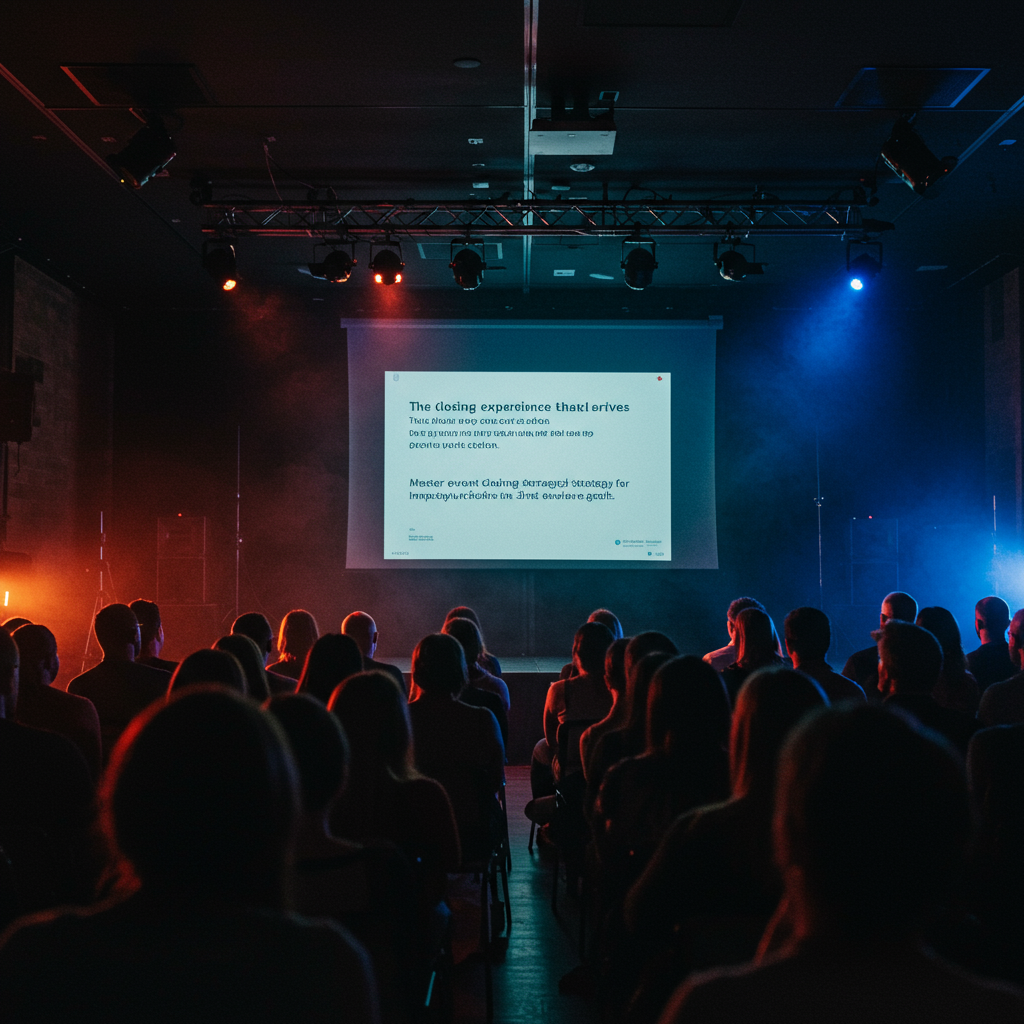
To empower organizations to build this capability in-house, we offer specialized training modules for event and marketing teams. These programs are designed to be practical, hands-on, and focused on delivering measurable improvements in event performance.
- Module 1: The Psychology of a Powerful Close: Understanding narrative structure, emotional arcs, and the principles of persuasion to design memorable and motivating closing sessions.
- Module 2: Post-Event Marketing Automation: A technical workshop on setting up, segmenting, and personalizing automated communication workflows in major platforms (e.g., HubSpot, Marketo).
- Module 3: Data & Analytics for Event ROI: Training on how to track the attendee journey across multiple touchpoints, connect event data to CRM, and build a comprehensive ROI dashboard.
- Module 4: Content Repurposing Masterclass: A creative and strategic session on how to multiply the value of your event content by transforming it into dozens of assets for long-term marketing campaigns.
- Module 5: The Event Closing Strategy Playbook: A capstone project where teams develop a complete closing strategy for an upcoming event, from goal setting to final reporting.
Methodology
Our training methodology is built on a “learn, do, measure” framework. Each module includes theoretical instruction, followed by practical exercises using real-world scenarios. Performance is evaluated using clear rubrics that assess the strategic thinking, technical execution, and potential business impact of the participants’ work. Graduates of the full program gain access to our network of event professionals and a “talent pool” for organizations looking to hire certified event strategists. The expected outcome is a demonstrable increase in the team’s ability to drive post-event conversions, with a target of improving key metrics by at least 15% within six months of completing the training.
Operational processes and quality standards
From request to execution
Our operational pipeline is designed for clarity, accountability, and consistent quality. Each phase has defined deliverables and acceptance criteria, ensuring the project stays on track and aligned with client objectives.
- Diagnostic & Scoping: We begin with a deep-dive session to understand the event’s goals, audience, and existing tech stack. The deliverable is a detailed Statement of Work (SOW) with clear KPIs.
- Strategic Blueprint: We develop a comprehensive strategy document outlining the closing narrative, communication plan, content map, and measurement framework. Acceptance criterion: Client sign-off on the blueprint.
- Pre-Production & Asset Build: Our team creates all required content and technical assets. Deliverables include keynote scripts, email copy, landing pages, and automation workflows. Acceptance criterion: All assets pass a multi-point quality assurance (QA) check.
- Integration & Rehearsal: We integrate all technical components and conduct a full run-through of the closing experience and post-event triggers. Acceptance criterion: A successful, error-free end-to-end test.
- Execution & Monitoring: We oversee the live execution and monitor the initial wave of post-event communications in real-time. Deliverable: An “execution summary” report within 24 hours.
- Nurture & Reporting: We manage the ongoing nurture campaign and provide weekly performance updates, culminating in a final ROI and insights report. Acceptance criterion: The final report clearly ties activities to the KPIs defined in the SOW.
Quality control
- Roles & Responsibilities: A dedicated Project Lead serves as the single point of contact. A Technical Lead oversees all integrations, and a Content Lead ensures brand and message consistency.
- Escalation Protocol: A clear protocol is established for handling any issues, from minor content typos to critical technical failures, ensuring rapid response and resolution.
- Service Level Agreements (SLAs): We commit to specific SLAs, such as 99.9% uptime for landing pages, email deliverability rates above 98%, and a response time of under 2 hours for critical inquiries during the execution phase.
- Acceptance Criteria: No phase is considered complete until the client formally approves the deliverables against the pre-agreed criteria.
| Phase | Deliverables | Control indicators | Risks and mitigation |
|---|---|---|---|
| Strategy | Strategy Blueprint Document | Client sign-off; Alignment with initial goals (NPS > 40, MQL > 500) | Risk: Misaligned objectives. Mitigation: Rigorous discovery phase and multiple stakeholder review cycles. |
| Pre-Production | All content & technical assets | 100% of assets pass QA; Brand guideline adherence check; Mobile responsiveness test. | Risk: Delays in asset approval. Mitigation: Detailed production schedule with clear deadlines and designated approvers. |
| Execution | Live closing session; Initial email deployment | Deployment within 1 hour; Open rate > 25% in the first 3 hours; Zero critical tech failures. | Risk: Platform or internet failure. Mitigation: Pre-recorded backups, redundant internet sources, and a tested contingency plan. |
| Post-Event | Final ROI Report | Report delivered on schedule; Data accuracy validated against CRM; Clear insights and recommendations. | Risk: Inaccurate data tracking. Mitigation: End-to-end data flow testing with UTM parameters and hidden fields before the event. |
Cases and application scenarios
Case 1: “Future of SaaS” – B2B Technology Conference
Context: An annual conference for 2,000 SaaS founders and executives. The primary goal was to convert attendees into qualified leads for their enterprise platform, which traditionally had a long sales cycle. The previous year’s event generated only 50 MQLs.
Strategy: The closing keynote was shifted from the CEO to a high-profile customer who shared a compelling case study. The CTA was not a “Book a Demo” link, but an invitation to an exclusive, post-event “Enterprise Growth” webinar hosted by that same customer. This positioned the follow-up as value-add education, not a sales pitch. We implemented a segmented follow-up based on the tracks attendees participated in (e.g., “FinTech,” “MarTech”), sending them tailored content. The event closing strategy was designed to pre-qualify interest.
Results:
- MQLs Generated: 215 (a 330% increase year-over-year).
- Webinar Attendance: 45% of attendees registered, with an 80% attendance rate.
- Sales Pipeline: The webinar generated over $1.2 million in new sales pipeline within 60 days.
- Cost Per MQL: Reduced from an estimated $450 to $180.
Case 2: “Impact Gala” – Non-Profit Fundraiser
Context: A high-end fundraising gala for 500 donors aiming to fund a new educational center. In past years, the “ask” was a traditional paddle raise, but engagement dropped off immediately after the event.
Strategy: We designed a multi-modal closing. The final five minutes featured a powerful short film about a beneficiary of their programs. As the film ended, the host made a direct, emotional appeal. Simultaneously, every table received a QR code linking to a simple, pre-filled donation page, and an SMS was sent to all registered phone numbers with the same link. A live “donation thermometer” was projected on screen. The follow-up email the next morning didn’t ask for more money but shared a “first look” at the architectural renderings of the new center, reinforcing the impact of their donation.
Results:
-
- On-Night Donations: Exceeded the fundraising goal by 35%.
- Post-Event Donations: An additional 15% of the total was raised in the 48 hours following the event, a channel that previously generated almost nothing.
– Donor Engagement: The post-event email had a 72% open rate and a 40% click-through rate to view the renderings.
Case 3: “Innovate Next” – Internal Corporate Summit
Context: A mandatory internal summit for 5,000 employees of a global consulting firm, introducing a new AI-powered knowledge management platform. The goal was 90% user adoption within 90 days.
Strategy: The closing session was not a speech but a “Mission: First Steps” interactive workshop. The CEO challenged employees to complete three simple tasks on the new platform before leaving the session. We used gamification, with a live leaderboard showing which departments were completing the tasks fastest. The post-event follow-up was a drip campaign of “pro-tips” and use cases relevant to each employee’s department. The entire event closing strategy was focused on immediate, practical application.
Results:
- Day 1 Adoption: 78% of attendees logged in and completed the initial tasks.
- 30-Day Adoption: Reached 92%, smashing the 90-day goal.
- Support Tickets: The proactive “pro-tips” campaign led to a 40% reduction in anticipated support ticket volume compared to previous software rollouts.
- NPS (internal): The platform launch received an internal NPS of +52, an unprecedented score for an IT project.
Case 4: “SoundWave Fest” – Hybrid Music Festival
Context: A 10,000-person hybrid music festival (8,000 in-person, 2,000 virtual). Key objectives were to drive early-bird ticket sales for the following year and foster a year-round community to sell merchandise and sponsorships.
Strategy: During the final headliner’s set, a surprise announcement was made: a “secret” headliner for the next year was revealed. On-screen graphics and a push notification to the event app immediately displayed a QR code for an exclusive 24-hour “Loyalty” flash sale on next year’s tickets, at the lowest possible price. The CTA also invited everyone to join the “SoundWave Inner Circle” on Discord to get clues about the rest of the lineup over the coming months.
Results:
- Early-Bird Sales: 30% of the next year’s tickets were sold within 24 hours, providing massive upfront revenue and validating demand.
- Community Growth: Over 4,000 attendees joined the Discord server within 72 hours, creating a highly engaged marketing channel.
- Data Acquisition: The sale provided valuable data on the most loyal and price-sensitive segment of their audience for future marketing.
Step-by-step guides and templates
Guide 1: The 48-Hour Post-Event Communication Blueprint
- T+0 to 1 Hour: The Instant “Thank You.”
- Channel: Email and/or SMS.
- Content: A simple, heartfelt thank you. No better asks. Include one key link, either to the main post-event resource hub or the feedback survey.
- Goal: Capitalize on immediate positive feeling. KPI: Open Rate > 50%.
- T+2 to 4 Hours: The Social Media “First Look”.
- Channel: Instagram, LinkedIn, X (Twitter).
- Content: A high-energy photo gallery or a 60-second sizzle reel. Tag speakers, sponsors, and attendees. Use the event hashtag.
- Goal: Extend the buzz and encourage user-generated content. KPI: Engagement Rate > 5%.
- T+24 Hours: The “Value-Add” Delivery.
- Channel: Email.
- Content: This is the main follow-up. Deliver the promised “post-event kit” (recordings, slides). Segment this email based on attendee data (e.g., “We saw you attended the session on AI, here’s some bonus content”).
- Goal: Fulfill promises and demonstrate value. KPI: Click-Through Rate > 15%.
- T+48 Hours: The Community Invitation.
- Channel: Email.
- Content: A personalized invitation to join your ongoing community (e.g., LinkedIn group, Slack channel, newsletter). Frame it as a way to “keep the conversation going.”
- Goal: Transition attendees from a one-time event to a long-term community. KPI: Community Join Rate > 10% of all attendees.
Guide 2: Designing a Call-to-Action (CTA) That Converts
- Step 1: Define Your ONE Primary Goal. Don’t confuse the audience. Do you want them to book a demo, download a paper, or join a community? Pick one. This is the North Star of your closing.
- Step 2: Create Urgency and Exclusivity. Why should they act NOW? Use time-limits (“Offer valid for 24 hours”), limited availability (“Only 50 spots available”), or exclusive access (“Get the report before it’s public”).
- Step 3: Make It Effortless. Reduce friction to zero. Use short URLs and large, scannable QR codes. If it’s a form, pre-fill it with the data you already have. The path of least resistance wins.
- Step 4: Use Strong, Action-Oriented Language. Start with a verb. Instead of “More Information,” use “Get Your Free Playbook.” Instead of “Submit,” use “Claim Your Spot.”
- Step 5: Prime the Audience. Your CTA shouldn’t come out of nowhere. The entire closing keynote should build a case for why taking this specific action is the logical and beneficial next step for the audience.
- Step 6: Visualize the Value. On the slide, don’t just put the link. Show a mockup of the e-book cover, a screenshot of the software, or a testimonial from someone who has already benefited from the offer.
Guide 3: The Event Content Repurposing Matrix
Use this framework to maximize the value of your event content over the 90 days following the event.
| Original Asset | Format 1: Blog Posts | Format 2: Social Media | Format 3: Lead Magnet |
|---|---|---|---|
| Keynote Recording (45 min) | A detailed summary post with key takeaways and embedded video clips. | Create 5-7 short (30-60 sec) video clips of the most powerful quotes for Instagram Reels/TikTok/Shorts. | Offer the full, high-resolution recording as a gated asset for new leads. |
| Panel Discussion (60 min) | A “5 Experts Answer [Key Question]” style post, with transcribed answers from each panelist. | Create quote graphics for each panelist and tag them. Post a poll on LinkedIn related to the discussion topic. | Compile the full transcript and an executive summary into a downloadable PDF. |
| Attendee Q&A Sessions | A “You Asked, We Answered” FAQ blog post that addresses the most common questions. | Post one question and its answer per day for a week to drive engagement. | Bundle the questions and detailed answers into an “Ultimate FAQ” guide. |
| Slide Decks | Embed the full deck (via SlideShare) into a blog post that adds context and commentary. | Pull out the most impactful stats or graphics and post them individually. Create a carousel post on Instagram/LinkedIn. | Offer a bundle of “All Session Decks” as a single download for attendees. |
Internal and external resources (without links)
Internal resources
- Event Closing Strategy Template (PowerPoint)
- Post-Event Email Sequence Playbook (PDF)
- Event ROI Calculator Spreadsheet (Excel)
- Speaker Closing Briefing Document Template (Word)
- Technical Run-of-Show Checklist for Hybrid Events
- Content Repurposing Planning Calendar
Recursos externos de referencia
- Event Marketing Institute’s Annual “EventTrack” Study
- Best practices and benchmarks from Cvent, Bizzabo, and Hopin industry blogs
- Net Promoter Score (NPS) methodology as developed by Bain & Company
- HubSpot Academy resources on marketing automation and lead nurturing
- “Made to Stick: Why Some Ideas Survive and Others Die” by Chip and Dan Heath for crafting memorable messages
Frequently asked questions
How soon should we start planning the event closing strategy?
You should start planning your closing strategy from the very beginning, during the initial event conception phase. The primary post-event goal should directly influence the event’s content, theme, and overall agenda. Treating it as a last-minute task is the most common path to failure.
What’s the single most common mistake in event closings?
The most common mistake is ending with a generic “thank you” and no clear, compelling, and singular call-to-action. This creates an “energy vacuum” where all the momentum and inspiration built during the event dissipates because the audience isn’t given a specific, valuable next step to take.
How do you measure the success of a closing strategy?
Success is measured by tracking post-event business metrics, not just “feel-good” feedback. Key KPIs include: lead conversion rates, sales pipeline generated, content download numbers, community sign-up rates, and early-bird ticket sales for the next event. These should be tracked against pre-defined goals.
Can this work for virtual and hybrid events?
Absolutely. The principles of a strong narrative, a clear CTA, and value-driven follow-up are universal. For virtual events, you can leverage digital tools more effectively, such as instant polls, chat-based CTAs, and immediate redirection to a landing page. For hybrid events, the key is to create an equally compelling closing experience for both audiences.
What’s a reasonable budget for a closing experience?
It’s better to think of it not as a separate budget but as an allocation of the total event marketing and content budget. A good rule of thumb is to allocate 10-15% of your marketing resources (time, money, personnel) to post-event activities that are kicked off by the closing. The investment in the follow-up is what generates the return.
Conclusion and call to action
The close of an event is not the end; it is the most critical transition point in the customer journey. An event’s true ROI is unlocked in the actions attendees take after they leave. By shifting your perspective from a simple wrap-up to a strategic launchpad, you can transform momentary inspiration into sustained momentum and measurable business results. A well-designed event closing strategy is the essential bridge between your event investment and your business objectives. It ensures that the conversation doesn’t end when the lights go up—it’s where it truly begins.
We encourage you to audit your current event process. In your next planning cycle, start with the end in mind. Define what you want your audience to do after the event, and architect every element of your closing experience to guide them toward that action. By implementing the frameworks, guides, and processes outlined here, you can create a closing experience that not only delights your audience but also delivers quantifiable value to your organization long after the applause has faded.
Glossary
- Call to Action (CTA)
- A prompt designed to provoke an immediate response or encourage a specific action, such as “Book a Demo” or “Download the Whitepaper.”
- Key Performance Indicator (KPI)
- A quantifiable measure used to evaluate the success of an organization, employee, or activity in meeting objectives for performance.
- Lead Nurturing
- The process of developing and reinforcing relationships with buyers at every stage of the sales funnel, often through automated marketing communications.
- Marketing Qualified Lead (MQL)
- A lead who has indicated they are more likely to become a customer compared to other leads, based on their web activity, content downloads, or other engagement.
- Net Promoter Score (NPS)
- A metric used to measure customer loyalty and satisfaction, calculated based on the answer to a single question: “How likely is it that you would recommend our company/product/service to a friend or colleague?”
- Return on Investment (ROI)
- A performance measure used to evaluate the efficiency or profitability of an investment. For events, it’s often calculated as (Gain from Investment – Cost of Investment) / Cost of Investment.
Internal links
- Click here👉 https://us.esinev.education/diplomas/
- Click here👉 https://us.esinev.education/masters/
External links
- Princeton University: https://www.princeton.edu
- Massachusetts Institute of Technology (MIT): https://www.mit.edu
- Harvard University: https://www.harvard.edu
- Stanford University: https://www.stanford.edu
- University of Pennsylvania: https://www.upenn.edu