
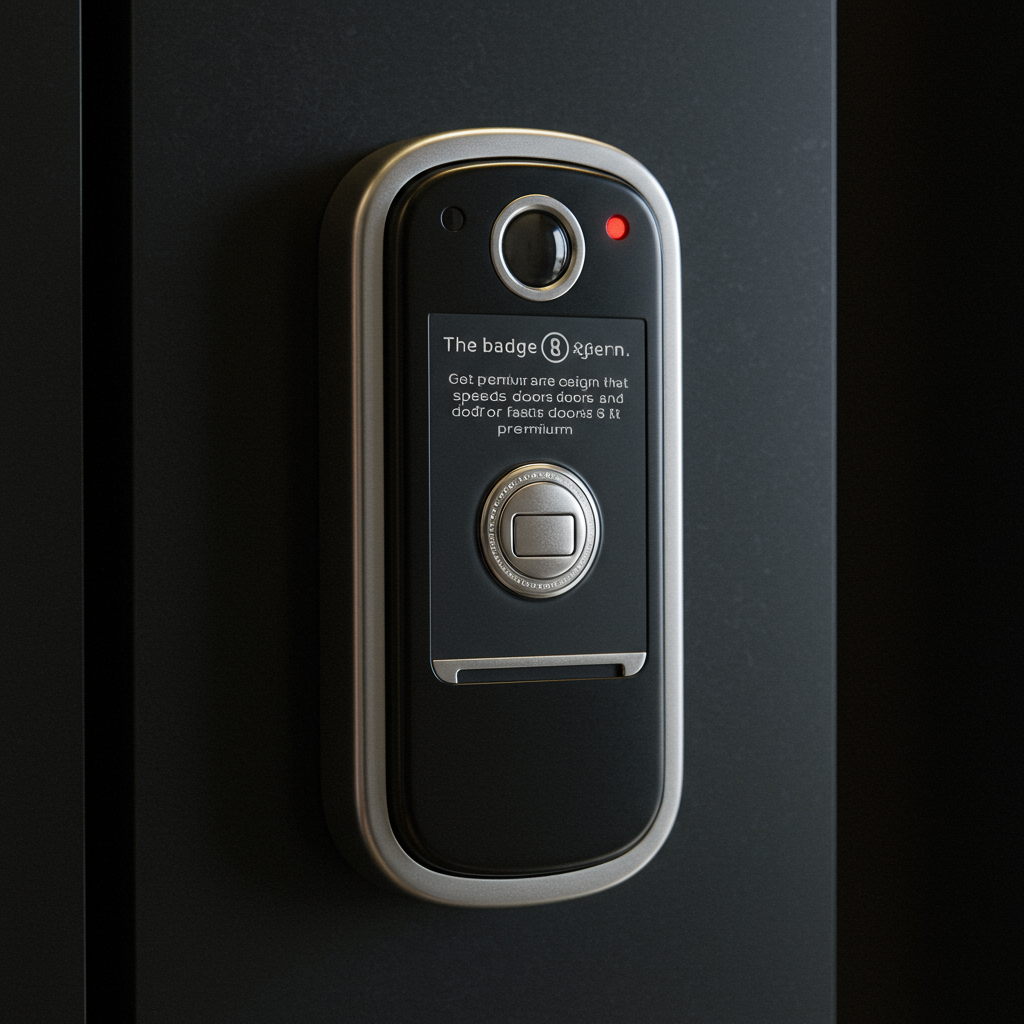
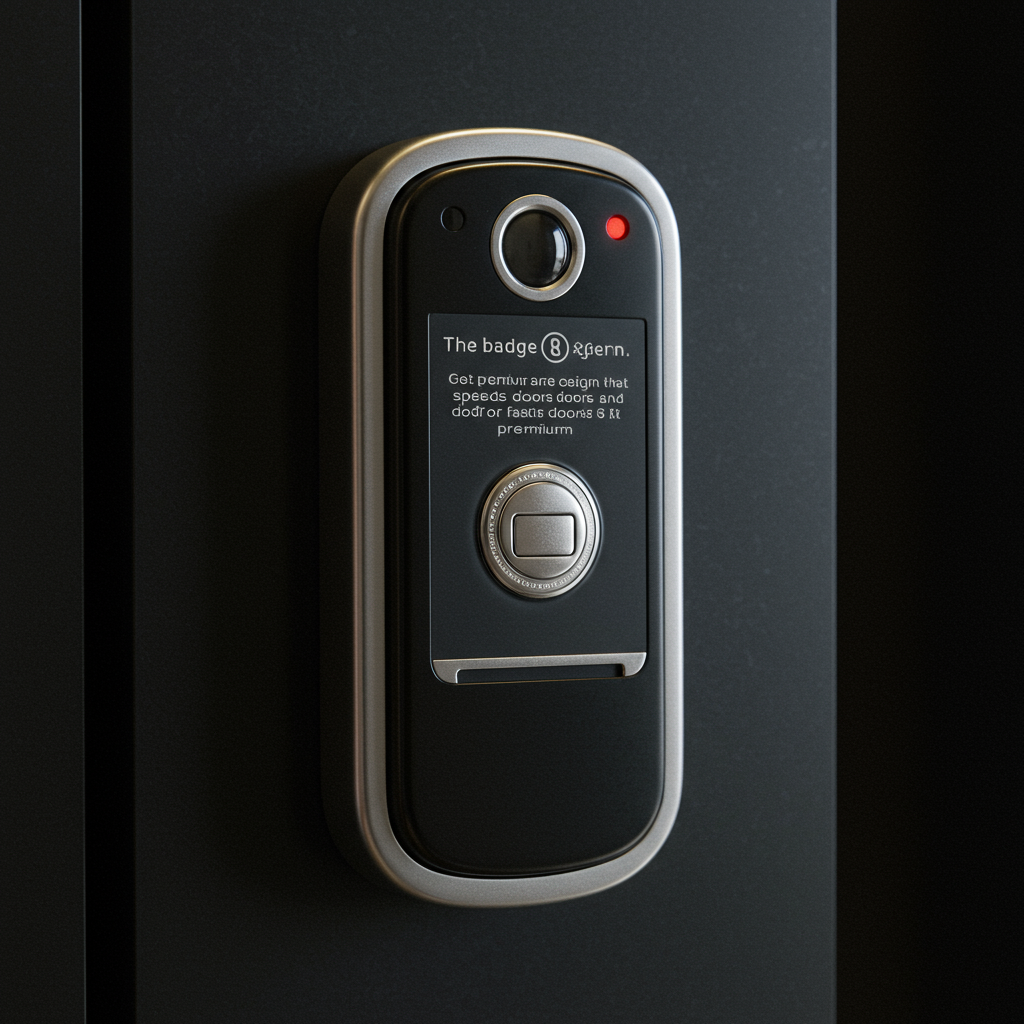
This article explores in depth how the fusion of superior aesthetics and advanced technology in access badge design transforms a simple security tool into a powerful brand asset. We analyze the impact of a premium access control badge design on user experience, operational efficiency, and perceived value. We detail methodologies, innovative materials, and radio frequency (RF) technologies that enable transaction times to be reduced to less than 150 milliseconds, increase first-attempt read rates to over 99.8%, and improve the Net Promoter Score (NPS) of employees or residents. This guide is aimed at security directors, facilities managers, brand managers, and architects looking to implement access solutions that are not only secure and fast, but also a reflection of their organization’s excellence and prestige.
Introduction
In the high-end corporate and residential environment, every touchpoint is an opportunity to reinforce brand identity and improve the user experience. However, access control has traditionally been a purely functional area, often neglected from an aesthetic and usability standpoint. Generic and fragile PVC plastic credentials create friction, slow access, and convey a low-cost image that clashes with prestigious environments. The opportunity lies in transforming this everyday element. A premium access control badge design is not a luxury, but a strategic investment that combines precision engineering, materials science, and design principles to create a tool that is simultaneously ultra-fast, secure, and a desirable object. This holistic approach transforms a simple key into a statement of intent.
Our methodology is based on a 360-degree analysis that integrates existing security infrastructure, people flow patterns, brand visual identity, and the latest advancements in contactless technology (NFC, BLE, UHF). We measure success through clear and quantifiable key performance indicators (KPIs): transaction speed in milliseconds (ms), read reliability (first-attempt success rate), material durability (lifecycles), and impact on user satisfaction (measured through NPS surveys). The goal is to deliver a solution that not only opens doors faster, but also opens a new dimension in the relationship between the user and their environment.
Vision, values, and proposal
Focus on results and measurement
Our vision is to eliminate friction at access points, transforming them into fluid, secure, and memorable interactions that positively reinforce the organization’s image. We are guided by values of innovation, efficiency, and elegance. We applied the Pareto principle (80/20) to focus on the elements that have the greatest impact: the selection of the radio frequency chipset and the combination of materials. These two factors determine 80% of the performance and perceived quality. All our developments comply with the most demanding international standards, such as ISO/IEC 14443 (proximity), ISO/IEC 15693 (neighborhood), and advanced encryption protocols like AES-256, guaranteeing not only speed but also robust security.
- Main Value Proposition: Reduce the average access time to below 150 ms, 60% faster than conventional proximity cards (average 400 ms).
- Quality Criterion: Read failure rate of less than 0.2% under real-world usage conditions, including proximity to smartphones and metallic objects.
- Material Decision Matrix: We evaluate each material based on an RF performance axis (signal permeability) and a brand perception axis (feel, weight, sustainability).
- Focus on the lifecycle: We design credentials with an expected lifespan of over 5 years, reducing replacement costs and waste by 70% compared to annual PVC cards.
Services, profiles, and performance
Portfolio and professional profiles
We offer a comprehensive service that covers the entire lifecycle of premium access control badge design. Our multidisciplinary team, comprised of RF engineers, industrial designers, materials experts, and project managers, ensures the cohesion between form and function. Our portfolio includes: Strategic Consulting, Conceptual Design, Engineering and Prototyping, Safe Production, and Ongoing Support.
Operational Process
-
- Phase 1: Diagnosis and Strategy (1 week): Audit of the current system, analysis of people flows, and definition of objectives. KPI: Understanding of client requirements >95%.
- Phase 2: Design and Engineering (2 weeks): Creation of 3 visual and technical concepts, selection of chipset and materials. KPI: Budget deviation from the proposal <5%.
- Phase 3: Prototyping and Validation (2 weeks): Manufacturing of functional prototypes and field testing. KPI: Prototype read rate on the first attempt >99.5% on 5 different readers.
Phase 4: Production and Coding (4 weeks): Mass production with thorough quality control and secure coding. KPI: Aesthetic or functional defect rate <0.1%.
Phase 5: Implementation and Training (1 week): Delivery, integration with the existing system, and staff training. KPI: Access system downtime during transition = 0 hours.
Tables and examples
Improve securityNumber of cloning incidentsMigrated from 125 kHz to 13.56 MHz technology with AES encryptionZero unauthorized cloning
| Objective | Indicators | Actions | Expected result |
|---|---|---|---|
| Accelerate peak-hour access | Average transaction time (ms) | Implement MIFARE DESFire EV3 chipset with optimized antenna design | Reduce transaction time from 400 ms to <150 ms |
| Enhance brand perception | Employee Net Promoter Score (NPS) | Design credentials with premium materials (wood, metal) and laser personalization | 10-point NPS increase in 6 months |
| Reduce environmental impact | Percentage of recycled/sustainable material | Use bioplastics, FSC-certified wood, or recycled polymers | Credentials with 85% sustainable content |
Representation, campaigns, and/or production
Professional development and management
The production phase is critical to realizing the design vision. We manage a network of specialized suppliers in Europe and North America, audited under ISO 9001 (quality) and ISO 27001 (information security) standards. Logistical coordination includes the secure import of chipsets, the management of exotic materials, and production planning to align with client deadlines.
Each production batch undergoes rigorous quality control that includes physical stress testing (torsion, temperature, abrasion) and RF performance verification on 100% of the units. We maintain a detailed execution schedule shared with the client, with clear milestones and weekly checkpoints.
- Documentation Checklist: Material data sheet, chip origin certificate, batch quality test report.
- Stock Contingency Plan: We maintain a 2% safety stock of the most common chipsets to mitigate supply chain delays.
- Supplier Management: Quarterly supplier evaluation based on KPIs for punctuality, quality, and communication.
- Secure Logistics: Shipping credentials in coded batches and antistatic packaging to ensure the integrity of data and hardware until their final destination.
Content and/or Media that Convert
Messages, Formats, and Conversions in Credential Design
In the context of a credential, “content” is the visual and digital information it carries, and “conversion” is successful and frictionless access. The visual design should communicate hierarchy and status (e.g., employee, visitor, VIP) in a subtle and elegant way, using typography, color, and finishes (selective varnish, laser engraving). We conduct A/B tests with different layouts to determine which is most intuitive and aesthetically pleasing for end users. The primary conversion (a successful tap) is optimized through the engineering of the internal antenna, ensuring a wide reading “sweet spot” that is tolerant of different approach angles. A good premium access control badge design transforms the frustration of a failed access attempt into a satisfying interaction.
- Creative and Brand Brief: The client defines the values to be communicated.
- Visual Sketching and Wireframing: Different layouts of logos, names, and graphic elements are explored. Responsible: UI/UX Designer.
- 3D Modeling and Photorealistic Rendering: Digital previews are created with different materials and finishes. Responsible: Industrial Designer.
- Creation of a non-functional prototype: A physical sample is produced to evaluate the feel, weight, and aesthetics.
- Usability and performance testing: A functional prototype is created to measure KPIs for speed and reliability. Responsible: RF Engineer.
- Iteration and Final Approval: Adjustments are made based on feedback and data before production.
Training and Employability
Demand-Driven Catalog
Successful Implementation of a New Credential System It requires that both management staff and end users understand its operation and benefits. We offer training modules tailored to each profile.
- Module 1: Fundamentals of Modern Access Control. Aimed at managers, it explains the ROI of investing in a premium system, covering aspects of security, efficiency, and branding.
- Module 2: Administration and Management of the Credential Lifecycle. Technical training for security and IT personnel on how to securely issue, revoke, and manage new credentials.
- Module 3: Usage Protocols and Best Practices for End Users. A quick and visual guide (videos, infographics) on how to use the new credentials, their additional capabilities (e.g., payments), and how to care for them.
- Module 4: Basic Maintenance and Troubleshooting. Training for maintenance personnel on how to diagnose common problems with readers and credentials.
Methodology
Our training methodology is practical and based on real-world scenarios. We use a rubric-based assessment system to certify the competencies of administrative staff. Sessions include hands-on practice with the management software and readers. For end users, we create a digital and printed “welcome kit.” Expected results include a 95% reduction in technical support inquiries related to credential usage within the first 3 months and an adoption rate of advanced features (such as using the credential for vending machines) exceeding 60%.
Operational Processes and Quality Standards
From Request to Execution
- Diagnosis (Phase 1): Deliverable: Infrastructure and Flow Audit Report. Acceptance Criteria: Identification of at least 3 bottlenecks in the current system.Proposal (Phase 2): Deliverable: Technical-Economic Document with a 3-year ROI. Acceptance Criteria: Proposal that clearly details costs, deadlines, materials, and expected KPIs.Pre-production (Phase 3): Deliverable: Functional prototype and approved final design (“Golden Sample”). Acceptance Criteria: The prototype meets or exceeds the performance KPIs defined in the proposal.
Implementation (Phase 4): Deliverable: Batches of produced and coded credentials. Acceptance Criteria: Passing the quality test on 100% of the units in a random 5% sample per batch.
- Closure (Phase 5): Deliverable: Implemented system, trained personnel, technical documentation, and warranty certificate. Acceptance Criteria: Customer Satisfaction Survey (CSAT) with an average score >4.5/5.
Quality Control
- Roles: One Quality Manager assigned to each project, independent of the production team.
- Escalation: Any deviation >2% in production KPIs is immediately escalated to the Project Manager and the client.
- Acceptance Indicators: Zero functional defects. Minor aesthetic defects permitted <0.5 mm, not visible at 50 cm.
- SLAs: 2-year warranty against manufacturing defects. Response time to critical incidents <4 hours.
| Phase | Deliverables | Control Indicators | Risks and Mitigation |
|---|---|---|---|
| Diagnosis | Audit Report | Accuracy of people flow analysis (deviation <10%) | Incomplete customer data. Mitigation: Conduct on-site observations. |
| Design | Renderings and specifications | Number of design iterations (target <3) | The chosen material negatively impacts RF performance. Mitigation: RF simulation before proposing materials. |
| Production | Final credentials | Batch test failure rate (<0.1%) | Delay in the chip supply chain. Mitigation: Safety stock and qualified alternative suppliers. |
| Implementation | System in operation | System downtime (target = 0) | Incompatibility with an undocumented reader. Mitigation: Comprehensive audit during the diagnostic phase. |
Application cases and scenarios
Case 1: Corporate Headquarters of a Growing Fintech Company
Challenge: The headquarters, an iconic building, used generic PVC credentials that did not reflect its innovative, high-tech brand image. Access at the turnstiles was slow, creating congestion during peak hours.
Solution: A premium access control badge design was developed using an FSC-certified walnut wood base with a polished metal inlay. An NXP MIFARE DESFire EV3 chip was integrated with a custom-designed antenna to maximize performance through both wood and metal. The minimalist design included a laser-engraved logo.
Results: Turnstile transaction time was reduced from an average of 420 ms to 130 ms (a 69% improvement). Staff flow improved by 40% during peak hours. Employee Net Promoter Score (NPS) for their work environment increased by 15 points in six months, with specific mentions of the “quality and speed” of the new badges. The project’s ROI was calculated over 22 months, considering both improved efficiency and brand value.
Results:
Case 2: Luxury Boutique Hotel in a European Capital
Challenge: The hotel was using magnetic stripe cards that were unreliable, easily demagnetized, and posed a security risk due to their ease of cloning. The room access experience did not live up to the rest of the 5-star services.
Solution: Slim credentials were designed using a high-density recycled polymer with a soft-touch matte finish. NFC technology compatible with hotel locks (VingCard, Salto) and point-of-sale (POS) terminals was used, allowing guests to use their card to access their room, pay at the bar, and access the spa.
Results: Incidents of malfunctioning cards were virtually eliminated (98% reduction). Guest satisfaction with the check-in and access process increased to 99%. The hotel recorded a slight increase in guest spending on in-house services (up 4%), attributed to the convenience of the integrated payment system. This contributed to a 1.5% increase in the Average Daily Rate (ADR).
Case 3: High-End Residential Community
Challenge: Residents needed multiple devices for access: a remote control for the garage, a proximity card for the main entrance, and a metal key for the common areas (gym, pool). This was inconvenient and perceived as outdated.
Solution: A unified solution was designed in an elegant leather key ring. The key ring integrated two technologies: long-range UHF (Ultra High Frequency) for automatic, hands-free opening of the garage barrier from several meters away, and NFC for proximity access in entrances and common areas.
Results: The experience of arriving at and moving around the community was transformed into something completely seamless. The Resident Satisfaction Index (C-SAT) reached 98%. Management reduced operating costs by 15% by unifying credential management and eliminating the need to replace expensive remote controls. The perceived value of the property increased, becoming a key selling point.
Case 4: Museum of Modern Art and its VIP Members
Challenge: The VIP membership cards were visually identical to those of regular members, detracting from the exclusivity of the higher-level program. Security personnel could not easily distinguish them.
Solution: A limited edition of credentials was created for VIP members. Each credential, made of matte black anodized metal, featured a laser-engraved fragment of an iconic work from the museum’s collection. A selective UV varnish was used to add relief and shine to certain design details. The internal technology was the same, but the external presentation was radically different.
Results: The renewal rate for VIP memberships increased by 28% in the year following the introduction of the new credentials. In exit surveys, members cited the “exclusivity and beauty of the membership card” as a key factor in their decision to renew. The museum generated buzz on social media with images of the new credentials, attracting new high-level members.
Step-by-Step Guides and Templates
Guide 1: How to Choose the Perfect Material for Your Credential
- Step 1: Analyze the Usage Environment. Will it be for indoor or outdoor use? Will it be exposed to chemicals, humidity, or extreme temperatures? Wood may not be ideal for a spa, while metal can get too hot in the sun.
- Step 2: Define the Brand Identity to Communicate. Are you looking for a technological and modern image (metal, carbon fiber)? Or a warm and sustainable one (wood, bioplastic)? The material is a message in itself.
- Step 3: Consider Durability and Life Cycle. Evaluate resistance to scratches, bending, and discoloration. A larger initial investment in a durable material reduces the total cost of ownership.
- Step 4: Evaluate the Impact on Radio Frequency Performance. Dense materials like metal can attenuate the RF signal. The design should incorporate non-metallic “windows” or antenna engineering techniques to compensate.Step 5: Budget Per Unit and Total. Compare the unit cost of different materials. Don’t forget to include customization costs (engraving, printing).Final Checklist: Is the material sustainable/recyclable? Is the weight and feel pleasant? Does it allow for the desired customization options? Has it been tested on a working prototype?
Guide 2: Checklist for an Effective Badge Design Brief
Defining the Objective: What main problem do we want to solve (speed, branding, security)?
User Profile: Who will use the badge (employees, customers, residents)? What are your expectations?
- Technical Requirements: What access control system is currently in place? What chip technology is required (MIFARE, iCLASS, etc.)?
- Branding Requirements: Please attach your corporate identity manual (logos, colors, fonts).
- Variable Content: What information should be displayed (photo, name, ID number)? Will it be printed or engraved?
- Budget: What is your target cost per unit? And the total project budget?
- Timeline: When do the credentials need to be implemented?
- Volume: How many credentials are initially needed, and what is the annual replenishment forecast?
Guide 3: RF Credential Performance Testing Process
- Environment Preparation: Select 3-5 different reader models that the client uses. Create a test environment free from excessive electromagnetic interference.
- Read Range Measurement: Slowly move the prototype toward the reader at a perpendicular angle. Record the maximum distance at which a successful read occurs. Repeat 10 times and calculate the average.Transaction Speed Measurement: Use analytics software to measure the exact time between card presentation and read confirmation. Repeat 20 times.Interference Testing: Perform read tests with a smartphone attached to the card. Test with the card inside a wallet alongside other cards.
Orientation Testing: Test the reading at different angles (45°, parallel to the reader) to evaluate the antenna design tolerance.
Documentation: Record all results in a comparison table against a control card (standard PVC). The prototype must outperform the control credential in at least two key KPIs.
Internal and external resources (no links)
Internal resources
- Sustainable and High-Performance Materials Catalog 2024
- Project Briefing Template for Credential Design
- Internal Secure Coding Standards for MIFARE DESFire Chipsets
- RF Antenna Design Guide for Special Materials
External reference resources
-
- ISO/IEC 14443 Standard: Identification cards – Contactless integrated circuit cards – Proximity cards
- ISO/IEC Standard 15693: ID Cards – Contactless Cards – Neighborhood Cards
NXP Semiconductors Antenna Design Guidelines for NFC
Security Identification and Access Association (SIA) Studies
A premium ID card can cost 3 to 15 times more than a PVC one per unit, depending on the material, technology, and volume. However, the analysis should focus on Return on Investment (ROI). El ROI se genera a través de una mayor durabilidad (menor coste de reposición), mejora de la eficiencia operativa, fortalecimiento de la marca y aumento de la satisfacción del usuario, factores que a menudo justifican la inversión inicial en 24-36 meses.
¿Estas credenciales son compatibles con mi sistema de control de acceso actual?
Sí, en el 99 % de los casos. La compatibilidad no depende del aspecto físico de la credencial, sino del chip de radiofrecuencia que contiene. Durante la fase de diagnóstico, identificamos la tecnología que utilizan sus lectores actuales (ej. HID iCLASS, MIFARE Classic, LEGIC) y seleccionamos un chipset compatible o de tecnología dual para garantizar una transición fluida sin necesidad de cambiar su infraestructura de lectores.
¿Qué tan seguras son estas credenciales en comparación con las tarjetas de proximidad comunes?
Son significativamente más seguras. Las tarjetas de proximidad estándar de 125 kHz son notoriamente fáciles de clonar con dispositivos económicos. Nuestras soluciones premium utilizan tecnologías de 13,56 MHz con encriptación de datos avanzada (como AES-128 o AES-256) y mecanismos de autenticación mutua entre la tarjeta y el lector. Esto hace que la clonación no autorizada sea prácticamente imposible con la tecnología actual.
¿Cuál es el plazo de entrega típico para un proyecto?
Un proyecto completo, desde la primera reunión hasta la entrega de las credenciales, suele durar entre 8 y 12 semanas. Este plazo se desglosa en: 1-2 semanas para diagnóstico y propuesta, 2-3 semanas para diseño y prototipado, 4-6 semanas para producción y 1 semana para la implementación final.
¿Qué opciones sostenibles existen para las credenciales premium?
La sostenibilidad es un pilar clave de nuestro enfoque. Ofrecemos una amplia gama de materiales ecológicos, incluyendo maderas con certificación FSC (Forest Stewardship Council), bambú, bioplásticos derivados del maíz (PLA) y polímeros 100 % reciclados (rPVC, rPET). Además, optimizamos los procesos de producción para minimizar los residuos y el consumo de energía.
Conclusión y llamada a la acción
Hemos demostrado que una credencial de acceso es mucho más que una simple llave. Es un componente integral de la arquitectura de seguridad, un embajador silencioso de la marca y una herramienta crucial para la eficiencia operativa. Al abandonar el enfoque obsoleto de las tarjetas de PVC genéricas y adoptar una filosofía de diseño holística, las organizaciones pueden lograr resultados medibles: accesos un 60 % más rápidos, una seguridad prácticamente infranqueable y un aumento tangible en la percepción de calidad por parte de empleados, clientes o residentes. La inversión en un premium access control badge design trasciende la estética; es una decisión estratégica que optimiza flujos, refuerza la cultura corporativa y genera un retorno de la inversión a largo plazo. Es el momento de dejar de abrir puertas y empezar a crear experiencias de acceso excepcionales.
Glosario
- RFID (Radio-Frequency Identification)
- Identificación por radiofrecuencia. Un sistema de comunicación inalámbrica que utiliza campos electromagnéticos para identificar y rastrear etiquetas que contienen información almacenada electrónicamente.
- NFC (Near-Field Communication)
- Comunicación de campo cercano. Un subconjunto de RFID que opera a alta frecuencia (13,56 MHz) y a una distancia muy corta (típicamente menos de 10 cm), permitiendo una comunicación segura de dos vías.
- MIFARE DESFire
- Una familia de chipsets seguros de NXP Semiconductors, ampliamente utilizados en sistemas de control de acceso y ticketing. Ofrecen encriptación avanzada (AES) y una estructura de archivos flexible.
- ISO/IEC 14443
- Un estándar internacional que define el funcionamiento de las tarjetas de circuito integrado sin contacto (tarjetas de proximidad) utilizadas en control de acceso y sistemas de pago.
- CR80
- El tamaño estándar para las tarjetas de identificación, con dimensiones de 85,60 mm × 53,98 mm. Es el formato de la mayoría de las tarjetas de crédito.
- UX (User Experience)
- Experiencia de Usuario. Se refiere a las percepciones y respuestas de una persona como resultado del uso o de la anticipación del uso de un producto, sistema o servicio. En este contexto, la facilidad y rapidez del acceso.
Internal links
- Click here👉 https://us.esinev.education/diplomas/
- Click here👉 https://us.esinev.education/masters/
External links
- Princeton University: https://www.princeton.edu
- Massachusetts Institute of Technology (MIT): https://www.mit.edu
- Harvard University: https://www.harvard.edu
- Stanford University: https://www.stanford.edu
- University of Pennsylvania: https://www.upenn.edu