Master’s in Crowd Science and Event Security Management
The Master's Program in Crowd Science and Event Security Management is a 100% online professional master’s program (1,500 hours, 12 months) for anyone who wants to build a career in crowd science and event security management. You learn through practical modules and real case studies, guided by tutors with industry experience, and finish with a capstone project.
New intake every two months · Interest-free payment plans · ESINEV certificate of completion (non-degree).
Overview
The Master's Program in Crowd Science and Event Security Management prepares you to work with confidence on projects related to Crowd Science and Event Security Management. You will learn to:
- Analyze needs, risks and opportunities.
- Design realistic solutions, plans and procedures.
- Coordinate teams, vendors and resources.
- Define KPIs to measure and improve results.
Your learning path
Curriculum
A 1,500-hour program in 10 modules that integrate crowd science, risk analysis and the operational management of safety at events of any scale.
Submodule 1.1. What a crowd is and how it behaves
Distinguish types of crowds and their basic patterns of collective behavior.
Submodule 1.2. Lessons from historical incidents
Analyze crowd crush incidents and the causes that triggered them.
Submodule 1.3. Crowd density and levels of service
Relate people per square meter to comfort, flow and risk.
Submodule 1.4. Pedestrian flow dynamics
Understand speed, specific flow and the capacity of corridors, doors and stairs.
Submodule 1.5. Social psychology of crowds
Debunk the myth of panic and study shared social identity.
Submodule 1.6. The DIM-ICE crowd management model
Apply the design, information and management model to each phase of the event.
Submodule 1.7. RAMP risk factors
Assess routes, areas, movement and people as crowd risk factors.
Submodule 1.8. Critical phenomena: waves and collapses
Recognize crowd turbulence, pressure waves and progressive crowd collapse.
Submodule 1.9. Terminology and reference guidance
Review international guidance on venue safety and crowd management.
Submodule 1.10. Field observation of crowds
Practice reading densities and behaviors at a real event.
Submodule 2.1. Risk assessment methodology
Apply risk identification, analysis, evaluation and treatment in line with ISO 31000.
Submodule 2.2. Likelihood and impact matrices
Build risk matrices and prioritize threats according to their criticality.
Submodule 2.3. Specific risks by type of event
Compare the risks of concerts, sporting events, trade shows and street celebrations.
Submodule 2.4. Deliberate threats and terrorism
Assess vulnerabilities to attacks, vehicles and explosive devices.
Submodule 2.5. Weather and environmental risks
Integrate storms, extreme heat and wind into event planning.
Submodule 2.6. Health and epidemiological risks
Manage public health risks, heatstroke and substance use.
Submodule 2.7. Technology risks and cybersecurity
Protect ticketing, communications and control systems against failures and attacks.
Submodule 2.8. Dynamic risk register
Maintain an up-to-date risk register before and during the event.
Submodule 2.9. Scenario and worst-case analysis
Develop reasonable worst-case scenarios to guide resource allocation.
Submodule 2.10. Risk assessment report
Write the documented risk assessment for a specific event.
Submodule 3.1. Reading plans and site layouts
Interpret venue plans and urban spaces for safety planning.
Submodule 3.2. Calculating safe capacity
Determine capacity based on usable area, density and evacuation capacity.
Submodule 3.3. Sizing evacuation routes
Calculate widths, evacuation times and the number of exits required.
Submodule 3.4. Entry design and access control
Plan gates, screening points and queues to prevent dangerous build-ups.
Submodule 3.5. Fencing, barriers and front-of-stage
Select perimeter and stage barriers according to loads and use.
Submodule 3.6. Holding areas and reserve zones
Design intermediate spaces that absorb peaks in arrivals and departures.
Submodule 3.7. Signage and audience wayfinding
Design clear signage to guide flows and help people find services and exits.
Submodule 3.8. Temporary infrastructure and structures
Check the safety of temporary stages, grandstands and marquees.
Submodule 3.9. Accessibility and evacuating vulnerable people
Plan the evacuation of people with disabilities or reduced mobility.
Submodule 3.10. Event safety site plan
Prepare the comprehensive safety plan with flows, exits and resources.
Submodule 4.1. Fundamentals of pedestrian modeling
Compare macroscopic, microscopic and agent-based models.
Submodule 4.2. Crowd simulation software
Learn about pedestrian simulation tools and their applications at events.
Submodule 4.3. Preparing a simulation model
Define the geometry, audience profiles and ingress and egress scenarios.
Submodule 4.4. Simulating arrivals and entry
Model queues and entry times to size gates and staffing.
Submodule 4.5. Simulating evacuations
Assess evacuation times and bottlenecks in different scenarios.
Submodule 4.6. Density maps and heat maps
Interpret density maps to detect critical areas.
Submodule 4.7. Model validation and limitations
Check results against real data and recognize the model's limitations.
Submodule 4.8. Sensitivity analysis
Assess how results change when capacity, exits or behavior are modified.
Submodule 4.9. Communicating results to authorities
Present simulation results clearly to support decision-making.
Submodule 4.10. Applied simulation study
Carry out a complete ingress and evacuation simulation for a venue.
Submodule 5.1. CCTV and video analytics
Apply CCTV and video analytics to measure densities and detect incidents.
Submodule 5.2. People counting and sensors
Use counters, turnstiles and sensors to track occupancy in real time.
Submodule 5.3. Mobile phone and Wi-Fi data
Interpret aggregated device data to estimate crowd flows.
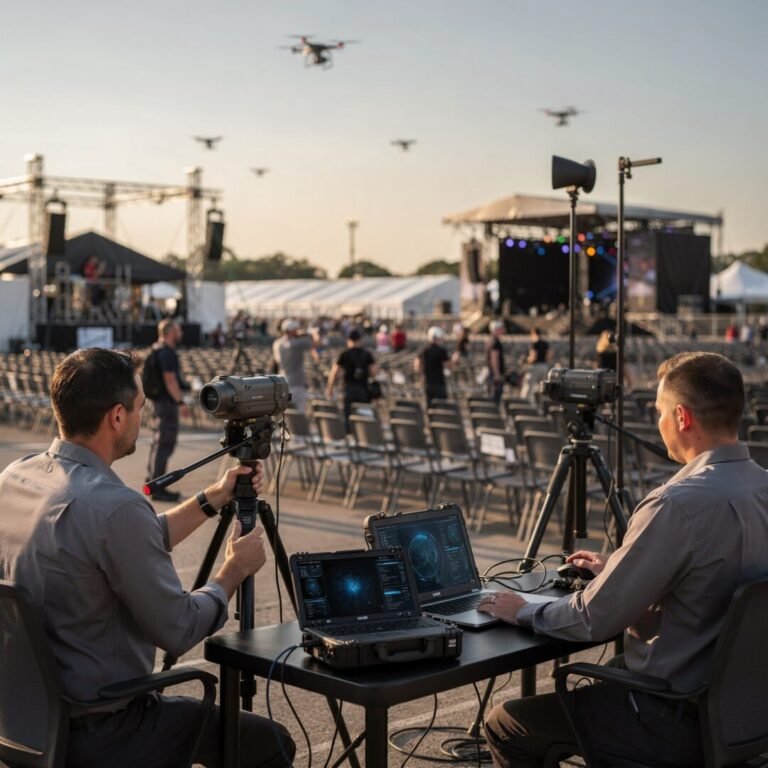
Submodule 5.4. Drones in safety management
Learn the uses, limitations and legal requirements of drones at events.
Submodule 5.5. Event control room
Design the control room with workstations, screens and information flows.
Submodule 5.6. Radio communications and protocols
Organize radio channels, codes and operational communication discipline.
Submodule 5.7. Digital ticketing and access control
Integrate ticket validation, accreditation and exclusion lists.
Submodule 5.8. Artificial intelligence for safety
Evaluate automatic detection systems and their ethical and legal implications.
Submodule 5.9. Data protection in security systems
Apply data protection legislation to CCTV, biometrics and attendee data.
Submodule 5.10. Operational safety dashboard
Build a panel with key indicators for the control room.
Submodule 6.1. Emergency planning regulations
Learn the emergency and self-protection regulations that apply to events and activities.
Submodule 6.2. Structure of the emergency plan
Write the chapters of the plan covering resources, organization and procedures.
Submodule 6.3. Event security plan
Integrate private security, access, perimeters and coordination with the police.
Submodule 6.4. Crowd management plan
Document strategies for arrival, circulation, departure and response to high densities.
Submodule 6.5. Traffic and mobility plan
Coordinate road closures, parking, public transport and pedestrian routes.
Submodule 6.6. Medical and first aid plan
Size medical resources, first aid posts and casualty evacuation.
Submodule 6.7. Fire safety plan
Define firefighting equipment, fire loads and preventive measures.
Submodule 6.8. Sizing security staffing
Calculate the security officers, assistants and stewards needed by zone and shift.
Submodule 6.9. Operational briefing sheets by post
Prepare clear instructions for each post and role in the operation.
Submodule 6.10. Submissions to public authorities
Prepare the documentation for the event's licenses and permits.
Submodule 7.1. Gold, silver and bronze command structures
Apply strategic, tactical and operational levels to running the operation.
Submodule 7.2. Incident command system
Organize roles, chain of command and span of control during incidents.
Submodule 7.3. Multi-agency coordination
Coordinate police, fire, medical services, civil protection and the event organization.
Submodule 7.4. Operational briefings and debriefings
Lead pre- and post-event meetings that align the safety team.
Submodule 7.5. Decision-making under pressure
Apply rapid decision-making models in situations of uncertainty.
Submodule 7.6. Situational awareness
Integrate field information and technology to maintain a common operating picture.
Submodule 7.7. Shift management and staff fatigue
Plan rotations and breaks that keep the team alert.
Submodule 7.8. Leading safety teams
Lead diverse teams with clear communication and legitimate authority.
Submodule 7.9. Decision logging and traceability
Document decisions and actions for later review and defense.
Submodule 7.10. Command post exercise
Take part in a simulated exercise directing operations from the control room.
Submodule 8.1. Activating emergency plans
Define thresholds and activation procedures for each emergency level.
Submodule 8.2. Full evacuation, partial evacuation and lockdown
Decide whether to evacuate, clear areas or shelter in place depending on the scenario.
Submodule 8.3. Stopping the show
Establish criteria and protocols for safely stopping a performance.
Submodule 8.4. Emergency messages to the audience
Write effective, reassuring PA and screen messages.
Submodule 8.5. Mass casualty response
Coordinate triage, medical care and evacuation when there are multiple casualties.
Submodule 8.6. Responding to threats and attacks
Apply protocols for bomb threats, attacks or an active shooter.
Submodule 8.7. Crisis communication with the media
Manage spokespeople, statements and social media during a crisis.
Submodule 8.8. Family reunification and lost children
Organize meeting points and protocols for lost children.
Submodule 8.9. Event continuity and recovery
Plan the orderly resumption or cancellation of the event after an incident.
Submodule 8.10. Drills and tabletop exercises
Design and evaluate drills to validate plans and teams.
Submodule 9.1. Public entertainment legislation
Review regional and local regulations on public entertainment and recreational activities.
Submodule 9.2. Private security legislation
Learn the roles, licensing and limits of private security staff.
Submodule 9.3. The organizer's civil and criminal liability
Identify the legal responsibilities of the organizer and its managers.
Submodule 9.4. Occupational health and safety at events
Coordinate contractor activities and safety during build and breakdown.
Submodule 9.5. Contracting security services
Define specifications, service levels and supervision of security companies.
Submodule 9.6. Right of admission and use of force
Apply the right of admission and proportionate intervention criteria.
Submodule 9.7. Insurance and risk transfer
Select public liability, cancellation and accident cover for the event.
Submodule 9.8. Incident investigation
Apply investigation and root cause analysis techniques after an incident.
Submodule 9.9. Ethics and fundamental rights
Balance security, privacy and attendees' rights.
Submodule 9.10. Documentation for legal defense
Organize evidence and records that demonstrate the organizer's due diligence.
Submodule 10.1. Safety culture in the organization
Foster a culture in which safety is part of every decision.
Submodule 10.2. Safety operation budget
Prepare and justify the safety budget to management and promoters.
Submodule 10.3. Safety performance indicators
Define KPIs for incidents, response times and plan compliance.
Submodule 10.4. Safety and the attendee experience
Integrate safety measures without degrading the audience experience.
Submodule 10.5. Major events and international bids
Analyze the safety requirements of major sporting and cultural events.
Submodule 10.6. Managing suppliers and subcontractors
Coordinate security, medical and access control companies.
Submodule 10.7. Organizational learning after events
Turn lessons learned into improvements to processes and training.
Submodule 10.8. Innovation in crowd management
Evaluate technological and methodological trends in event safety.
Submodule 10.9. Training safety staff
Design training programs for stewards, security officers and volunteers.
Submodule 10.10. Medium-term safety strategy
Define a multi-year safety strategy for a venue or organizer.
Preparation and defense of a comprehensive safety and crowd management plan for a high-capacity event, with risk assessment, capacity calculation, ingress and evacuation simulation, command structure, budget, KPIs and presentation before a panel.
Career paths
This program strengthens your profile for roles related to Crowd Science and Event Security Management: project coordination, operations, consulting and specialized event services at agencies, venues, hotels and corporate event teams.
Admissions
- Request information
Leave your details and an adviser will contact you.
- Guidance call
We review your profile and career goals.
- Enrolment and access
Secure your place and get access to the campus.
Fees & payment
Indicative instalment. Please confirm payment terms with the admissions team.
Frequently asked questions
Is this an official degree?
On completion you receive an ESINEV certificate. It is not an official degree; recognition can be assessed depending on the programme you complete and local regulations.
How long is it and how many hours?
Duration: 12 months. Study load: 1,500 hours, designed to fit around your work.
Is it taught online?
Yes. It is 100% online, with a virtual campus, downloadable materials and tutoring from industry professionals.
Can I pay in instalments?
Yes. Payment: Up to 12 monthly payments. The admissions team will confirm the terms.
When can I start?
Classes start exactly one month after you enroll: if you enroll today, you start on 29 December 2026. Enrollment is open all year and closes every Friday.
Shall we talk about your future in events?
Leave your details and an adviser will walk you through the programme, dates and payment options.
WhatsApp